


Neil has been keeping, breeding, and selling guinea pigs at Paradise Pets Swindon since 1988 — over 35 years of daily first-hand experience with these animals and the people who keep them. A guinea pig that hides all the time is one of the most common concerns owners bring to the counter — and one of the most consistently misread. Most owners think the guinea pig is unfriendly or scared of them personally. Almost always, the real explanation is something else entirely. This is his honest guide to why guinea pigs hide, what each cause looks like, and what actually changes it.
A mother came in with her two children, both primary school age. They had got two guinea pigs about six weeks earlier — a bonded pair from a rescue. The children were disappointed because both guinea pigs spent almost all of their time inside their wooden hide. They came out to eat, occasionally, and then went straight back in. The children had tried sitting with them, talking to them, offering them food from their hands. Nothing seemed to make a difference.
I asked a few questions. Where was the enclosure? In the living room, directly opposite the television. Was there a dog or cat in the house? A dog, yes — a friendly one, they were quick to add, who had never gone near the guinea pigs. What size was the enclosure? One of the standard two-level cages sold in most pet shops.
I told them three things. The enclosure was too small. The position was too exposed and too noisy. And the dog — however friendly — was registering as a predator every time it moved through the room, regardless of whether it had ever done anything to the guinea pigs at all.
They had three separate problems and the hiding was the cumulative result of all three. Address all three and the guinea pigs would come out. Leave any one of them unaddressed and the hiding would continue regardless of what else changed.
They came back about two months later. Larger enclosure, different room, the dog kept out during free-range time. The guinea pigs were out and grazing for most of the day. The children were hand-feeding them without any problem.
That is almost always how it goes. The hiding is not the guinea pig’s personality. It is the guinea pig’s response to its environment.
Why Guinea Pigs Hide — The Honest Explanation
Before I go through the specific causes, I want to explain the biology behind hiding behaviour — because understanding it changes everything about how owners interpret what they are seeing and what they do about it.
Guinea pigs are prey animals. Small, slow-moving, with no meaningful defensive capability — they cannot bite hard enough to deter most predators, they cannot run fast enough to reliably escape, and they cannot climb or fly. In the wild, their primary survival strategy is concealment. They live in dense vegetation and burrow systems. They emerge to graze and socialise, but they do so with constant vigilance — and at the first sign of threat, the correct response is to return to cover immediately.
The domestic guinea pig has the same hardwired system. The hide is the burrow. The open floor of the enclosure is exposed ground. And any stimulus that the guinea pig’s nervous system classifies as potentially threatening — a large animal moving nearby, a sudden loud sound, an unfamiliar scent, insufficient cover in the living space, a cage that is too small to feel safe in — will produce the same response that wild guinea pigs use to stay alive. They go in and they stay in.
This is not shyness. It is not unfriendliness. It is the animal doing exactly what its biology requires.
- A guinea pig that hides is responding to something in its environment — the hiding is the symptom; the environment is the diagnosis; changing the response rather than addressing the cause does not work
- Guinea pigs need to feel safe before they will explore — safety comes from adequate space, appropriate cover within the living area, the absence of predator stimuli, and the presence of a companion; when all of these are in place, most guinea pigs will come out readily
- Chronic hiding is a welfare indicator — a guinea pig that spends most of its time hidden is a guinea pig under chronic stress; this has real health consequences over time, not just the social consequences owners notice
- The hiding is not directed at the owner personally — it is a response to the environment; most owners take it personally and that is an understandable but inaccurate reading of what is happening
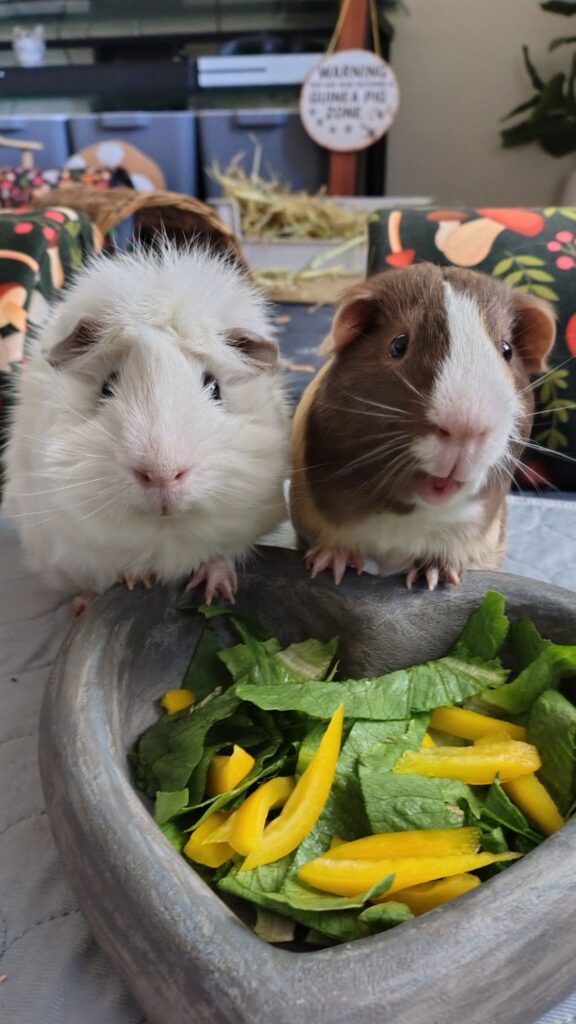
Once you understand this, the causes and solutions below make complete sense. And so does why trying to coax a hiding guinea pig out — removing its hide, forcing interaction, repeatedly approaching the hide — makes the problem significantly worse rather than better.
The Main Causes — What Is Actually Keeping Your Guinea Pig In Hiding
Predator Presence or Scent — The Most Common Cause
This is the cause I find most often and the one owners are most reluctant to accept — because the dog or cat has never done anything to the guinea pig, is perfectly friendly, and has been in the household for years. None of that changes what the guinea pig’s nervous system registers.
A dog or cat is a predator species. The guinea pig’s biology does not make exceptions for friendly individuals. The scent of a dog or cat in the room is sufficient to maintain a state of elevated alert in a guinea pig indefinitely. The guinea pig does not habituate to the scent of a predator the way it habituates to neutral smells — because habituating to predator scent in the wild would be fatal.
- Any dog or cat that has access to the room where the guinea pig lives — even if it never approaches the enclosure, even if it is entirely indifferent to the guinea pigs; its presence and scent maintains the guinea pig’s alarm state
- A dog or cat that has sniffed at, pawed at, or approached the enclosure even once — the guinea pig remembers this and classifies the enclosure as a place where predators come; this association persists and affects behaviour long after the event
- Predators outside — cats that enter the garden where an outdoor hutch is kept; foxes that move through the garden at night; birds of prey overhead; the guinea pig does not need physical contact for these to maintain its hiding behaviour
- What to do — separate the guinea pig’s living space from dogs and cats entirely; this means a room the dog or cat does not enter, not just a room where the dog or cat is not currently present; the scent needs to be absent, not just the animal; wash hands before handling guinea pigs if you have been handling a cat or dog
Enclosure Too Small or Too Exposed
This is the second most common cause I see, and it is directly related to the fact that most standard guinea pig cages sold in pet shops are significantly smaller than guinea pigs actually need.
A guinea pig in a small enclosure cannot establish a genuine territory. It cannot create the spatial separation between its sleeping area and its active area that makes the active area feel safe. It cannot engage in the normal locomotion — running, popcorning, exploring — that is part of healthy guinea pig behaviour. The result is a permanently stressed animal that retreats to the only safe space available — its hide — and stays there.
- Minimum space for two guinea pigs is 120cm by 60cm of floor space — the Rabbit and Guinea Pig Welfare guidelines recommend significantly more; most standard cages fall well below even the minimum; if the enclosure is smaller than this, inadequate space is almost certainly contributing to the hiding
- Two-level cages with ramps — guinea pigs are not climbers by nature and many find ramps stressful; a two-level cage does not provide double the effective space because the upper level is often underused; floor space is what matters
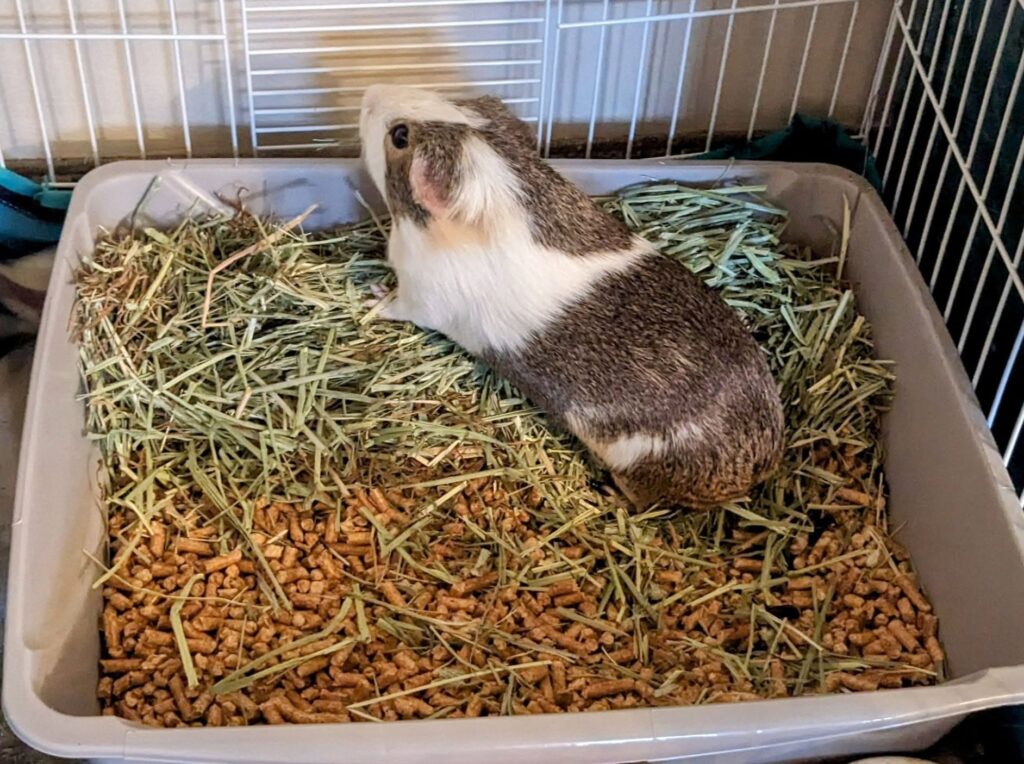
- Exposed enclosures with no cover within the living space — a guinea pig needs more than one hide; a single hide in a bare enclosure means the guinea pig has one safe space and spends all of its time there; providing multiple low shelters and tunnels throughout the enclosure means the whole space feels safer and the guinea pig uses more of it
- C&C cages or large indoor pens — these provide the space guinea pigs actually need at a reasonable cost; owners who switch from a standard pet shop cage to a properly sized C&C setup almost always report a dramatic improvement in how much time their guinea pigs spend out and active
Noise, Vibration, and Environmental Stress
Guinea pigs have sensitive hearing — significantly more sensitive than humans — and they are highly responsive to vibration. An enclosure positioned in a noisy, high-traffic area of the house is an enclosure in which the guinea pig is perpetually in a state of low-level alarm.
- Television and music — a loud television near the enclosure produces a constant stream of unpredictable sounds that the guinea pig cannot evaluate or habituate to; the unpredictability is the problem more than the volume; sudden sound changes are more alarming than sustained sound
- Children running and playing near the enclosure — the vibration of footsteps, the sudden movements, the unpredictable sounds — all of these maintain the guinea pig’s alarm state; guinea pigs in busy family rooms with young children often spend most of the day hidden
- Washing machines, tumble dryers, and kitchen appliances — vibration from these appliances travels through floors and surfaces; a guinea pig enclosure in a utility room or kitchen is exposed to significant vibration during machine cycles
- What to do — position the enclosure in the quietest area of the house with the most predictable environment; a room that has moderate, consistent activity is better than a room that alternates between silence and sudden noise
Solitary Housing
Guinea pigs are profoundly social animals. In the wild, they live in groups and their social structure provides the collective vigilance and mutual reassurance that allows individuals to feel safe enough to emerge and graze. A guinea pig kept alone does not have this — and the resulting anxiety is expressed as heightened hiding behaviour.
- A single guinea pig is a stressed guinea pig — this is not a minor welfare consideration; solitary housing is one of the most significant causes of chronic stress and hiding behaviour in guinea pigs; the RSPCA and most welfare organisations in the UK explicitly recommend that guinea pigs should not be kept alone
- A guinea pig that lives alone and hides all the time is telling you its most fundamental social need is not being met — no amount of owner interaction, however attentive, replicates the constant presence and communication of another guinea pig
- Guinea pig companionship requires proper introduction — two guinea pigs placed together without introduction will often fight; introductions need to happen on neutral territory, gradually, following the standard bonding process; done correctly, bonded pairs typically come out of hiding significantly more than solitary animals
- If the guinea pig is already paired and hiding — check the relationship between the two animals; a guinea pig that is being bullied by its companion will hide from the companion as well as from environmental stressors; look for whether one animal is preventing the other from accessing food, water, or the hide
A New Animal Adjusting to Its Environment
This cause is completely normal and is worth understanding clearly — because owners of newly acquired guinea pigs often panic about hiding behaviour that is simply the animal adjusting to a new and unfamiliar space.
- A newly acquired guinea pig will typically hide for the first two to four weeks — sometimes longer; it is in an unfamiliar space, surrounded by unfamiliar smells, and has not yet established what is safe and what is threatening in its new environment; this is normal and does not indicate a problem with the animal or the setup
- The correct response is patience and no pressure — do not try to force the guinea pig out, do not remove the hide to make it interact, do not handle it before it has had time to settle; let the animal learn its environment at its own pace
- Talk softly near the enclosure, offer food by hand at the hide entrance, sit quietly near the cage — all of these build positive associations without creating pressure; the guinea pig learns the owner’s voice and scent as safe over time
- If hiding persists beyond six to eight weeks without any change — it is no longer just settling-in behaviour; look at the environmental factors above
Illness or Pain
 A guinea pig that is unwell will hide more than usual — and because guinea pigs hide their illness extremely well, the increased hiding may be the first or only visible sign that something is physically wrong.
- Sudden increase in hiding in a previously more sociable guinea pig — always consider health first; a guinea pig that was coming out regularly and has suddenly stopped warrants a vet check before environmental adjustments
- Respiratory illness — guinea pigs are susceptible to upper respiratory infections; a guinea pig that is hiding alongside reduced appetite, discharge from the nose or eyes, or laboured breathing needs a vet visit the same day
- Dental disease — guinea pig teeth grow continuously; misalignment causes chronic pain that the animal masks by withdrawing; weight loss alongside hiding, or difficulty eating, suggests a dental problem
- Urinary problems — bladder stones are relatively common in guinea pigs; the pain they cause produces restlessness, reduced activity, and increased hiding; blood in the urine or obvious straining alongside hiding is a same-day vet visit
- Vitamin C deficiency (scurvy) — guinea pigs cannot synthesise their own Vitamin C; deficiency causes joint pain, lethargy, and reluctance to move; hiding alongside reduced food intake in a guinea pig not receiving adequate fresh vegetables warrants both a diet review and a vet check
- Sudden increase in hiding in a guinea pig that was previously more social — rule out illness before anything else
- Hiding alongside reduced food or water intake, weight loss, or visible weight change
- Hiding alongside any respiratory symptoms — discharge, laboured breathing, clicking sounds
- Hiding alongside obvious discomfort when moving — hunched posture, reluctance to bear weight
- Hiding alongside blood in the urine or straining — bladder stones, a genuine emergency
- Any hiding behaviour that has changed suddenly rather than been present since acquisition
Incorrect Handling and Approach
Sometimes the hiding is specifically owner-related — not because the owner is doing anything cruel, but because the way they approach, pick up, or handle the guinea pig is triggering the defensive response every time.
- Reaching into the hide to retrieve the guinea pig — this is the most alarming possible approach; the guinea pig went to the hide because it felt unsafe; reaching into the hide confirms that the hide is not actually safe; over time this produces a guinea pig that is increasingly reluctant to use or return to its hide, and has no safe space in the enclosure at all
- Approaching quickly or with sudden movements — guinea pigs need time to assess an approaching hand; slow, predictable movement gives the animal time to decide the approach is not threatening; quick movements produce the hide response
- Handling too frequently or for too long before trust is established — a guinea pig that is handled multiple times a day before it has settled in is a guinea pig that learns the enclosure is a place where unpredictable, unavoidable handling happens; the hide becomes a retreat from that expectation
- The correct approach — sit near the enclosure, let the guinea pig come to investigate you rather than always approaching it; offer food at the enclosure entrance rather than inside the hide; wait until the guinea pig is voluntarily near you before attempting to pick up; use two hands to support the whole body when lifting — a guinea pig that feels unsupported will struggle and will be reluctant to be picked up again
What Actually Changes Hiding Behaviour — In Order of Impact
- Remove predator access and scent from the living space — if a dog or cat has access to the room, this single change produces the most dramatic improvement in hiding behaviour of any intervention; the guinea pig cannot relax while predator scent is present and it will not come out reliably until that scent is gone
- Increase the enclosure size — a properly sized enclosure with adequate floor space and multiple shelters distributed throughout transforms how much of the space the guinea pig uses; this change alone, in a guinea pig with no predator exposure, often resolves hiding behaviour significantly within days
- Provide multiple hides and cover throughout the enclosure — when the whole enclosure feels safe rather than just one corner of it, the guinea pig uses the whole enclosure; tunnels, low shelters, hay piles that provide cover without complete concealment all extend the area the guinea pig perceives as safe
- Ensure companionship — a bonded companion guinea pig is the single most impactful welfare improvement for a solitary animal; the social reassurance of another guinea pig changes baseline anxiety in a way that no environmental change fully replicates
- Reposition the enclosure — quieter room, away from televisions and appliances, away from high-traffic areas; the enclosure should be in a position where the guinea pig can hear and observe the household from a distance without being in the middle of it
- Be patient and reduce pressure — stop trying to make the guinea pig come out; let it set the pace; the more pressure owners apply, the more the guinea pig associates the owner with the hide response; withdraw the pressure and the hiding often reduces spontaneously within a week or two
- Hand-feed from outside the enclosure — offer small pieces of favourite vegetables — cucumber, bell pepper, fresh grass — at the enclosure entrance daily; do not push the hand inside; wait for the guinea pig to come to the food; this builds the association that the owner’s hand means something good, at the guinea pig’s pace

Reading Hiding Behaviour — A Practical Reference
| What You Are Seeing | Most Likely Cause | What To Do |
|---|---|---|
| Hiding since acquisition, not improving after 8 weeks | Environmental — enclosure, position, predator presence, or solitary housing | Systematic environmental review — work through all factors above |
| Hides when dog or cat enters the room | Predator presence | Separate guinea pig’s living space from all predator species entirely |
| Only comes out at night or very early morning | Daytime activity levels too high, or predator present during the day | Reposition enclosure; reduce daytime disturbance; check for daytime predator access |
| Hides when approached but comes out when alone | Handling pressure or incorrect approach technique | Reduce direct approach; sit near enclosure passively; hand-feed at the entrance |
| Sudden increase in hiding in a previously social guinea pig | Illness or pain — rule this out first | Vet visit before environmental adjustments |
| One of a pair hiding from the other | Bullying within the pair | Assess the relationship; ensure multiple food and water stations; consult vet or animal behaviourist if bullying is severe |
| Hiding alongside weight loss or reduced appetite | Illness — dental, respiratory, or other | Vet visit same day |
| Recently acquired animal, hiding for first few weeks | Normal settling-in behaviour | Patience; no pressure; soft voice; hand-feeding at enclosure entrance |
Frequently Asked Questions
My guinea pig only comes out at night. Is that normal?
Guinea pigs are crepuscular — naturally most active at dawn and dusk. Some daytime hiding is normal. A guinea pig that comes out freely at dawn and dusk but is in its hide during the busy midday and afternoon hours is behaving normally. A guinea pig that is only visible at night and hides the entire time the household is active is responding to something about the daytime environment — usually noise, activity level, or predator presence — that makes the daytime feel unsafe. Review the daytime environment rather than accepting the pattern as fixed.
My guinea pig has been hiding for months. Is it too late to change it?
No. I have seen guinea pigs that had been hiding for most of their lives change significantly when the right environmental adjustments were made. The change may not happen overnight — a guinea pig with months of hiding history has well-established associations between its environment and threat — but with the right changes applied consistently, improvement is realistic. The most dramatic improvements come from removing predator access and significantly increasing enclosure size.
Should I remove the hide to make my guinea pig come out?
No. This is one of the most counterproductive things an owner can do. The hide is not the problem — it is the solution the guinea pig has found to a problem in its environment. Removing the hide does not make the guinea pig feel safer; it removes the one safe space the guinea pig has identified. The result is a more stressed and more reactive animal, not a more social one. The goal is to make the whole enclosure feel safe enough that the guinea pig chooses to come out — not to force it out by removing its options.
Could my guinea pig be hiding because it is lonely?
Yes, significantly. A solitary guinea pig has no companion to provide the mutual reassurance and collective vigilance that makes it feel safe enough to be out. The anxiety of social isolation is one of the consistent contributors to hiding behaviour in guinea pigs. Two guinea pigs in the same enclosure, properly bonded, will almost always spend more time out and active than either would alone — because the presence of the companion signals that it is safe to be out.
My guinea pig comes out for food but goes straight back in. Is that good progress?
Yes — it means the guinea pig is not so stressed that it suppresses eating, which would be a concerning sign. It also tells you the enclosure is not in acute predator-alert mode every moment. But coming out only for food and returning immediately is still a hiding-dominant pattern and it suggests the open space of the enclosure does not feel safe enough to occupy voluntarily. The next step is to make the open space feel safer — more cover, better position, removal of predator stimuli — so that the time between eating and hiding lengthens gradually.
How long does it take for a guinea pig to stop hiding?
It depends entirely on what is causing the hiding and how completely those causes are addressed. A newly acquired guinea pig in an appropriate environment often settles within two to four weeks. A guinea pig whose hiding is driven by chronic predator exposure or inadequate space may take months to change if the changes are made gradually, or weeks if the changes are comprehensive and immediate. There is no universal timeline — the measure is the guinea pig’s behaviour, not the calendar.
Where can I get help with a guinea pig that hides all the time in Swindon?
Come in to Paradise Pets at Manor Garden Centre, Cheney Manor Industrial Estate, Swindon SN2 2QJ — or call us on 01793 512400. Tell me what the enclosure looks like, where it is positioned, what other animals are in the house, and how long the hiding has been happening. I will tell you honestly what I think is causing it and what to prioritise changing first. Free advice, no obligation. That is how we have done things here for 35 years.
One Last Thing From Me
The family I described at the start — the mother and two children with the pair of guinea pigs that never came out — sent photographs about two months after their second visit. Both guinea pigs were out in the middle of the day, grazing, popcorning — the joyful little leaping run that guinea pigs do when they feel genuinely safe and content — and being hand-fed by the children without any hesitation.
Nothing about the guinea pigs had changed. The animals were the same animals they had always been. What had changed was the environment they were living in — more space, quieter position, the dog kept out — and the result was that the guinea pigs the family always hoped they had turned out to actually exist.
They were always there. The environment just had not allowed them to show up.
A guinea pig that hides all the time is not a guinea pig that is fundamentally shy, antisocial, or broken. It is a guinea pig that has correctly identified that something in its environment is not safe enough to be out in. Change the environment and you change the behaviour — because you have changed the reality the behaviour is responding to.
That is the honest answer. It is not about the guinea pig. It is about what you give the guinea pig to live in.
Guinea Pig Hiding All The Time And Not Sure Why? Come In And Talk It Through.
Tell me about the setup — enclosure size, position, other animals in the house, how long it has been happening — and I will give you my honest read on what is most likely causing it and what to change first. Free advice, no obligation. That is how we have done things here for 35 years.
⭐ Customer Reviews
Amazing Bird Selection
Had a lovley visit today,staff were very friendly and very helpful,such a great petshop,their selection of birds is incredible,really impressed,thank so much to the staff at Paradise Pets

Friendly Helpful Staff
I have been coming to this place for years and they have a great stock of food for all types of pets. Have a great selection of small mammals and a lot of birds. Staff are friendly and helpful.

Great Quality Hutch
Bought a guinea pigs hutch and run combo, very happy with the service, the hutch was put in my car for me without even asking for help. The wood quality is very good, the instructions easy to follow and we are extremely happy with the fully built hutch. A good size for 2 guinea pigs

Response from Paradise Pets | Wiltshire
Thank you Melanie Latus Nice to provide services to you.
Best Bird Shop Around
It’s the best pet shop in and around Swindon. They always have an amazing selection of birds and all you need to keep them happy. I keep birds myself and the guys there are happy to answer questions and really know their stuff. I have seen budgies etc. in chain pet shops in the area looking really unhealthy and ill – I wouldn’t go anywhere else than Paradise Pets for animals.

Highly Recommended Bird Shop
I could not praise this shop enough. Really helped my Grandson buy his first bird and he’s loving it. Travelled from Somerset and was welcomed with open arms.

Great Shop with Competitive Prices
Great shop with amazing selection for small animals, hamsters, mice ect, highly recommend!
Also has a great selection for dogs & cats too & very competitive prices! 💖

