
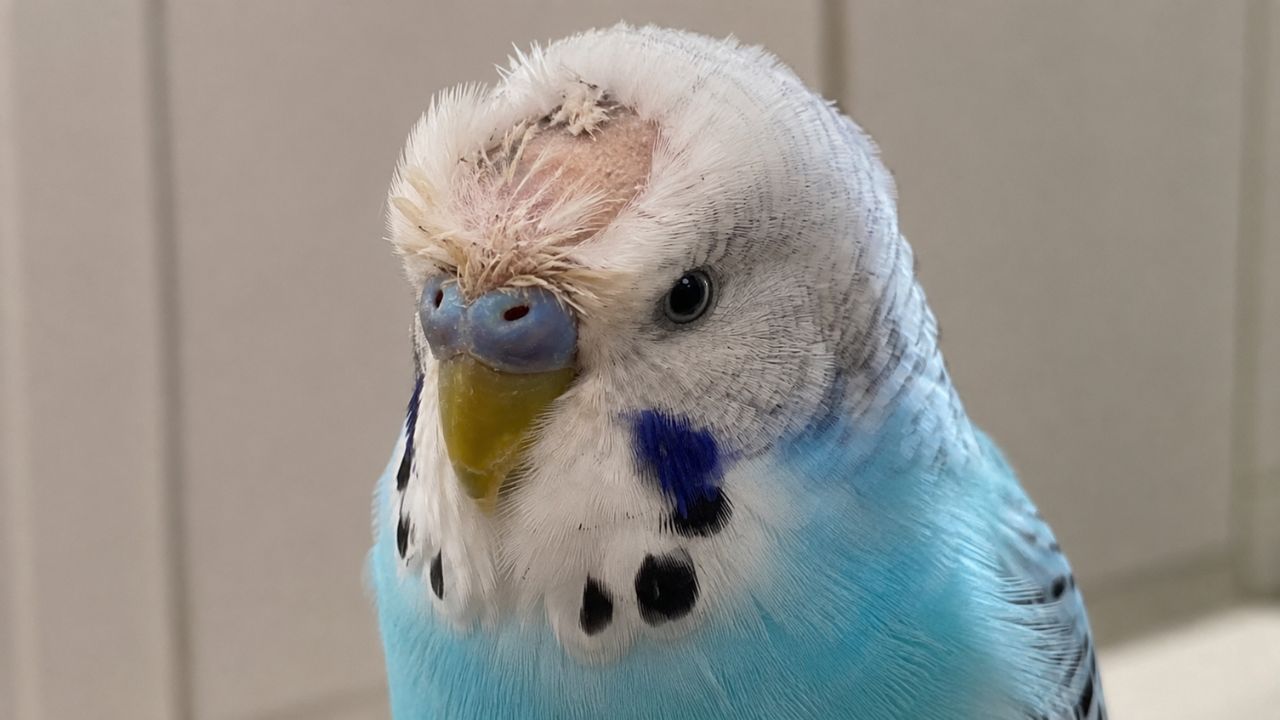

Neil has sold and kept budgies at Paradise Pets Swindon since 1988 — over 35 years of first-hand experience with one of the UK’s most popular cage birds. A budgie with a bald or thinning head is one of the most common health concerns he sees owners bring in — and one of the most misunderstood. This article is his honest, complete guide on why budgies go bald on the head, what is driving it in each specific case, and what owners can actually do about it.
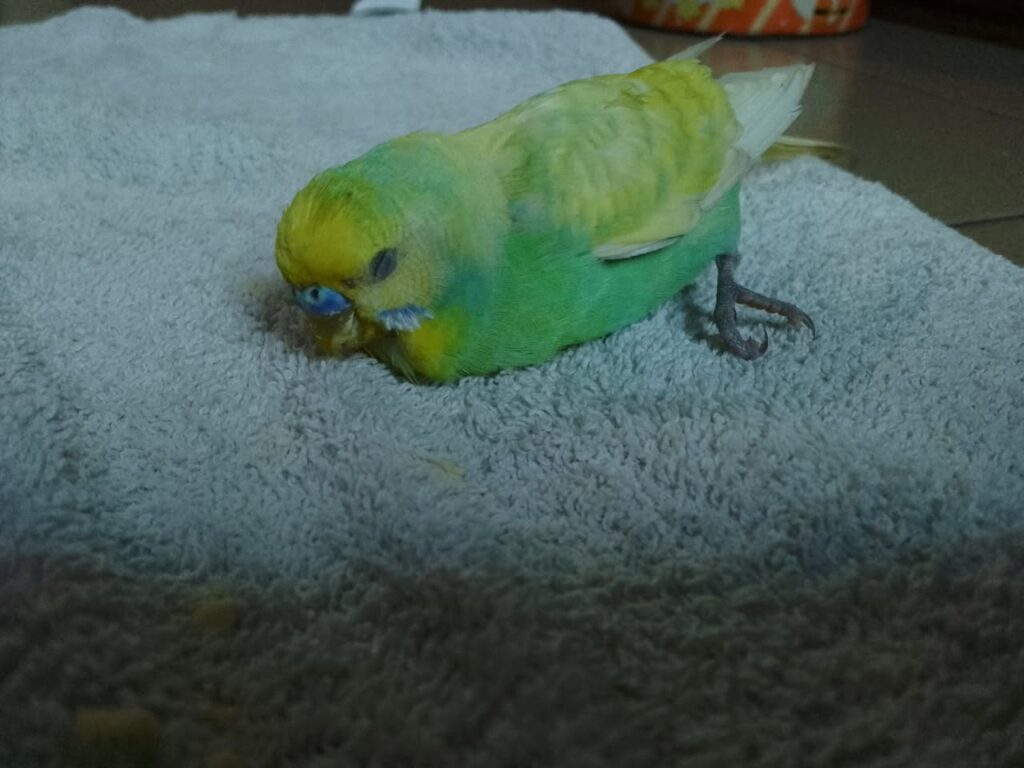
A woman came in about eighteen months ago with her budgie in a small carry cage. She’d had him for four years. Green and white, very chatty, completely tame. She held the cage up and pointed to the top of his head.
“He’s going bald,” she said. “It happened really quickly. I noticed it about three weeks ago and it’s getting worse.”
She was convinced it was something serious. She’d been reading online for two weeks and had convinced herself it was either mites, a fungal infection, or something she’d done wrong.
I looked at the bird. I asked her a few questions. Did she have another budgie? Yes — a female she’d had for about eight months. Had she watched them together recently? Not particularly, she said. They seemed fine. They preened each other all the time.
I told her that was almost certainly her answer.
She looked at me as if I’d told her something impossible. “Preening is doing that?”
In this case, yes. But that is not always the answer — and knowing the difference between the causes that are harmless and the ones that need a vet matters enormously. That is what this guide is for.
First — Look at What You Are Actually Seeing
Before you can identify the cause, you need to be precise about what the baldness looks like. Not all head baldness in budgies is the same, and the appearance gives you a great deal of diagnostic information before anything else.
Look carefully and note the following:
- Is the bald area on the very top of the head, the back of the head, or around the face and cere?
- Is the skin underneath clean and normal-coloured, or is it red, irritated, crusty, or textured?
- Are the feathers simply absent, or are the ones remaining broken, stubby, or damaged-looking?
- Is the bald area symmetrical and neat, or ragged and irregular?
- Is it getting worse week on week, staying stable, or does it seem to fluctuate?
- Is the bird otherwise well — eating, active, normal droppings — or are there other signs something is wrong?
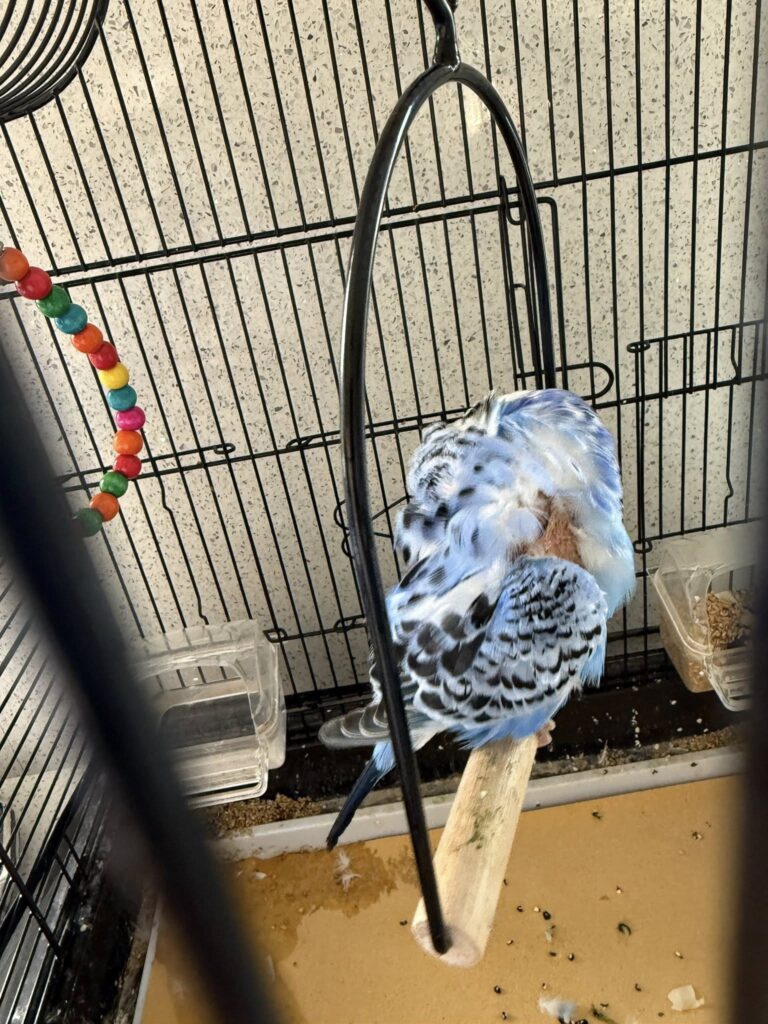
Write down what you are seeing before you read further. When you get to the causes below, the details will help you identify which one you are dealing with. And if you end up needing a vet, this information is exactly what they will ask for.
The 6 Most Common Reasons a Budgie Goes Bald on Its Head
In 35 years, I have seen budgie head baldness caused by all of the following. Some of them are common and easily resolved. One of them requires a vet visit without delay. Knowing which is which is the whole point of this guide.
Cause 1: A Cage Mate Preening Too Much — The Most Common Cause I See
This is what was happening with the woman’s green budgie, and it is what I see behind budgie head baldness more often than anything else. It is also the one that causes the most unnecessary panic — because it looks alarming and turns out to be almost entirely harmless.
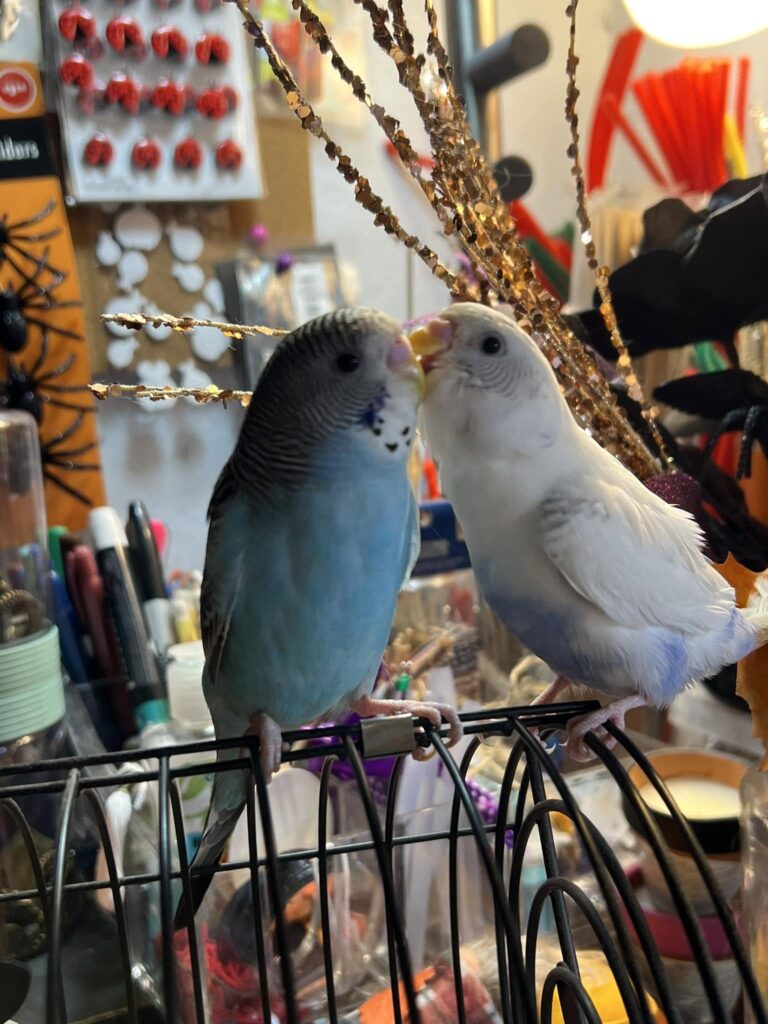
Budgies are social birds. Mutual preening — allopreening — is a core bonding behaviour. One bird works through the other’s head and neck feathers, and the recipient usually sits with its eyes half-closed looking entirely satisfied with the arrangement. It is one of the nicest things budgies do.
But some birds preen with more enthusiasm than their partner strictly needs. They work the same area repeatedly. Over weeks, the repeated attention starts to thin the feathers on the top or back of the head — and eventually produces a bald patch that can look quite dramatic, despite being entirely the product of affection rather than aggression.
- The bald area is on the very top of the head or the back of the neck — exactly where another bird’s beak can reach
- The skin underneath is clean, smooth, and normal-coloured — no redness, crusting, or irritation
- The affected bird seems completely unbothered — no scratching, no distress, normal behaviour
- You have more than one budgie and the other bird is the one doing the preening
- The baldness is neat and roughly symmetrical rather than ragged or patchy
- The bald area has developed gradually over weeks rather than appearing suddenly
What to do
Watch the pair together for a day and confirm that the preening is what is causing it. If one bird is clearly working the same patch repeatedly, you have your answer. In most cases you do not need to do anything at all — the bald area will often recover naturally over time as the bird moults through, and the behaviour is not harming the affected bird.
If the preening is very persistent and the baldness is expanding significantly, a temporary separation of a week or two — with the cages side by side so the birds can still see and hear each other — usually gives the feathers a chance to recover. Reintroduce them gradually and monitor.
The one thing worth checking: make sure the preening is genuinely mutual and affectionate rather than one bird being dominant or aggressive toward the other. A bird that is being bullied by a cage mate will show other signs — being pushed off perches, not getting access to food, appearing stressed. If that is what you are seeing, the problem is more than enthusiastic preening.
Cause 2: Cnemidocoptes Mites (Scaly Face Mite) — See a Vet
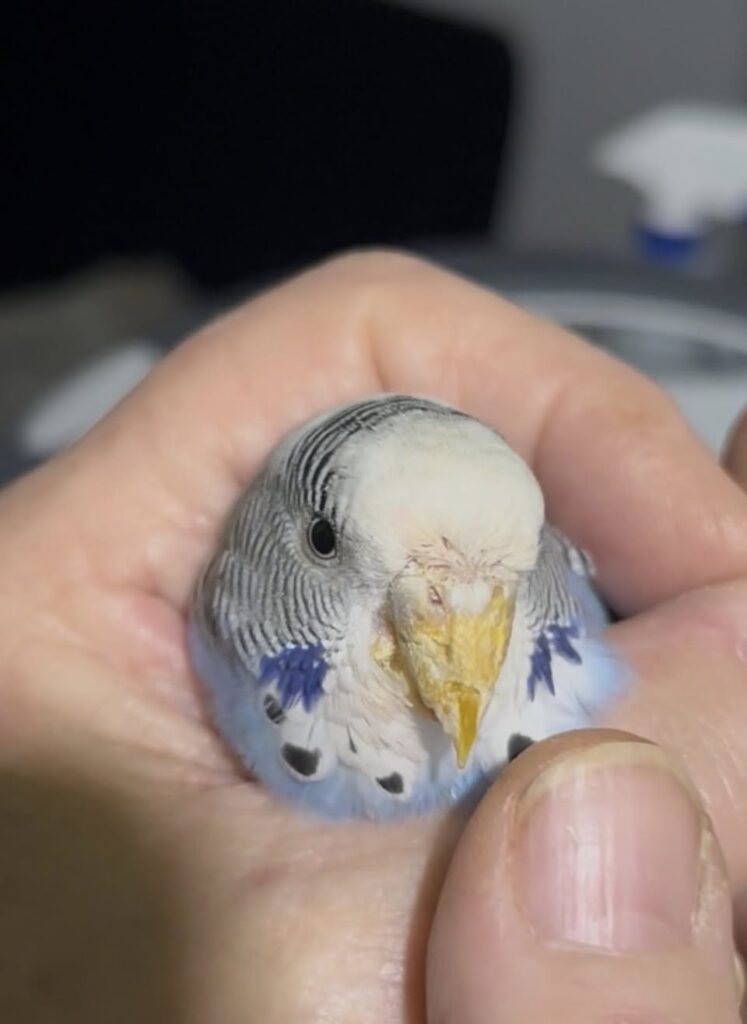
This is the cause I am most alert to, because it is the one where delay costs the bird most. Cnemidocoptes pilae is a burrowing mite that infests the skin around the cere, beak, and face of budgies. It causes a distinctive crusty, honeycomb-textured build-up that starts small — easily missed — and spreads steadily if untreated.
In the early stages, owners notice a slight roughness or paleness around the corners of the beak or the cere. As it progresses, the crusting becomes more obvious. In advanced cases it spreads across the face, causes feather loss around the head, and begins to distort the beak itself. Beak distortion from advanced scaly face mite is permanent. It cannot be fully corrected once it has happened.
I have seen birds come in with beaks so badly distorted by neglected scaly face mite that feeding was genuinely difficult. Every one of those cases could have been resolved completely if caught in the first few weeks.
- Visible crusty, spongy, or honeycomb-textured deposits around the corners of the beak, the cere, or the eye area
- The skin around the beak or cere looks roughened, pale, or textured rather than smooth
- Feather loss specifically around the face and beak area, not just the top of the head
- The bird rubs its face against perches or the cage bars
- The beak looks uneven, roughened on the surface, or beginning to grow asymmetrically
- The affected bird was recently acquired from a pet shop or from another bird collection
What to do
Vet visit — and do not delay. Scaly face mite is treated with ivermectin prescribed by an avian vet, and it works very well when caught early. The treatment is straightforward. The outcome for an early-stage bird is complete resolution. The outcome for an advanced case is management of damage that should never have been allowed to develop.
Do not attempt to treat scaly face mite with home remedies or products that have not been prescribed by a vet. Dosing errors with ivermectin in a small bird are serious. Get a professional diagnosis and the correct treatment.
- Any crusty, textured, or honeycomb-like deposit around the beak, cere, or eye area
- A beak that is beginning to look uneven or roughened on its surface
- Feather loss specifically around the face combined with any skin texture changes
- A bird that was bought recently and is showing any of the above — scaly face mite is common in newly acquired birds from retail environments
Cause 3: Normal Moult at an Awkward Stage
Budgies moult throughout the year — a gradual, ongoing process of replacing old feathers with new ones. The head feathers moult too, and the timing is not always even. Sometimes a bird goes through a period where the head feathers are between generations — the old ones have gone and the new ones have not fully emerged yet — and the result is a temporarily patchy or thin-looking head that can alarm owners who are not expecting it.
Young birds going through their first full adult moult, usually between three and four months of age, can look particularly rough. The head is often the area where this is most visible. Pin feathers — the new feathers still in their waxy protective sheaths before they open — can give the head a spiky, sparse, slightly reptilian appearance that is completely normal and completely temporary.
- The bird is young — under twelve months — and this is its first adult moult
- You can see pin feathers on the head — small, waxy-tipped quills emerging from the skin
- The baldness is clearly changing week by week — new feathers are visibly coming through
- The bird is otherwise completely well — eating normally, active, normal droppings
- The skin underneath looks entirely normal — no redness, crusting, or texture changes
- The thinning is general across the top of the head rather than a specific defined patch
What to do
Nothing urgent. Support the moult with good nutrition — protein and essential fatty acids are what feather growth requires, and a bird on a seed-only diet may be nutritionally limited in ways that slow feather recovery. Fresh dark leafy greens — spinach, kale, broccoli — add nutrients that seeds do not provide. Egg food, available from most UK pet shops, provides additional protein during active moult and is worth offering two or three times a week.
Monitor the progress. A moult-related thin patch should be visibly improving over four to six weeks as pin feathers open and mature. If it is not improving or is getting worse, it is not just moult.
Cause 4: French Moult or Feather Mites
Feather mites are a genuine welfare issue in budgies, particularly in birds kept in aviaries or bought from large pet shop environments with high stock turnover. They live in the feather shafts and cause feathers to break, look ragged, fail to develop properly, or fall prematurely. The result is not the clean absence of feathers you see in preening-related baldness — it is feathers that look damaged, stubby, or uneven.
French moult — caused by budgerigar fledgling disease virus — primarily affects flight and tail feathers in young birds, but in more severe presentations can affect body and head feathers too. It is most commonly seen in birds from breeding environments and tends to appear in the first moult.
- Feathers on the head look broken, stubby, or ragged rather than simply absent
- There may be visible debris or a powdery residue at the base of the feather shafts
- The bird scratches its head more than usual
- Flight or tail feathers are also affected — short, broken, or falling prematurely
- The bird was recently acquired or lives with other birds in an aviary setting
- The condition is progressing rather than resolving
What to do
A vet visit is the right call here. Feather mites are treatable — but the correct treatment and dosing for a small bird requires professional guidance. Using the wrong product or the wrong dose can cause serious harm. Get a diagnosis before you treat anything.
French moult has no specific treatment, but affected birds can live well with appropriate care and management. An avian vet can advise on what to expect and how to support the bird’s quality of life.
Cause 5: Stress or Feather Destructive Behaviour
Feather destructive behaviour — where a bird chews or pulls its own feathers — is more commonly associated with parrots than budgies, but it does occur, particularly in birds that are kept alone, in understimulating environments, or that are experiencing chronic low-level stress.
The head is a useful area to consider here because budgies cannot comfortably reach the very top of their own head with their beak. If the baldness is strictly on the crown, the bird almost certainly cannot be doing it to itself. If it is lower — around the cheeks, face, or chin — self-directed feather damage becomes more plausible.
- The bird is kept alone with limited interaction or environmental enrichment
- The bald area is on the lower head, face, or chin rather than the crown
- Feathers found on the cage floor have ragged, chewed ends rather than clean shafts
- The bird is seen actively chewing at its own feathers
- There has been a recent significant change in the environment — a house move, loss of a companion bird, change in routine
- The bird seems generally anxious or unsettled rather than well and active
What to do
Assess the environment honestly. A budgie pulling its own feathers out is communicating something about its quality of life. Is it getting enough social interaction? Is the cage large enough with enough to do — foraging toys, varied perches, things to chew? If the bird is kept alone, would a companion help?
Feather destructive behaviour that has become established is worth discussing with an avian vet, as in some cases it reflects an underlying health issue rather than a purely environmental one. Do not assume it is behavioural until illness has been ruled out.
Cause 6: Illness or Hormonal Imbalance — The Cause That Needs a Vet
Feather loss can be a symptom of systemic illness in budgies — thyroid dysfunction, liver disease, certain viral infections, and reproductive hormonal imbalances in female birds can all present with changes in feather quality or coverage. This is the cause that owners worry about first, and while it is less common than the others on this list, it is real and it matters.
The key distinction here is whether the feather loss is happening in isolation or alongside other signs that the bird is unwell. A budgie losing feathers from the head while being otherwise completely well and active is far more likely to have one of the other causes above. A budgie losing feathers alongside behavioural changes, reduced activity, or any other physical sign is a different situation entirely.
- Feather loss alongside any change in the bird’s energy, posture, or activity level
- Changes in droppings — loose, discoloured, or significantly increased water content
- Reduced appetite or changes in drinking behaviour
- A female budgie with feather loss around a swollen or enlarged abdomen
- The bird sits fluffed up for extended periods — a non-specific but significant sign of illness in budgies
- An older bird with no previous feather issues that has started showing head baldness
What to do
Do not wait. Budgies are prey animals and they mask illness — by the time a budgie looks obviously sick, it has often been unwell for longer than the owner realises. Any feather loss combined with other signs of being unwell is a vet visit today, not a situation to monitor at home.
- Feather loss alongside any other sign that the bird is not well
- A bird that is fluffed, quiet, or less active than normal alongside the head baldness
- Any female budgie with feather changes and an enlarged or swollen abdomen
- Sudden-onset baldness with no obvious cause in an otherwise solitary bird
- Any skin that looks inflamed, red, or textured under or around the bald area
How I Work Through It — My 35-Year Approach
When an owner brings in a budgie with head baldness, here is the sequence I go through. It takes a few minutes and almost always points clearly toward the cause.
- Where exactly is the bald area? Top of the crown or back of the neck points strongly toward a cage mate. Around the beak and cere points toward scaly face mite. Lower face or chin raises the possibility of self-directed feather damage.
- What does the skin look like underneath? Clean, smooth, normal-coloured skin is reassuring. Any redness, texture, crusting, or honeycomb appearance is a vet situation.
- What do the remaining feathers look like? Simply absent is different from broken or stubby. Broken or ragged feathers suggest mites or feather destructive behaviour. Clean absence suggests preening by a cage mate or moult.
- Do you have another budgie? If yes, watch them together. If one bird is clearly working the same spot on the other bird’s head repeatedly, you have your most likely answer.
- Is the bird otherwise well? Eating, active, normal droppings. If yes, the urgent causes are less likely. If anything else seems off, the vet is the next step regardless of what the baldness looks like.
- How quickly did it appear? Gradual over weeks is more likely to be preening or moult. Rapid onset with no obvious cause warrants closer attention.
What Not To Do
| What owners do | Why it is a problem | What to do instead |
|---|---|---|
| Apply human or dog/cat mite treatments to the bird | Products not formulated for budgies can be toxic at any dose — birds have entirely different sensitivities to many compounds. This can kill a budgie very quickly | See an avian vet for any mite treatment — get the correct product in the correct dose for a bird of this size |
| Assume it is always just preening and do nothing | Preening is the most common cause but not the only one — delaying a vet visit for scaly face mite or illness because you assumed it was harmless is how manageable problems become serious ones | Check the skin carefully. If anything looks abnormal beyond simple feather absence, get a professional opinion |
| Separate a bonded pair permanently at the first sign of over-preening | Budgies are highly social and permanent separation from a bonded cage mate causes significant distress — the cure can be worse than the problem | A temporary separation with cages side by side, then gradual reintroduction with monitoring, is usually sufficient |
| Wait months before acting on symptoms that suggest illness | Budgies mask illness effectively — a bird that looks only slightly off may be significantly unwell. Delayed treatment reduces outcomes considerably | Any feather loss alongside other signs of being unwell is a same-week vet visit, not a watch-and-see situation |
| See a general small animal vet rather than an avian vet | General vets may have limited experience with budgies specifically — the diagnostic and treatment approach for small birds is genuinely different from cats and dogs | Find an avian vet before you need one urgently. The Association of Avian Vets maintains a UK directory |
Will the Feathers Grow Back?
This is what owners want to know most, and the honest answer is: it depends on the cause and how long it has been going on.
In preening-related baldness, feathers almost always recover fully once the behaviour is managed — budgies moult regularly and the affected area fills back in naturally. In moult-related thinning, recovery is automatic. In mite infestations caught early and treated correctly, full feather regrowth is the normal outcome.
Where the feather follicles have been damaged over a longer period — through chronic mite infestation, repeated physical trauma, or certain viral conditions — the follicles themselves may no longer be capable of producing feathers. The skin remains bare permanently. This is not a welfare crisis in an otherwise healthy bird, but it is the outcome you are trying to avoid by acting early.
The earlier you identify and address the cause, the better the prognosis for full recovery. A bird that has been losing head feathers for three weeks is in a very different position from one that has been managing the same problem for two years.

Frequently Asked Questions
My budgie has one bald patch and it has not changed in months — should I be worried?
A stable bald patch that has not grown or changed, with clean skin underneath and an otherwise well bird, is unlikely to be an active problem. It may be a permanently resolved case of over-preening, or historic follicle damage from a previous moult or mite issue that has since resolved. Monitor it but do not panic about it. If anything changes — growth, skin appearance, or the bird’s general condition — revisit it with a vet.
Could the cage or toys be rubbing the feathers off?
Unlikely on the head specifically, but worth checking if the cage contains anything the bird is pressing its head against repeatedly — a mirror placed at head height, a toy positioned where the bird rubs it. More commonly, cage-related feather loss appears on the chest or wings from bar-rubbing, not the top of the head.
My budgie is bald on the head and is also moulting everywhere — is this connected?
A heavy all-over moult combined with head thinning is usually just the moult going through an awkward phase — head feathers and body feathers do not always emerge on the same schedule. If the bird is otherwise well and you can see pin feathers coming through on the head, this is almost certainly just timing. Give it four to six weeks and you should see clear recovery.
I bought my budgie two months ago and it already has a bald patch — did the shop sell me a sick bird?
Possibly, yes — and this is not uncommon. Newly acquired birds from retail environments sometimes carry low-level mite infestations or other issues that only become visible after the stress of rehoming. A vet check within the first few weeks of buying any new bird is always worthwhile. Catching something early is far better than discovering it later when it has progressed.
Where can I get budgie health advice in Swindon?
Come and see us at Paradise Pets, Manor Garden Centre, Cheney Manor Industrial Estate, Swindon SN2 2QJ. Or ring us on 01793 512400. We have been keeping and advising on budgies for over 35 years and will give you a straight assessment of what you are looking at with your specific bird.
One Last Thing From Me
The woman with the green budgie came back about six weeks later. She had watched her two birds together and confirmed the female was preening the male’s head repeatedly — enthusiastically and at length, every morning. She had moved the perches to reduce the access angle slightly. She had not separated them.
The feathers had started coming back.
“I felt so stupid worrying about it,” she said.
I told her she should not feel stupid. Coming in to check something that worried her was exactly the right thing to do. The time to feel bad is if you notice something, dismiss it without checking, and it turns out to be the thing that needed catching early.
The budgie head baldness cases I remember with regret are not the ones where owners panicked unnecessarily. They are the ones where someone had been watching a bird for six months, knew something was not right, and kept hoping it would sort itself out.
Most of the time, head baldness in a budgie is nothing serious. But most of the time is not all of the time. That is why it is worth knowing the difference.
Come and see us if you want a second opinion on what you are looking at.
Concerned About Your Budgie’s Feathers? Come In and Let’s Have a Look
We have been keeping, selling, and advising on budgies for over 35 years. Head baldness always has a cause — and in most cases it is either straightforward to resolve or straightforward to get the right help for. Bring your bird in and let us take a look. Free advice, no obligation. That is how we have always done things.
⭐ Customer Reviews
Amazing Bird Selection
Had a lovley visit today,staff were very friendly and very helpful,such a great petshop,their selection of birds is incredible,really impressed,thank so much to the staff at Paradise Pets

Friendly Helpful Staff
I have been coming to this place for years and they have a great stock of food for all types of pets. Have a great selection of small mammals and a lot of birds. Staff are friendly and helpful.

Great Quality Hutch
Bought a guinea pigs hutch and run combo, very happy with the service, the hutch was put in my car for me without even asking for help. The wood quality is very good, the instructions easy to follow and we are extremely happy with the fully built hutch. A good size for 2 guinea pigs

Response from Paradise Pets | Wiltshire
Thank you Melanie Latus Nice to provide services to you.
Best Bird Shop Around
It’s the best pet shop in and around Swindon. They always have an amazing selection of birds and all you need to keep them happy. I keep birds myself and the guys there are happy to answer questions and really know their stuff. I have seen budgies etc. in chain pet shops in the area looking really unhealthy and ill – I wouldn’t go anywhere else than Paradise Pets for animals.

Highly Recommended Bird Shop
I could not praise this shop enough. Really helped my Grandson buy his first bird and he’s loving it. Travelled from Somerset and was welcomed with open arms.

Great Shop with Competitive Prices
Great shop with amazing selection for small animals, hamsters, mice ect, highly recommend!
Also has a great selection for dogs & cats too & very competitive prices! 💖

