
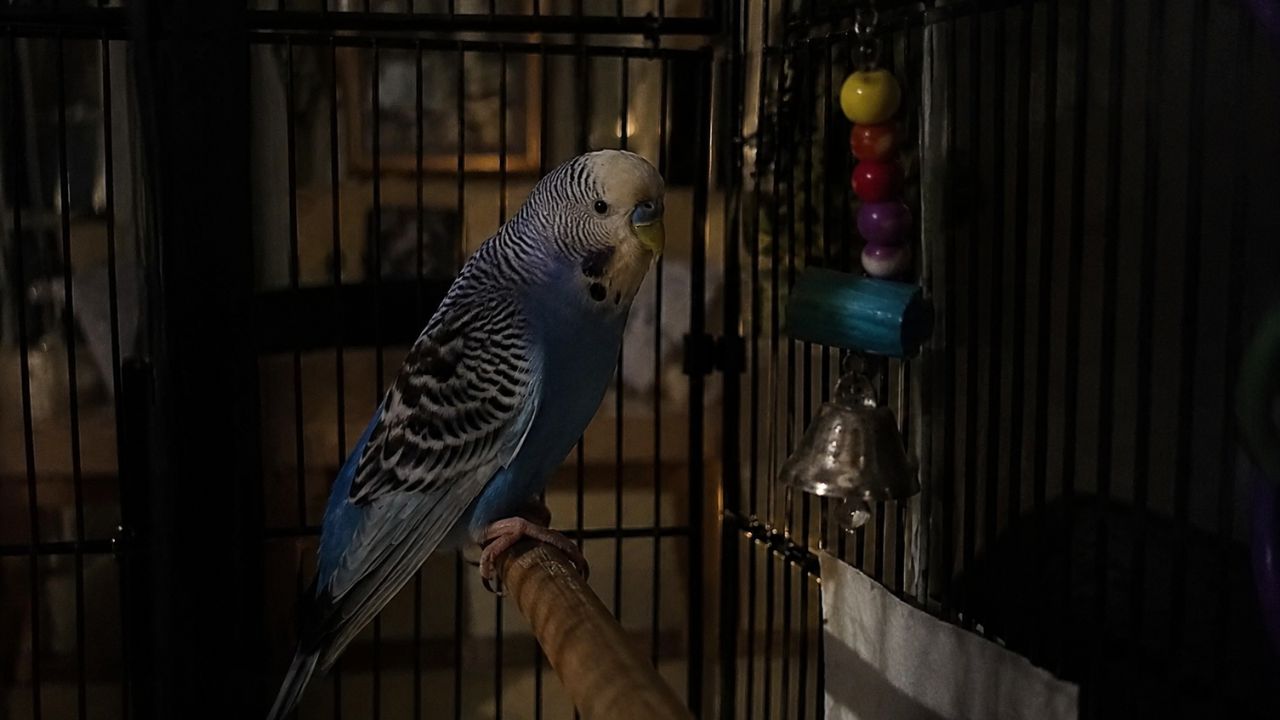

Neil has kept, bred, and sold budgerigars at Paradise Pets Swindon since 1988 — over 35 years of first-hand experience with these birds. A budgie that is not sleeping at night is one of the concerns that owners do not always take seriously enough. In most cases, there is a specific and identifiable cause. In some cases, it is a sign of something that needs prompt attention. This guide explains how to read the difference — and what to do about it.
It starts the same way almost every time. Someone comes in and mentions, almost as an aside, that their budgie has been restless at night. Moving on the perch. Calling out. Not settling. They have been hearing it through the bedroom wall, or they have got up for a glass of water and seen it awake and active when it should be still.
They are not always sure whether to be concerned. Most of the time, they have decided it is probably nothing. They mention it after they have already asked about something else.
I always stop them there. Because a budgie that is not sleeping properly at night is worth taking seriously — and the cause is almost always one of a small number of specific things, most of which are entirely fixable once you know what you are looking for.
I have been selling and keeping budgies for thirty-five years. Sleep disturbance is one of those signs that can mean very little or can mean quite a lot, and understanding which is which is genuinely important for the bird’s health and wellbeing.
Here is what I tell owners at the counter.
Why Budgie Sleep Matters More Than Most Owners Realise
Budgies in the wild sleep for roughly twelve hours in every twenty-four. They are strict diurnal animals — active during daylight, resting once it is dark. That rhythm is not flexible. It is tied to their biology in a way that directly affects their immune system, their hormonal regulation, and their overall health.
A budgie that is consistently disturbed at night is not just tired the next day. It is operating under physiological stress. Chronic sleep disruption in birds suppresses immune function, increases susceptibility to respiratory illness and infection, affects feather condition, and can contribute to behavioural problems including excessive screaming, feather plucking, and aggression during the day.
That is not alarmist. It is simply what happens to a prey animal that is chronically deprived of the rest it is built to need.
The good news is that most causes of nighttime disturbance are environmental — meaning they are identifiable, and fixing them is usually straightforward. But you have to know what you are looking for.
The Most Common Cause — Light in the Room
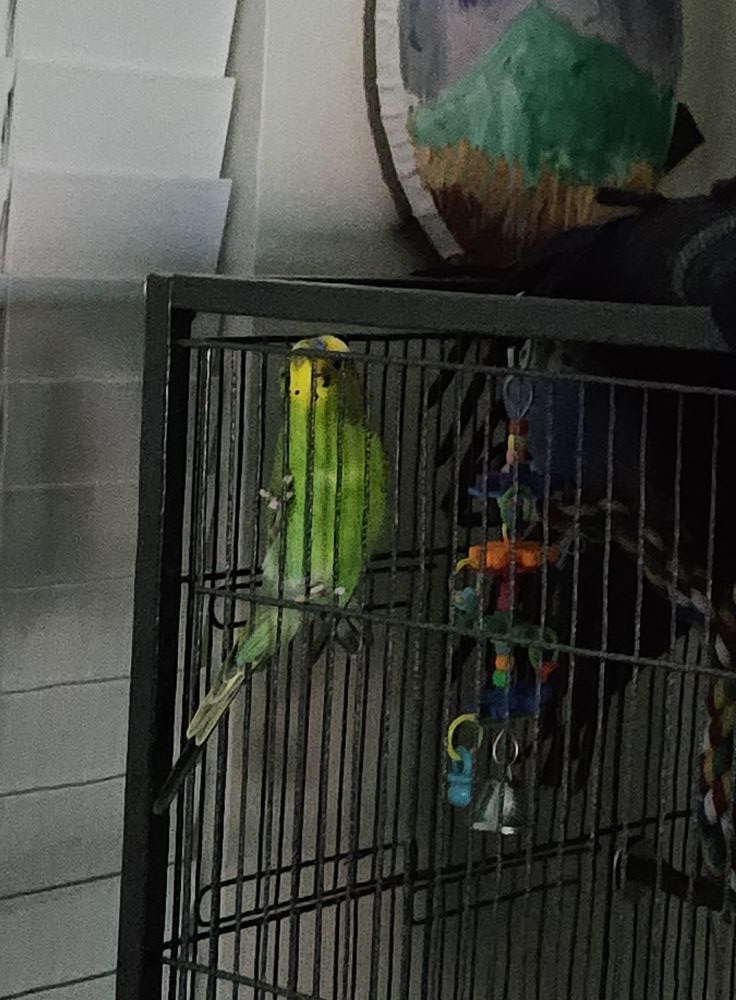
This is the cause I identify most often, and it is the one that surprises owners most when I mention it. The room the cage is in is not dark enough.
Budgies are highly sensitive to light. Their pineal gland — the part of the brain that regulates the sleep-wake cycle — responds directly to light levels. In a room with streetlight coming through curtains, a television on standby, a phone charging with its screen occasionally lighting up, or any other low-level ambient light source, a budgie does not fully enter the deep rest phase its body needs. It may doze intermittently but it will not sleep properly.
This is particularly common in living rooms, where cage birds are often kept. A living room that seems dark to a human — television off, main lights off — may still have enough ambient light from outside, from electronics, from a hallway, to keep a budgie in a state of shallow, interrupted rest.
The solution is a proper cage cover. Not a decorative cage drape — a cover that blocks light effectively, that fits the cage properly, and that is put on at the same time each evening and taken off at the same time each morning. Consistency matters almost as much as darkness. A predictable light-dark cycle is what the budgie’s biology is calibrated to. Irregular covering times create their own disruption.
If you are using a cover and the bird is still restless, check for light sources you may not have considered. A gap in curtains. A smoke alarm with a blinking LED. A router with an active light. Any of these can be enough to disturb a bird that is already sensitive.
Night Frights — What They Are and What Causes Them
A night fright is a specific event, distinct from general restlessness, and it is one that can cause real injury if it happens repeatedly.
A budgie that is startled in the dark — by a sudden noise, a movement outside the window, a vehicle passing, a door slamming elsewhere in the house — will react with an immediate flight response. Because the cage is dark and the bird is disoriented, it will thrash against the bars, fall from the perch, flutter to the cage floor. In a well-set-up cage, the bird usually recovers and resettles within a few minutes. In a cage with toys hanging at the wrong height, perches positioned badly, or not enough floor space to land safely, injury is possible.
The morning after a night fright, an owner sometimes finds feathers on the cage floor and a bird that seems shaken or is sitting lower than usual. That is what night fright looks like in retrospect.
The causes are almost always external sounds or movements that enter the room without warning. In a quiet house, even a relatively minor noise — a cat walking across the roof, a car alarm in the street, the boiler firing up — can be enough.
The management approach has two parts. First, reduce the sources of sudden noise where possible — closing the door to the room, keeping the cage away from windows that face a road or garden with regular foot traffic. Second, consider a small nightlight on a very dim setting in the room. This sounds counterintuitive given what I said about light, but a very dim constant light source is often less disruptive than complete darkness followed by a sudden noise, because the bird can see where it is and reorient itself more quickly if startled.
This is a case where the specific circumstances matter. Some birds do better in full darkness with no exceptions. Others are more settled with a very faint background light. You will learn which yours is.
Temperature and Draughts — The Silent Disruptors
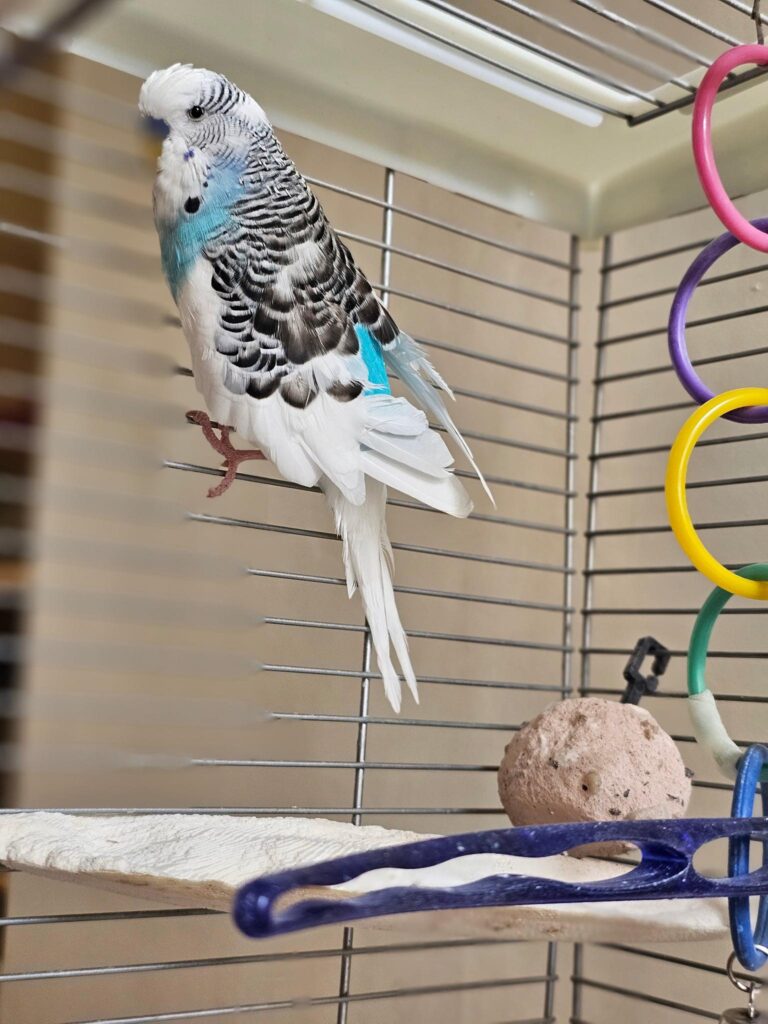
Budgies are originally from the arid interior of Australia. They are more tolerant of warmth than cold, and they are particularly sensitive to draughts — moving air that drops the ambient temperature around the cage even when the room itself seems warm enough.
A cage positioned near a window, near an air vent, near a door that opens to a cooler hallway, or in any position where there is regular airflow at night will often produce a restless bird. The bird is not sick. It is cold, or it is uncomfortable, and it cannot settle.
The signs of a draught problem are often subtle. The bird may sit fluffed more than usual — feathers raised to trap warmth. It may move position on the perch repeatedly, trying to find somewhere more sheltered. It may not be vocalising or in obvious distress, just persistently unsettled.
Check the cage position critically. Put your hand where the cage is at different times of the evening and notice whether you can feel air movement. If the cage is near a window, feel along the frame for gaps. Night temperatures in a UK home in autumn or winter can drop significantly near a window even when the rest of the room is comfortable.
Moving the cage to a more sheltered position in the room — away from windows, away from external walls, away from vents — often resolves this entirely.
Another Bird in the Cage — Social Disruption
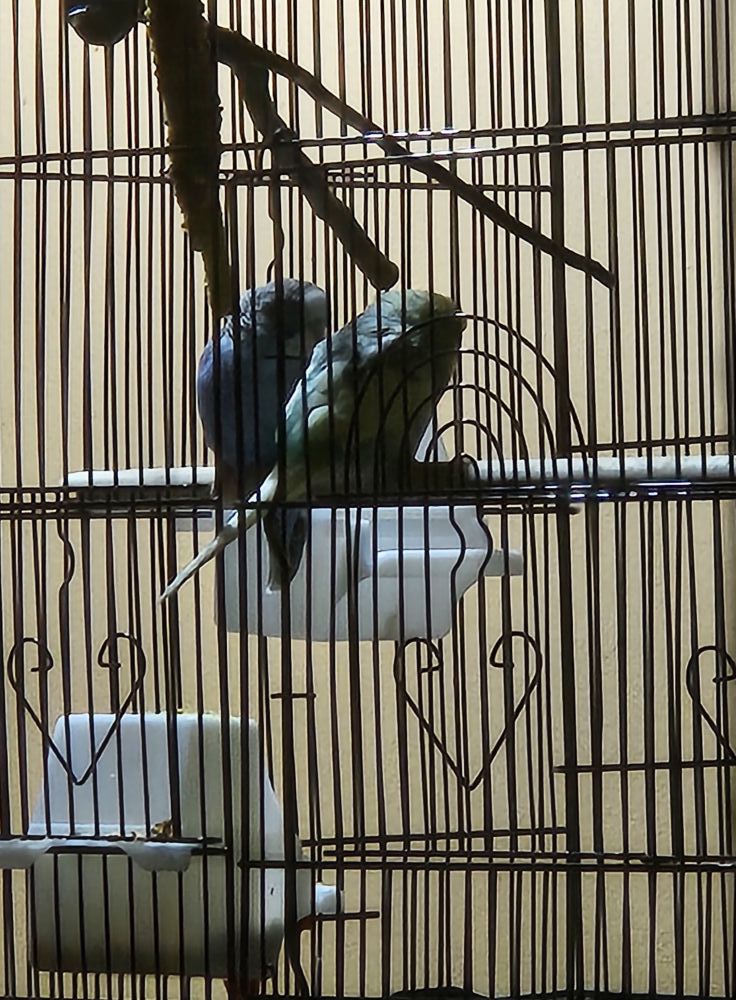
If you have more than one bird, the cause of nighttime restlessness may not be environmental at all. It may be coming from within the cage itself.
Budgies in a pair or group do not always sleep peacefully together. A dominant bird that is active and preventing others from settling, birds that are incompatible and creating ongoing low-level tension, or a bird that is unwell and moving about restlessly — any of these can disturb the whole cage.
This is worth observing directly. If possible, check on the cage after lights-out, quietly and without disturbing the birds unnecessarily. What you see will tell you more than I can guess from a description at the counter. If one bird is clearly settled and another is moving, or if there is any obvious tension between birds on the perch, the social dynamic inside the cage is the place to focus.
Incompatibility between budgies is real and not always resolvable without separating the birds. Two males that looked fine together during the day can be in genuine conflict overnight. Two birds of mismatched personality — one extremely active, one that needs stillness — can disrupt each other without any visible aggression. If you have ruled out environmental causes and the restlessness persists, the other bird is the next thing to look at.
Illness — When Night Restlessness Is a Symptom
This is the category that matters most to get right, because it is the one where delay has consequences.
A budgie that is unwell — with a respiratory infection, with air sac mites, with any internal condition that is affecting its breathing or its comfort — will often show increased restlessness at night before it shows obvious daytime symptoms. Birds conceal illness during the day as a survival instinct. At night, when the performance of being well is no longer needed and the bird is alone in the dark, the discomfort it has been masking becomes more visible.
Respiratory illness in budgies often produces a subtle clicking or wheezing sound that is easier to hear in the quiet of the night. Air sac mites — a parasitic infection that affects the respiratory tract — produce a characteristic clicking breath that owners sometimes describe as a ticking sound from the cage at night. If you have ever heard your bird making a sound like this and dismissed it as the cage creaking or a toy moving, listen again more carefully.
The pattern to watch for: nighttime restlessness that is not resolved by addressing the obvious environmental causes — light, noise, temperature — and that is accompanied by any other change in the bird. Changes in droppings. A bird that seems quieter than usual during the day. Tail bobbing when breathing at rest. Spending more time at the bottom of the cage. A slight change in the quality or frequency of vocalisation.
Any of these alongside nighttime restlessness is a reason to see an avian vet promptly. Not in a few days. This week.
Hormonal Restlessness — The Season-Related Cause
Budgies are strongly seasonal animals. As day length increases in spring and early summer, budgies enter a reproductively active phase — and this hormonal shift affects behaviour across the board, including sleep.
A budgie that becomes more restless at night specifically during spring, that is also showing other signs of hormonal activity — increased regurgitation, more time spent investigating the cage for potential nesting spots, more territorial behaviour — is likely responding to the longer days rather than having a health problem.
The management of hormonal restlessness is primarily about light management. Keeping the day-length the bird experiences at a consistent twelve hours year-round — using the cage cover to artificially create a stable light-dark cycle regardless of the actual sunrise and sunset — reduces the intensity of the hormonal response and the sleep disruption that accompanies it.
This is one of the practical arguments for consistent covering times regardless of the season. A bird on a stable twelve-hour light cycle is calmer, more predictable, and healthier than one that experiences the full range of UK day lengths from sixteen hours of light in June to eight in December.
What I Tell Budgie Owners at the Counter
When someone comes in and mentions that their budgie is not sleeping, the first thing I ask is: what does the room look like at night? And the second thing I ask is: has anything changed recently — new noise source, new position, new bird in the cage, change in the season?
In the majority of cases, those two questions identify the cause within a few minutes. A room that is not dark enough. A cage near a window. The nights drawing in and the covering routine not adjusted to match. A new bird that is disrupting the existing one.
Those causes are all fixable without a vet. Change the environment, give the bird a week to adjust, and in most cases the problem resolves.
What I want every budgie owner to take from this is a simple principle: your budgie’s sleep is not optional. It is not a background detail of its existence. It is a core part of its health. A bird that is sleeping well is a bird that is physically and mentally in balance. A bird that is consistently disturbed at night is running a physiological deficit that will show up somewhere eventually.
Take it seriously from the start. The causes are almost always findable. Most of them are fixable at home. But if you cannot find the cause, or the restlessness persists despite addressing what you can — come and see us, or get the bird checked by a vet. We are at Manor Garden Centre, Cheney Manor Industrial Estate, Swindon, SN2 2QJ — open every day. Or call us on 01793 512400.
- “Budgies don’t need much sleep — they’re small” — Size has nothing to do with it. Budgies need roughly twelve hours of sleep in every twenty-four, and that requirement is fixed by their biology. A small bird that is chronically sleep-deprived is under the same physiological stress as any larger animal in the same situation.
- “My budgie sleeps during the day so it’s fine if it’s awake at night” — Daytime napping does not compensate for disrupted nighttime sleep. Budgies are diurnal — their deep, restorative sleep happens at night when it is dark. Daytime dozing is supplementary, not equivalent. A bird that is napping during the day because it is not sleeping properly at night is showing a sign of disruption, not managing it.
- “It only woke up once — that’s not a sleep problem” — One event is one event. A pattern of waking regularly, or evidence that the bird is frequently restless rather than deeply settled, is a sleep problem regardless of whether the waking is technically counted as one or several incidents.
- “I leave the TV on at night so the room isn’t completely dark — that’s fine” — This is almost certainly contributing to sleep disruption. Television light is intermittent, flickering, and produces exactly the kind of irregular light stimulus that prevents a budgie from reaching deep sleep. A properly darkened room with a cover is always preferable to a room with background television light.
- “It’s been like this for months so it must be normal for this bird” — Duration does not make a problem normal. A bird that has been sleeping poorly for months has been under chronic physiological stress for months. The fact that it is still alive and functioning does not mean the situation is acceptable. Find the cause and fix it.
- Bird restless at night, room is not fully dark, no cover in use.
Light problem — fit a proper cage cover that blocks light fully. Use it at a consistent time every evening. Give the bird one week to adjust. This resolves the majority of cases. - Bird waking suddenly, thrashing, feathers on cage floor in the morning.
Night fright — identify and reduce sources of sudden noise. Consider a very dim constant nightlight. Check perch positioning and cage layout to reduce injury risk if it happens again. - Bird restless, cage near a window or vent, room cooler than the rest of the house at night.
Draught or temperature issue — move the cage to a more sheltered position away from windows and air movement. Recheck after repositioning. - Two or more birds in cage, one settled, one or more restless.
Social disruption — observe the cage after lights-out. Assess compatibility. If one bird is consistently disturbing others, separation may be necessary. - Restlessness paired with any clicking or wheezing sound from the bird at night.
Possible respiratory illness or air sac mites — vet this week. Do not wait. Breathing sounds at night are significant and should not be dismissed. - Restlessness increased specifically in spring, with other signs of hormonal activity.
Seasonal hormonal response — stabilise the light cycle using a cover to maintain a consistent twelve-hour day year-round. This reduces the intensity of the hormonal response over time. - Environmental causes addressed, restlessness persists, bird showing any other change in behaviour or condition.
Possible underlying health issue — see an avian vet. Describe the pattern of restlessness, when it started, and any other changes you have noticed. A vet needs the full picture.
Visit Us at Paradise Pets Swindon
We stock budgerigars year-round alongside a full range of cage and aviary birds — all UK-sourced, kept in proper conditions before going to a new home. If you have a question about your budgie’s sleep or behaviour, or you are thinking about getting your first bird and want to understand what to expect, come in and talk to us.
We also stock gerbils and hamsters, guinea pigs, and rabbits.
⭐ Customer Reviews
Amazing Bird Selection
Had a lovley visit today,staff were very friendly and very helpful,such a great petshop,their selection of birds is incredible,really impressed,thank so much to the staff at Paradise Pets

Friendly Helpful Staff
I have been coming to this place for years and they have a great stock of food for all types of pets. Have a great selection of small mammals and a lot of birds. Staff are friendly and helpful.

Great Quality Hutch
Bought a guinea pigs hutch and run combo, very happy with the service, the hutch was put in my car for me without even asking for help. The wood quality is very good, the instructions easy to follow and we are extremely happy with the fully built hutch. A good size for 2 guinea pigs

Response from Paradise Pets | Wiltshire
Thank you Melanie Latus Nice to provide services to you.
Best Bird Shop Around
It’s the best pet shop in and around Swindon. They always have an amazing selection of birds and all you need to keep them happy. I keep birds myself and the guys there are happy to answer questions and really know their stuff. I have seen budgies etc. in chain pet shops in the area looking really unhealthy and ill – I wouldn’t go anywhere else than Paradise Pets for animals.

Highly Recommended Bird Shop
I could not praise this shop enough. Really helped my Grandson buy his first bird and he’s loving it. Travelled from Somerset and was welcomed with open arms.

Great Shop with Competitive Prices
Great shop with amazing selection for small animals, hamsters, mice ect, highly recommend!
Also has a great selection for dogs & cats too & very competitive prices! 💖

