
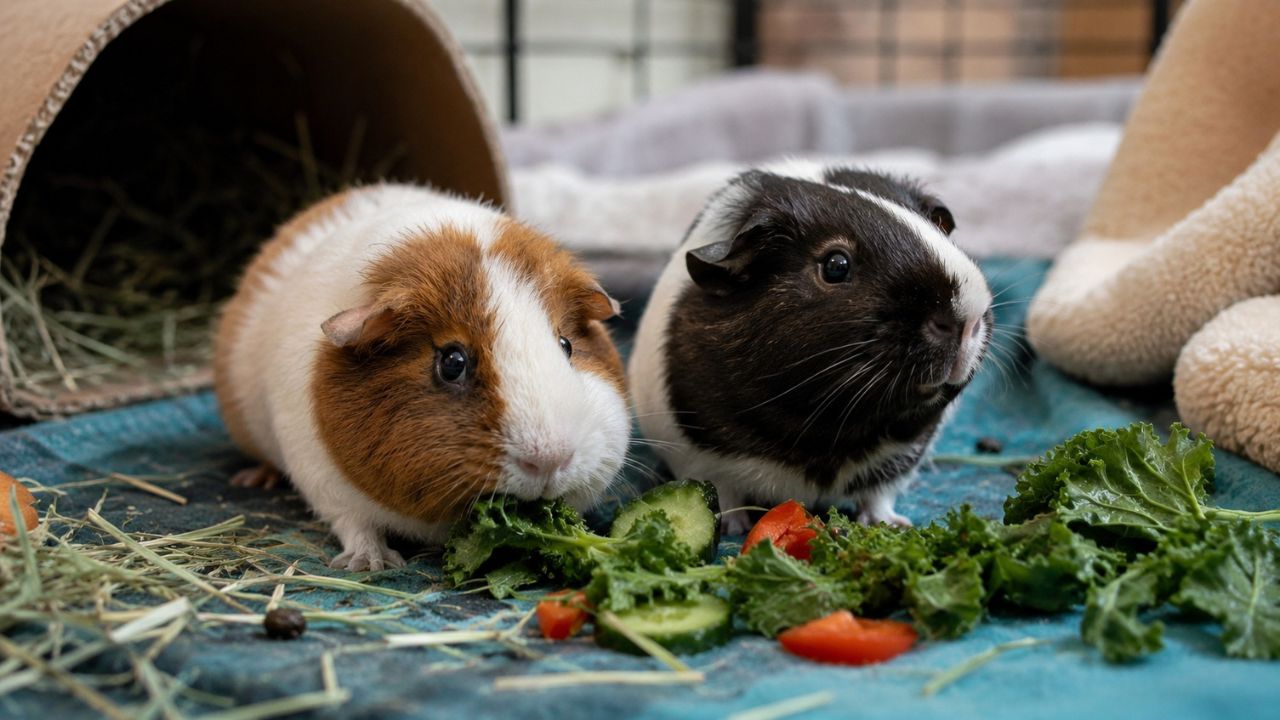

Neil has been keeping, breeding, and selling guinea pigs at Paradise Pets Swindon since 1988 — over 35 years of daily first-hand experience with these animals and the UK owners who keep them. In that time, he has watched hundreds of guinea pigs in hundreds of different homes, and he has learned to read their behaviour with a precision that most owners never develop — not because they do not care, but because nobody ever showed them what to look for. This article is that knowledge, written down honestly.
A family came in on a Saturday afternoon — parents, two children around eight and ten. They had owned two guinea pigs for about six months. Everything seemed fine, they said. The animals were eating, drinking, moving around. No obvious problems. But the mother had a question she had been turning over for a while.
“How do we actually know if they’re happy? They don’t really do much. They just sit there.”
It is a fair question, and it gets asked more often than you might expect — not just by new owners, but by people who have kept guinea pigs for years and are still not entirely sure what contentment looks like in the species. Dogs and cats are relatively transparent. A wagging tail, a purr — the signals are familiar and culturally embedded. Guinea pigs are different. Their emotional expressions are subtler, less anthropomorphic, and often completely missed by owners who do not know what to look for.
The honest answer to that mother’s question is that guinea pigs express happiness and contentment constantly — but they do it in ways that are easy to overlook if you have not been shown what they mean. A guinea pig that looks like it is just sitting there may be expressing deep contentment. A guinea pig that looks perfectly fine may be telling you, in the language of its species, that something is not right.
Before The Signs — Why Guinea Pig Happiness Is Misunderstood
Before I go through the seven signs, I want to explain why this question is harder than it sounds — and why getting it right matters more than most owners realise.
Guinea pigs are prey animals. Like budgies, like rabbits, like most of the small animals people keep as pets, their biology is built around concealment of weakness. An animal that looks unwell in the wild is an animal that attracts predators. So they are, by evolutionary design, good at appearing fine even when they are not.
This concealment instinct works in the other direction too. A guinea pig that is genuinely content will express that contentment in specific, observable ways — but those expressions are the vocabulary of the species, not of a dog or a cat. An owner looking for human-adjacent happiness signals — eye contact, seeking out the owner, demonstrating affection in recognisable ways — will often miss the signals that are genuinely there.
The result is that many UK guinea pig owners fall into one of two positions. Either they assume their animal is happy because nothing is obviously wrong. Or they assume their animal is unhappy because it is not demonstrating affection in ways that feel meaningful. Both positions, in many cases, are incorrect — and both can lead to care decisions that do not serve the animal well.
What I am going to give you is neither. It is the honest picture of what a contented guinea pig actually looks, sounds, and behaves like — based on 35 years of observing these animals daily.
Sign 1 — Popcorning
This is the one that guinea pig owners either know immediately and treasure, or have never seen and do not know to look for. If your guinea pig has ever done it in front of you, you will remember it.
Popcorning is a spontaneous burst of movement — a sudden leap, twist, or hop that the animal produces for no apparent external reason. It looks slightly chaotic. The animal jumps, often changes direction mid-air, lands, and resumes whatever it was doing. It can happen once or several times in quick succession. It is most common in young guinea pigs, but adult animals do it too.
It means the animal is experiencing something close to what we might call joy. It is not a stress response. It is not a reaction to threat. It is a spontaneous physical expression of positive emotional state — the guinea pig equivalent of a dog bounding across a room for no reason. Ethologists who study small animal behaviour interpret it as one of the clearest positive affect signals in the species.
- Most common in young animals — juveniles popcorn frequently; adult animals do it less, but a genuinely settled adult that popcorns occasionally is telling you something clearly positive
- Often triggered by fresh food, out-of-enclosure time, or a companion — the trigger is usually something the animal finds genuinely pleasurable
- More frequent in animals that have adequate space and social companionship — a guinea pig that never popcorns despite being young is sometimes telling you something about its environment
- Cannot be faked or performed under stress — this is the key thing; an animal that is frightened, in pain, or severely stressed does not popcorn; it is an involuntary expression of positive state
If your guinea pig popcorns, even occasionally, you are looking at an animal that experiences genuine positive affect in its environment. That is meaningful information.
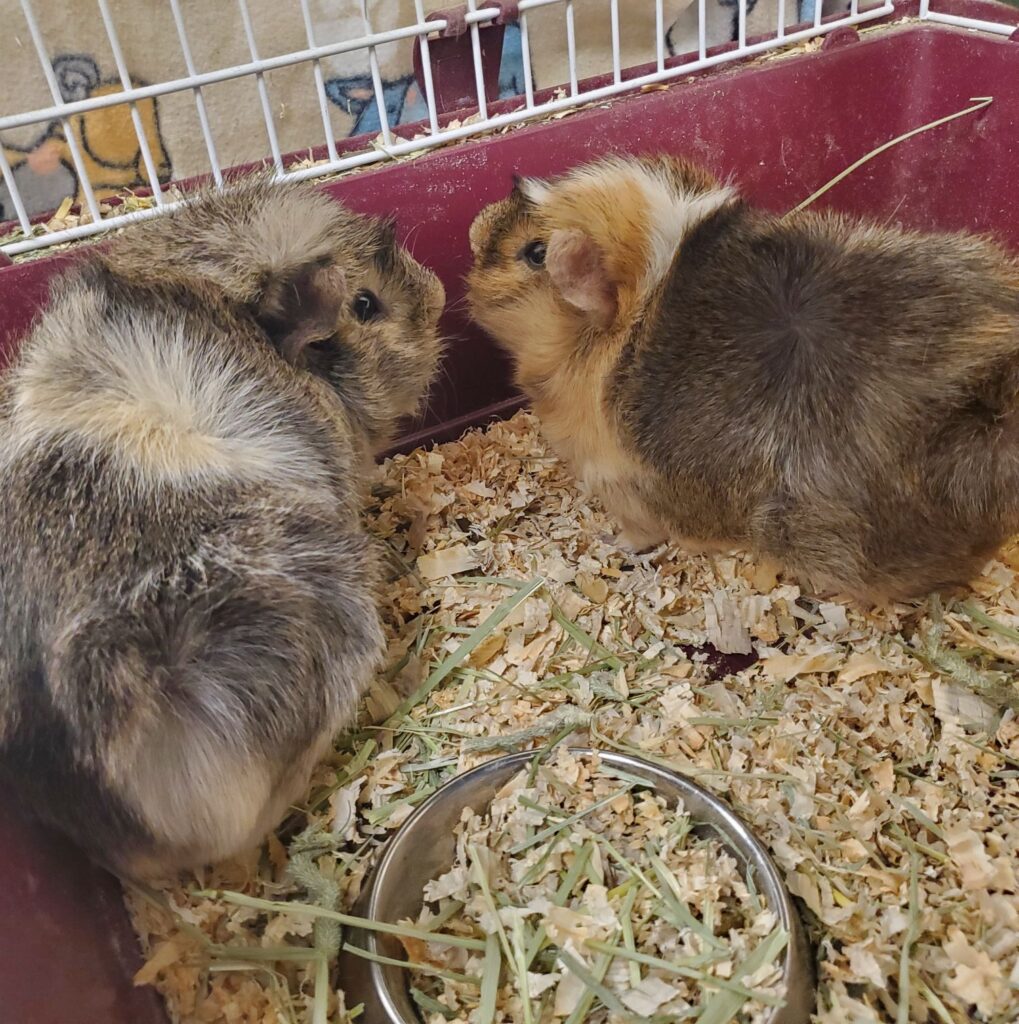
Sign 2 — The Full Range Of Vocalisations, Used Appropriately
Guinea pigs are among the most vocal of commonly-kept small animals. They produce a wide range of distinct sounds, and each one means something specific. An owner who has learned to read these sounds has a communication channel with their animal that most owners never develop.
The sounds that indicate a happy, settled animal:
- Wheeking — the high-pitched, excited call most guinea pig owners recognise; produced in anticipation of food, at the sound of the fridge, or at a familiar person’s footsteps; it is an expression of anticipatory excitement; a guinea pig that wheeeks at you is a guinea pig that associates you with something positive
- Purring — a low, continuous rumble produced when the animal is being handled contentedly or sitting with a companion it is comfortable with; different from the teeth-chattering sound which is a warning; genuine purring is a contentment signal
- Soft chutting — a quiet, murmuring sound produced by a guinea pig moving through its environment contentedly; exploratory, settled behaviour producing a running commentary; easy to miss but significant when you hear it
- Responding vocally to your voice — a guinea pig that wheeeks or chutts in response to the sound of your voice has made a positive association with you; it knows you and it considers your arrival a positive event
The sounds that indicate distress and are sometimes confused with contentment:
- Teeth chattering — a sharp, rapid clicking of teeth; this is not purring; it is a warning signal; the animal is uncomfortable or threatened
- Shrieking — a loud, sharp cry; fear or pain; always investigate immediately
- Repetitive, monotonous calling — prolonged, unchanging vocalisation can indicate loneliness, particularly in a single animal; this is distress, not contentment
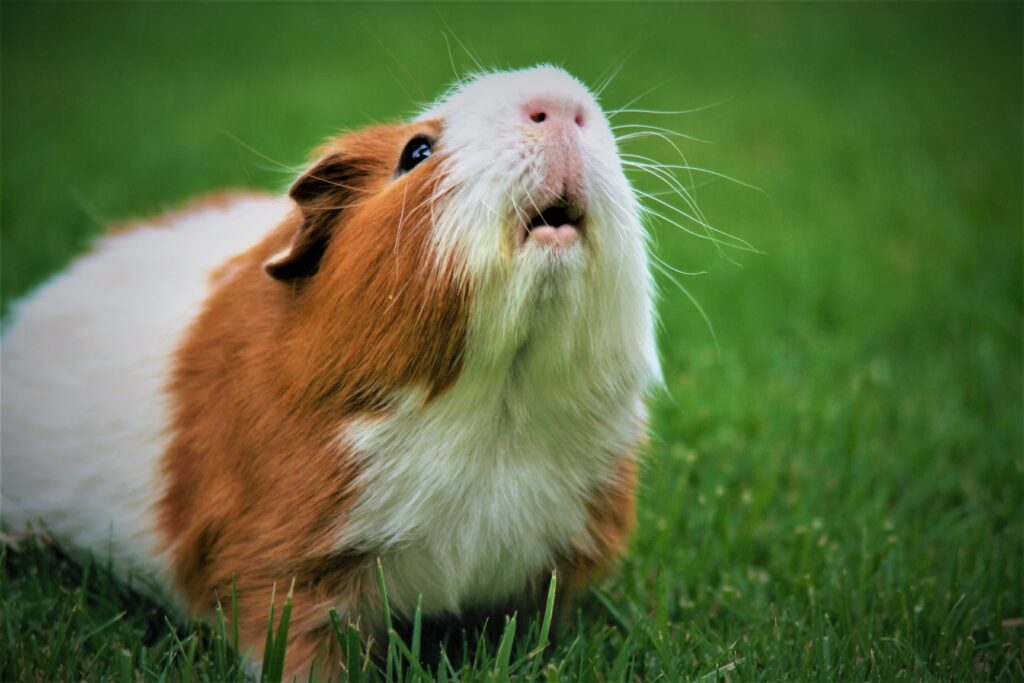
An owner who knows the difference between these sounds has a genuinely useful window into their animal’s state that requires no specialist equipment — only attention and the knowledge of what each sound means.
Sign 3 — Relaxed, Exploratory Movement
This is the sign the mother in my opening story was missing when she said her guinea pigs just sat there.
A guinea pig that is genuinely relaxed and content moves through its environment in a particular way. The movement is not frantic or nervous. It is not pressed against the walls of the enclosure. It is not frozen. It is unhurried, investigating, pausing to sniff and assess, covering the space available to it with the casual confidence of an animal that knows its environment is safe.
- Moving through the full extent of the enclosure — a content guinea pig uses most of the space available to it; an anxious or unwell animal often confines itself to a small area or a corner
- Pausing to sniff, investigate objects, and assess new things — curiosity is a sign of positive welfare; an animal that explores is an animal that feels safe enough to be curious
- Moving without apparent purpose — just covering ground, just being in the space; this is what normal settled behaviour looks like and it can be easily mistaken for doing nothing
- Returning to the same familiar spots — a contented guinea pig develops regular routes and preferred positions in its enclosure; the predictability of its movement is a sign of its familiarity and comfort with the space
- Coming to investigate when you approach — a guinea pig that moves toward you when you approach its enclosure has made a positive association with your presence; this is trust being expressed through movement
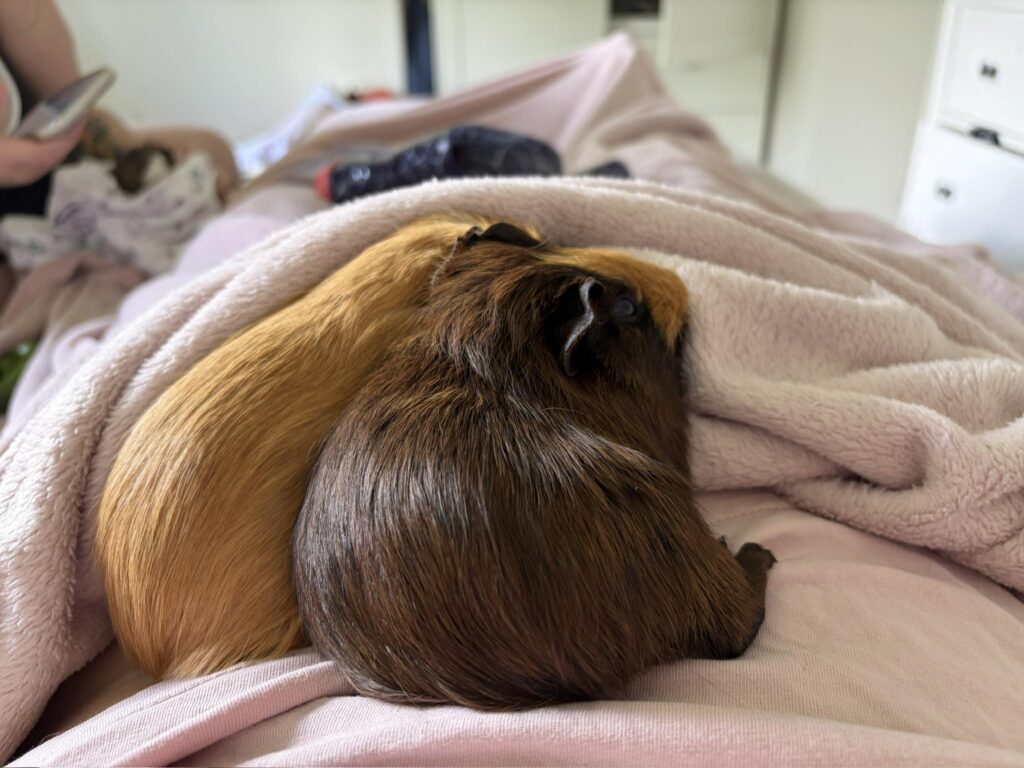
The “just sitting there” that the mother described is, in many cases, exactly this kind of settled exploratory behaviour seen from outside the enclosure by someone who expected something more dramatic. If the animal is moving calmly, pausing, nosing around its environment, going back to a familiar spot — it is expressing contentment. It is simply not doing it in a way that looks exciting from the outside.
Sign 4 — Normal, Enthusiastic Eating And Drinking
This sign is one that experienced owners learn to read with a precision that goes well beyond “is it eating or not.”
A contented, healthy guinea pig approaches food with enthusiasm. It does not approach timidly, snatch food and retreat, or eat pressed against a wall with one eye on its surroundings. It moves to the food source with purpose, eats with genuine interest, and shows the physical alertness of an animal that is engaging pleasurably with something it wants.
- Moving promptly toward fresh food when it is offered — a guinea pig that comes to fresh vegetables or hay with enthusiasm, rather than hesitating or waiting until you have moved away, is a settled and confident animal
- Wheeking at familiar food cues — the sound of the fridge, the rustle of a vegetable bag, your footsteps at feeding time; a guinea pig that has learned these cues and responds to them with excited calling is one that associates its environment with positive experiences
- Eating in the open, not hidden — a guinea pig that feels safe will often eat in the open; one that eats only when hidden or when it does not know you are watching is an animal that does not yet feel fully secure in its environment
- Drinking normally at regular intervals — a content guinea pig drinks regularly and without apparent anxiety around the water source
- Showing interest in variety — a guinea pig in good health and positive welfare will typically investigate and try new foods when offered; a very anxious or unwell animal may refuse anything unfamiliar
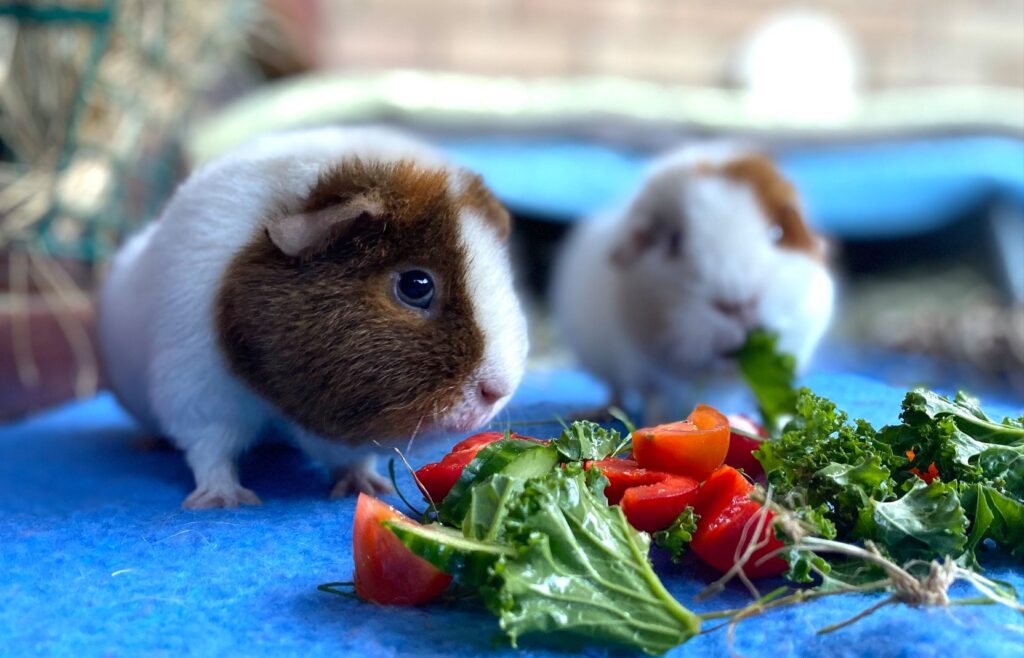
Changes in eating behaviour — reduced appetite, eating less openly, losing interest in foods it previously enjoyed — are among the earliest indicators that something is not right. Because eating is such a consistent daily behaviour, deviations from normal are meaningful.
Sign 5 — Social Behaviour With Companions
This sign applies specifically to guinea pigs kept in pairs or groups — which, as I tell every guinea pig owner, is how they should be kept. A single guinea pig cannot express the social behaviours that indicate genuine wellbeing in the species, because those behaviours require another guinea pig.
- Mutual grooming — guinea pigs that groom each other are expressing trust and social comfort; this is one of the clearest positive social signals in the species and it requires genuine calm and confidence in both animals
- Sleeping in contact with a companion — two guinea pigs that sleep touching, or curled together, are animals that feel genuinely safe with each other; sleep requires vulnerability, and vulnerable animals do not share it with companions they do not trust
- Following a companion through the enclosure — not chasing, not being chased; simply moving together through the space; social cohesion in motion
- Eating alongside a companion without tension — food is a potential source of competition; animals that eat side by side at the same food source without showing tension, teeth chattering, or displacement behaviour are genuinely comfortable with each other
- Communicating softly with a companion — the quiet chutting and murmuring sounds that bonded guinea pigs produce to each other are social contentment signals; if you hear this between your animals, you are hearing a settled social bond
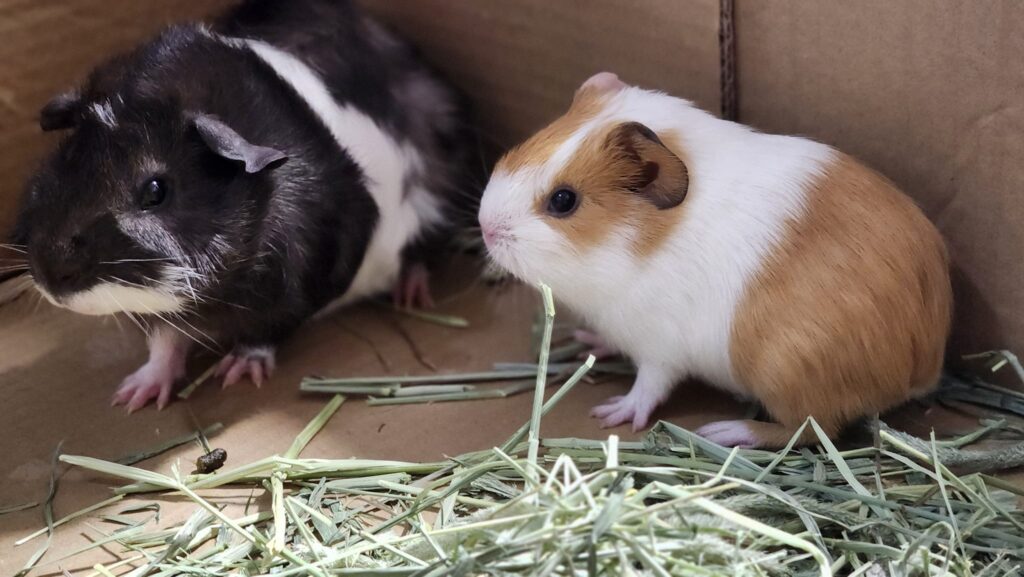
A guinea pig kept alone cannot show you any of these signs. This is one of the reasons I always recommend pairs — not only because single keeping produces loneliness, but because you lose access to the most expressive range of the animal’s positive social behaviour, which is also the most meaningful indicator of its genuine wellbeing.
Sign 6 — Relaxed Body Posture And Physical Ease
Posture communicates state in guinea pigs, and a contented animal carries itself differently from a stressed or unwell one. Learning to read posture requires observing your animal regularly enough to know what its relaxed baseline looks like — which is itself a practice worth developing.
A relaxed, content guinea pig:
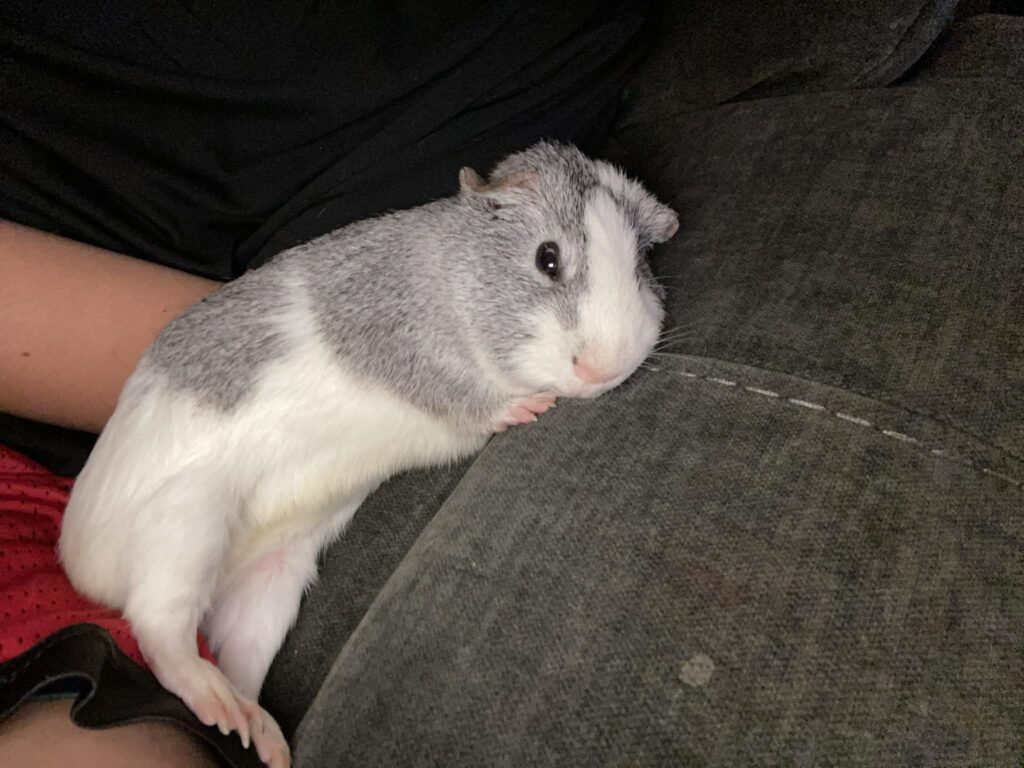
- Stretches out fully when resting — a guinea pig that lies stretched out on its side or with its legs extended behind it is an animal that feels entirely secure; this position is physically vulnerable and an animal only adopts it when it genuinely does not feel threatened
- Has smooth, flat fur in its normal coat condition — a content guinea pig in good health has coat that lies flat and in good condition; rough, raised, or unkempt coat is a sign that something is wrong physically or in the animal’s stress levels
- Holds its head at a normal upright angle — a head tilt is a sign of illness; a slightly bowed head when relaxed is normal; an upright, alert head position when active indicates confident engagement with the environment
- Has bright, clear, open eyes — eyes that are half-closed outside of sleep, sunken, or showing discharge are health signs worth attending to; clear, bright eyes in an alert animal are a basic positive indicator
- Sits comfortably in your hands without sustained struggle — a guinea pig that has been properly handled from a young age and has been given time to become familiar with its owner will sit in your hands without prolonged struggling; some initial adjustment is normal; a settled, trusting animal will relax into handling within moments
Sign 7 — Regular, Predictable Routines
This is the sign that most owners never think to look for, and it is one of the most reliable indicators of genuine wellbeing in guinea pigs.
A contented guinea pig develops routines. It tends to be active at the same times each day. It gravitates to the same spots for different activities — sleeping in one place, eating in another, exploring at particular times. It has established patterns that it follows with enough regularity that an attentive owner can predict them.
- Predictable activity periods — guinea pigs are crepuscular, most active at dawn and dusk; a settled animal will show clear, consistent activity peaks at these times and quieter periods between them
- Preferred resting spots used consistently — a guinea pig that has a particular corner, a particular hide, a particular position it returns to for sleep is an animal that has made its environment its own; familiarity and ownership of space are signs of genuine settlement
- Consistent toilet habits — guinea pigs tend to use particular areas for toileting; a settled animal that has established these habits and uses them reliably is in contrast to an anxious animal whose habits are erratic
- Responding to the household routine — a guinea pig that has been in a home long enough will begin to respond to the patterns of the household; waking at the same time the family wakes, anticipating feeding at usual times, reacting to familiar voices; this synchronisation with the household is a sign of deep settlement
What Unhappiness Looks Like — The Signs To Watch For
I want to give equal space to the other side of this question, because recognising unhappiness in a guinea pig is as important as recognising contentment — and the signs are often equally subtle.
| Sign | What It Usually Means | What To Do |
|---|---|---|
| Hiding for long periods, rarely venturing out | Stress, fear, or illness; an animal that feels safe comes out; one that does not feel safe stays hidden | Assess environment — other pets, noise, handling; vet check if persistent |
| Teeth chattering at companions or at you | Warning signal; the animal is uncomfortable, threatened, or in pain | Investigate trigger; vet check if directed at companions without obvious cause |
| Repetitive, monotonous calling | Loneliness, particularly in a single animal; sometimes pain | If single: get a companion; if in a pair: vet check |
| Stereotypic behaviours — bar chewing, repetitive pacing | Insufficient space, boredom, or chronic stress | Increase enclosure size; add enrichment; review social environment |
| Rough, raised, or patchy coat | Nutritional deficiency, parasites, illness, or chronic stress | Vet check; review diet — Vitamin C in particular |
| Reduced appetite or interest in food | Illness — in guinea pigs, reduced appetite is always significant; gut stasis is a medical emergency | Vet within 24 hours if appetite is significantly reduced; same day if not eating at all |
| Lethargy — less movement than normal | Illness, pain, or significant welfare problem | Vet check; always investigate a notably less active guinea pig |
| Aggression between companions that was not previously present | Pain in one animal causing defensive behaviour; inadequate space; social incompatibility emerging | Vet check for pain; review space; consider whether pairing is working |
The most important thing to understand about this table is the last point in the eating row. Guinea pigs have continuously growing teeth and a digestive system that requires near-constant movement. A guinea pig that stops eating is not having an off day — it is in genuine danger of gut stasis, which is a medical emergency. Any significant reduction in appetite in a guinea pig requires vet attention within 24 hours. Complete loss of appetite requires same-day attention.
A Note On Vitamin C — The Silent Cause Of Unhappiness
I want to add this separately because it is specific to guinea pigs and because it is the nutritional deficiency I see most often in UK animals — usually because their owners did not know about it.
Guinea pigs cannot synthesise their own Vitamin C. Unlike most mammals, they must obtain it from their diet every single day. A guinea pig that does not receive adequate Vitamin C develops scurvy — a progressive condition that causes joint pain, coat deterioration, reduced immune function, and general malaise. A guinea pig with low-level Vitamin C deficiency will not look dramatically ill. It will simply seem a little less active, a little less interested in its environment, a little less like a happy guinea pig. The signs from this article will be present, but dimmer.
- Fresh vegetables every day — bell peppers are one of the highest natural sources of Vitamin C and most guinea pigs eat them readily; leafy greens, broccoli, and parsley are also good sources
- Hay should be available at all times — Timothy hay forms the bulk of a healthy guinea pig diet; it supports dental and digestive health and should never run out
- Do not rely on water-soluble Vitamin C supplements — Vitamin C degrades rapidly in water and is usually insufficient by the time the animal drinks it; fresh food is the reliable source
- Pellets alone are not sufficient — many guinea pig pellets contain Vitamin C, but the levels degrade during storage; fresh vegetables are the dependable daily source
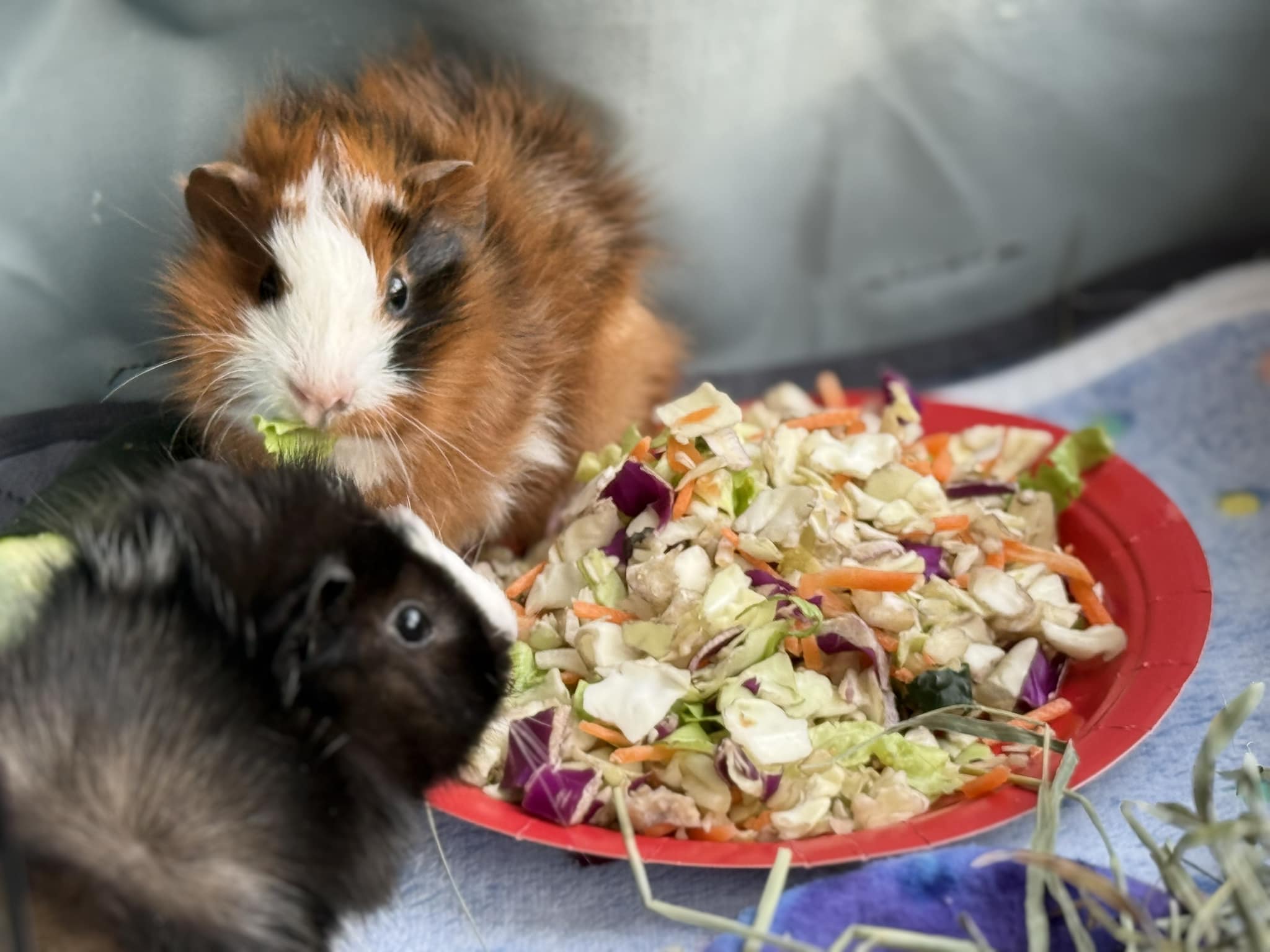
A guinea pig receiving adequate Vitamin C every day is a guinea pig whose body can function as it is meant to. That functioning — physically comfortable, nutritionally supported — is the foundation of the happiness signals I have described throughout this article. Without it, you are looking at an animal that is doing its best under a constraint it has no way to communicate to you.
Frequently Asked Questions
What does a happy guinea pig sound like?
A happy, settled guinea pig wheeeks with excitement at food and at familiar people, purrs when being handled contentedly, and produces a quiet chutting murmur when exploring its environment comfortably. These sounds are distinct from the teeth chattering of a warning signal or the shrieking of a frightened or pained animal. Learning the difference takes a little time but becomes intuitive quickly. A household where guinea pigs are wheeking regularly at mealtimes is a household where the animals have made positive associations with the people who feed them.
My guinea pig never popcorns. Does that mean it is unhappy?
Not necessarily. Popcorning is most common in young animals and decreases as guinea pigs age — many adult guinea pigs rarely popcorn even when in excellent welfare. The absence of popcorning in an older animal is not in itself a concern. Look for the other signs in this article — relaxed exploratory movement, enthusiastic eating, soft vocalisations, mutual grooming if kept in a pair. These together give you a much more complete picture than any single sign.
How do I know if my guinea pig likes me?
A guinea pig that likes you and feels safe with you will wheek at the sound of your voice, approach you when you come near the enclosure rather than retreating, settle quickly when you pick it up rather than struggling continuously, and eat from your hand without extended hesitation. These are all expressions of a positive association with you specifically. Building them requires consistent gentle handling, predictable behaviour around the animal, and the patience to let the relationship develop at the guinea pig’s pace rather than yours.
Is it normal for guinea pigs to hide a lot?
Some hiding is entirely normal — guinea pigs feel secure in covered spaces and will use hides regularly. What is not normal is a guinea pig that almost never comes out, that retreats immediately when approached, or that spends the majority of its active periods hidden. This level of hiding usually indicates stress — from predator presence (even a cat watching through a window is significant), handling that has not been built up gradually, an environment that does not feel safe, or occasionally illness. Investigate the environment first and vet check if the behaviour persists.
Do guinea pigs need companions to be happy?
Yes, in all but exceptional circumstances. Guinea pigs are profoundly social animals. The social signals that indicate genuine happiness — mutual grooming, sleeping in contact, eating alongside, soft social vocalisations — are only possible with a companion of their own species. A single guinea pig can form a positive relationship with its owners, but it cannot have what its biology requires from its own kind. I recommend pairs to every guinea pig owner, same-sex to avoid breeding complications. The welfare difference between a single guinea pig and a bonded pair is real and consistent.
My guinea pig runs away when I try to pick it up. Is it unhappy?
Running from a descending hand is a normal prey animal response, even in well-handled, settled guinea pigs. A guinea pig that runs from being picked up is not necessarily unhappy or untrusting — it is responding to the approach of something much larger than itself from above, which is exactly how predators approach in the wild. The meaningful question is what the animal does once you have it in your hands. A guinea pig that settles quickly, stops struggling, and sits calmly is an animal that has learned to trust handling even if the initial catch still triggers the flight response. A guinea pig that struggles continuously, bites, and never relaxes is telling you that the trust has not been built yet.
What is the most common reason guinea pigs seem unhappy in UK homes?
In my experience, the most common reason is being kept alone. The second most common is a diet that is insufficient in fresh Vitamin C — the animal is in low-level discomfort that it cannot communicate clearly. The third is an enclosure that is too small for the animal to express normal behaviour. These three things — single keeping, inadequate diet, insufficient space — account for the majority of unhappy guinea pigs I have encountered at the counter over 35 years. All three are straightforwardly fixable.
Where can I get honest advice about my guinea pig’s welfare in Swindon?
Come in to Paradise Pets at Manor Garden Centre, Cheney Manor Industrial Estate, Swindon SN2 2QJ — or call us on 01793 512400. We have been keeping and selling guinea pigs for 35 years and we are happy to talk through your specific animals, their behaviour, their setup, anything that is concerning you. The advice is always free and it is always honest.
One Last Thing From Me
The family from the Saturday afternoon — the parents and their two children — spent about fifteen minutes at the counter going through what I have written in this article. Before they left, the older child asked me a question I thought was unusually good for a ten-year-old.
“If they can’t talk, how do you learn what they’re saying?”
I told her the honest answer: you watch. You watch them when they don’t know you’re watching. You learn what normal looks like so that you notice when something has changed. You learn the sounds well enough to tell the difference between a wheek and a teeth chatter. You pay attention to the same animal, over time, until its behaviour becomes readable.
She nodded as if this made complete sense to her. I think it did.
About three months later her mother sent a short message to the shop. The older daughter had apparently become, in her mother’s words, “obsessed” with reading the guinea pigs’ behaviour. She had identified that one of them was showing slightly reduced appetite and had insisted on a vet visit, which had caught a dental issue early and resolved it without complications.
“She said she learned it from the article the man at the pet shop told her about,” her mother wrote.
That is the outcome this article exists to produce. Not a checklist ticked off and forgotten, but a genuine change in how an owner relates to their animal — a shift from looking at it to reading it. That shift is available to every guinea pig owner who decides to make it. It does not require any special skill. It requires attention and the knowledge of what to pay attention to.
You now have that knowledge. The rest is simply watching.
Questions About Your Guinea Pig’s Wellbeing? Come And See Me
Bring your questions — about behaviour, diet, housing, or anything that does not seem quite right. I will give you a straight answer based on 35 years of keeping and selling these animals. No obligation, no sales pressure. Just honest advice.
⭐ Customer Reviews
Amazing Bird Selection
Had a lovley visit today,staff were very friendly and very helpful,such a great petshop,their selection of birds is incredible,really impressed,thank so much to the staff at Paradise Pets

Friendly Helpful Staff
I have been coming to this place for years and they have a great stock of food for all types of pets. Have a great selection of small mammals and a lot of birds. Staff are friendly and helpful.

Great Quality Hutch
Bought a guinea pigs hutch and run combo, very happy with the service, the hutch was put in my car for me without even asking for help. The wood quality is very good, the instructions easy to follow and we are extremely happy with the fully built hutch. A good size for 2 guinea pigs

Response from Paradise Pets | Wiltshire
Thank you Melanie Latus Nice to provide services to you.
Best Bird Shop Around
It’s the best pet shop in and around Swindon. They always have an amazing selection of birds and all you need to keep them happy. I keep birds myself and the guys there are happy to answer questions and really know their stuff. I have seen budgies etc. in chain pet shops in the area looking really unhealthy and ill – I wouldn’t go anywhere else than Paradise Pets for animals.

Highly Recommended Bird Shop
I could not praise this shop enough. Really helped my Grandson buy his first bird and he’s loving it. Travelled from Somerset and was welcomed with open arms.

Great Shop with Competitive Prices
Great shop with amazing selection for small animals, hamsters, mice ect, highly recommend!
Also has a great selection for dogs & cats too & very competitive prices! 💖

