
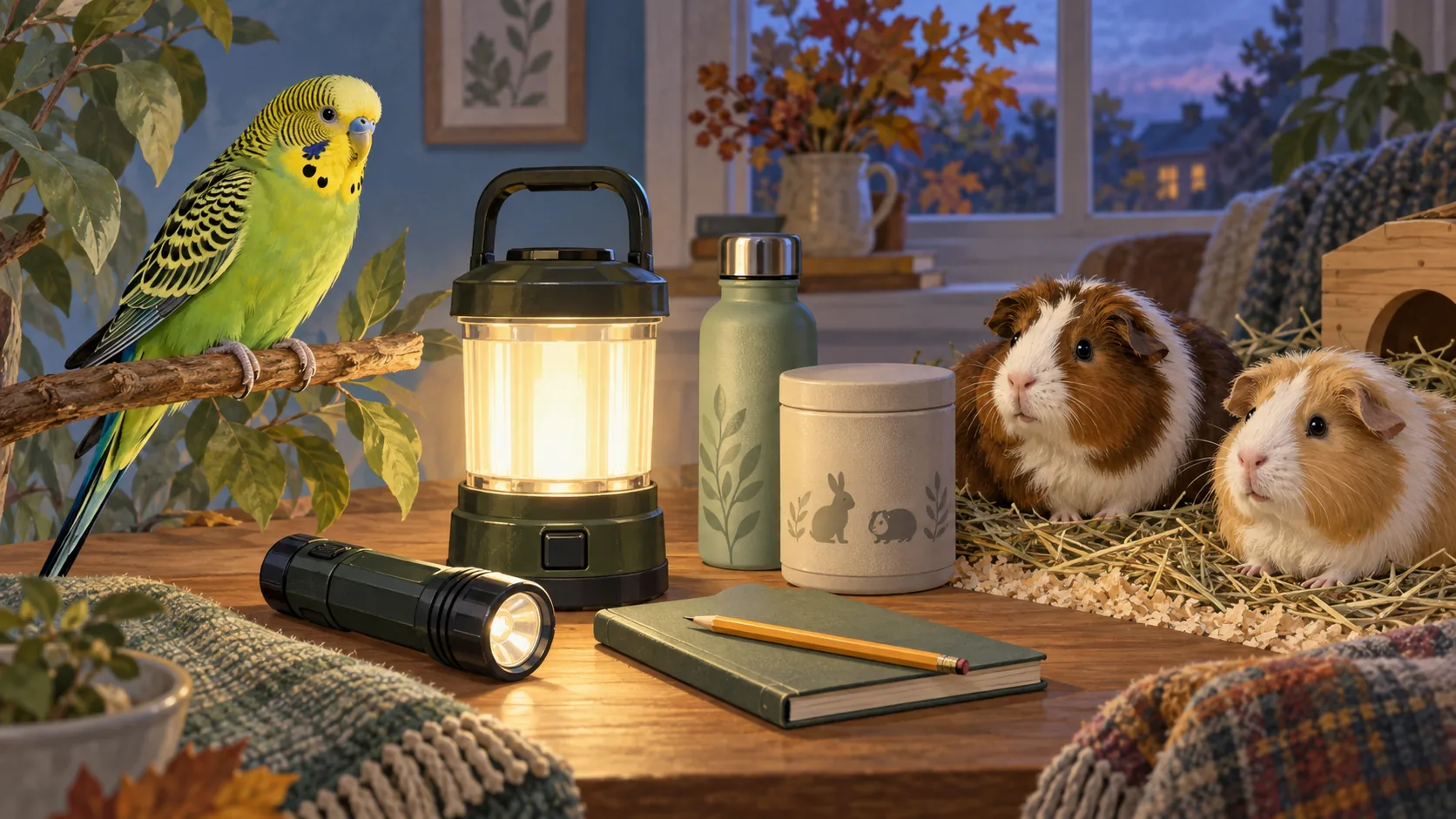

Featured image: AI-generated concept image; animals and supplies are shown together for illustration, not as a housing arrangement.
A power cut can interrupt more than the lights. The heating may stop, the internet may disappear and an automatic device may no longer do the job you expect. For a household with birds or small pets, the useful question is: which parts of their normal care depend on electricity?
Answering that before an outage makes decisions easier in the dark. This guide helps you draw up a practical household plan, whether you look after a budgie, guinea pigs, rabbits or another small pet. It does not assume every species needs the same conditions or equipment.
If the power has just gone off
- Find your torch and check that people, pets and enclosures are secure.
- Note when the outage began, check the room conditions and identify which parts of care have stopped working.
- In England, Scotland and Wales, call 105 to report a power cut or reach your electricity network operator. This is not a veterinary helpline.
- If an animal is unwell, contact your vet or their out-of-hours service. Do not wait for the electricity to return.
1. Find the hidden electricity dependencies
Walk through an ordinary day of care, from the morning check to bedtime. Look at what you actually use, rather than buying equipment because it appears on an emergency checklist.
Does the room rely on central heating? Can somebody read the care instructions if the router is off? Does any existing device restart automatically? The UK Government’s power-cut guidance explains that gas boilers and home communications can also depend on electricity, and recommends keeping important contacts on paper.
Use this inventory to record the arrangements relevant to your pets:
| Part of care | Prepare before an outage | Check if power goes off |
|---|---|---|
| Room conditions | Identify a suitable alternative space and agree how you will assess when it is needed. | Check the actual conditions; do not assume the room stays suitable because it still feels comfortable to you. |
| Existing electrical care equipment | Read its instructions and ask the manufacturer about interruption and restart behaviour. For prescribed care, agree a contingency with your vet. | Identify what has stopped. Follow the agreed plan rather than improvising a repair or substitute. |
| Food and water | Record what each animal normally receives and where it is kept. | Check access directly, including any automatic system you already use. |
| Medicines, if applicable | Ask your vet or pharmacist what to do if specified storage conditions cannot be maintained. | Follow that advice; do not change treatment or guess whether a medicine is still usable. |
| Contact and care information | Keep a printed care sheet, addresses and telephone numbers together. | Use the paper copy if your phone, internet or charging arrangements fail. |
2. Put the essentials somewhere obvious
A useful kit is one another household member can find without asking you. Keep a working torch, spare batteries, a charged power bank and the printed care sheet in a known place. Check them occasionally: an empty battery pack is easy to overlook until it matters.
Know where the usual pet food, drinking water, bedding and transport carriers are kept. Record where you can obtain replacements if your normal supplier is closed. The aim is continuity of familiar care, not a sudden menu change or a collection of unfamiliar emergency products.
Keep carriers accessible rather than behind boxes in a shed. Check their fastenings in advance. A label with the animal’s details, your telephone number and the vet’s contact information can travel with the care sheet if someone else needs to help.
3. Agree a suitable alternative place
“We could go to a friend’s” is only the beginning of a plan. Speak to that person before you rely on the arrangement. Check what accommodation is available, who can transport the animals, and whether the destination could be affected by the same outage.
Discuss the practical details: space for suitable housing, the animals’ usual routine, other pets, smoke or household fumes, and a quiet area where doors can be controlled. Do not assume a spare room is ready simply because it is warm. Take the animal’s existing health needs into account with your vet.
The RSPCA’s winter advice for pet birds specifically recommends planning for power outages. It also stresses routine and avoiding draughts, direct radiator heat and harmful fumes. For everyday room preparation, see our winter budgie room checks. Guinea-pig owners planning a seasonal move can use the separate guide to preparing indoor winter accommodation.
4. Avoid improvised heating
Do not bring a camping stove, portable barbecue, lit charcoal or generator into an enclosed space to provide warmth or power. Dorset & Wiltshire Fire and Rescue Service warns of the carbon-monoxide risk and recommends torches in preference to candles during power cuts.
Keep unfamiliar heating arrangements out of the pet-care plan. If your animals depend on particular environmental conditions or prescribed equipment, ask the relevant professional about a suitable contingency beforehand. There is no single safe waiting time that covers every species, animal and room.
5. Copy this one-page household plan
Fill this in while the lights are on, then put a copy with the supplies. Make sure your backup carer can understand it without a tour of the house.
- Animals and normal care: names, species, enclosure locations, food, water and usual routine.
- Electricity dependencies: what stops working and where its instructions are kept.
- People: the main carer, a backup carer and someone who can provide transport.
- Veterinary help: usual practice, out-of-hours number and address. Keep these separate from 105 — electricity network help in England, Scotland and Wales.
- Alternative accommodation: the agreed place, contact person, available housing and route there.
- Supplies and carriers: their location and anything the carer needs to take.
6. Keep checking the animals, not just the outage updates
An estimated restoration time cannot tell you whether an individual animal is well. The RSPCA advises immediate veterinary contact for respiratory signs in birds, including difficulty breathing. Its guinea-pig health guidance also calls for immediate veterinary advice if eating or drinking changes, or droppings reduce or stop. Seek help for illness rather than attributing it to the disruption.
Once power returns, check that the equipment you normally use is working as intended, including any settings or timers. Check food, water and the animals again. Afterwards, add whatever was missing to your written plan so the next person caring for them has clearer instructions.
