

Neil has kept, bred, and sold budgerigars at Paradise Pets Swindon since 1988 — over 35 years of first-hand experience with these birds. Curling feet in a budgie is one of those signs that can mean something very minor or something that needs urgent attention — and telling the difference quickly matters. This guide explains every cause, how to read the pattern, and exactly what to do depending on what you are seeing.
It is the kind of thing an owner notices almost by accident. They are watching the bird on the perch and something about the feet looks different. The toes are not gripping in the usual way. One or both feet seem curled — not flat against the perch the way they should be, but bent inward, or the toes angled unusually, or the bird shifting its weight in a way that suggests the feet are not comfortable.
Sometimes they have been watching it for a few days before they come in. Sometimes they noticed it that morning and came straight to us. The ones who come in straight away are usually right to do so.
Curling feet in a budgie are not a single thing. They are a symptom — and the cause behind that symptom ranges from something as simple as a perch that needs changing to something as serious as a neurological condition or systemic illness. The pattern of how the curling presents, what the rest of the bird looks like alongside it, and how quickly it came on are the things that tell you which end of that range you are dealing with.
I have been reading these signs for thirty-five years. Here is what they mean.
What Normal Budgie Feet Look Like — And What Changes Mean
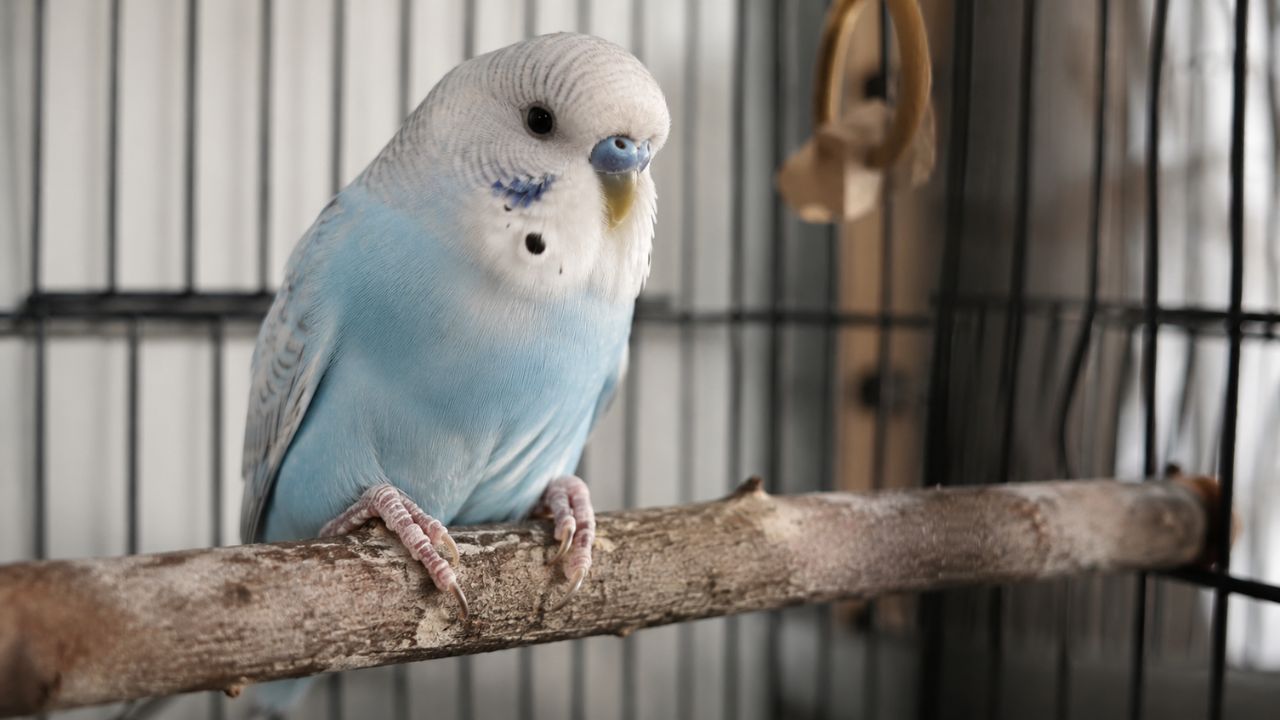
A budgie has four toes on each foot — two pointing forward, two pointing back. This zygodactyl arrangement is designed for gripping perches and branches with strength and precision. At rest, the toes should be wrapped evenly around the perch, gripping lightly but securely, with no visible tension or asymmetry. The scales on the feet should be smooth and flat, the joints clean, and the nails trim enough to allow a normal grip without curling back on themselves.
A budgie that is healthy and comfortable on its perch shifts its weight naturally, grooms its feet regularly, and shows no sign of discomfort when gripping. It sleeps standing on one foot with the other tucked up — this is completely normal and not a sign of a foot problem. The tucked foot should look relaxed and natural, not clenched or awkwardly positioned.
When toes begin to curl — turning inward toward the palm of the foot, failing to straighten when the bird lands or grips, or remaining bent even when the bird is walking — something has changed. That change is what needs identifying.
The Most Common Cause — Perch Problems
This is the cause I identify most often, and it is the one that is most completely within the owner’s control to fix.
Budgies spend the majority of their lives on perches. In the wild, they grip natural branches of varying diameter, texture, and surface — constantly shifting the position and angle of the foot as they move between different surfaces. The muscles and tendons of the foot stay supple because they are being used in many different ways across the course of the day.
A cage with a single diameter dowel perch — the smooth, uniform wooden or plastic rod that comes with most budget cages — forces the foot into exactly the same grip position hour after hour. The toes never move through their full range. The tendons shorten. The muscles weaken. Over weeks and months, the foot begins to conform to the shape it is always held in rather than the shape it should naturally adopt.
The result is toes that start to curl inward, a grip that looks tighter or more cramped than it should, and eventually a bird that is visibly uncomfortable on standard perches because its feet have lost the flexibility they need.
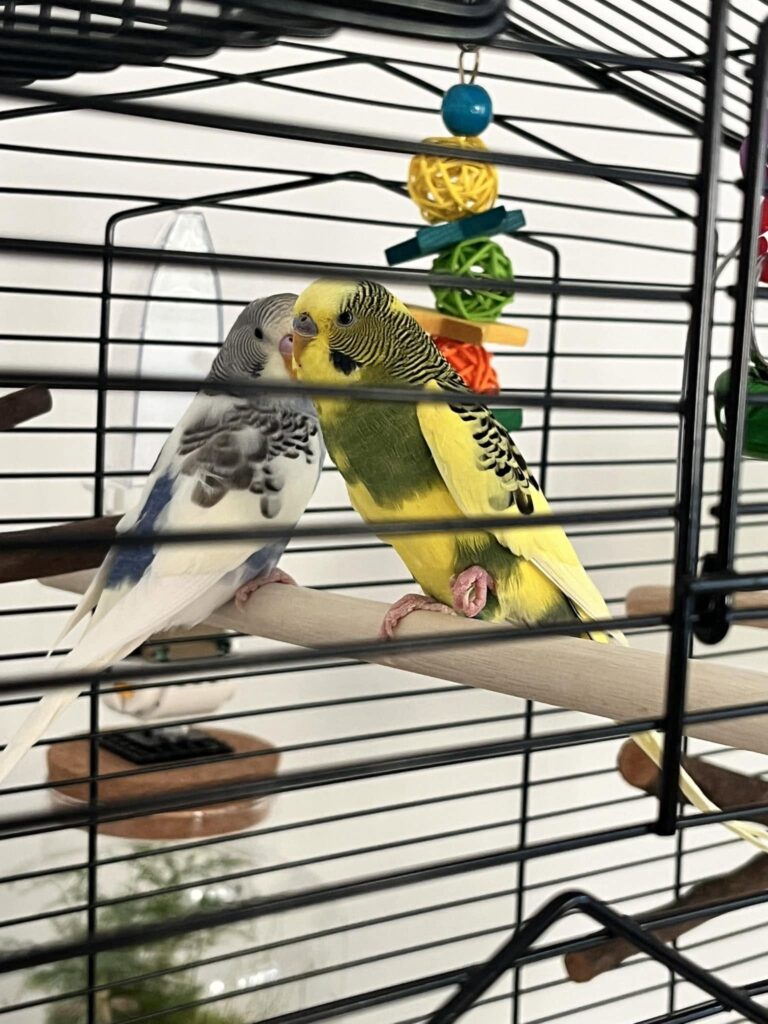
The fix is perch variety. A cage should have at least two or three perches of different diameters and different textures — natural wood branches of varying thickness, a rope perch that shifts under the foot and varies the grip, a mineral or concrete perch at one end that also helps keep nails in check. The feet need different positions across the day in the same way any muscle does.
If the perch is the cause, improving the perch setup and giving the foot time to recover — sometimes supported with gentle daily foot manipulation if the bird will allow it — can reverse mild curling entirely. It takes time, weeks rather than days, but a foot that has been cramped by a poor perch is not a permanently damaged foot.
Nutritional Deficiency — The Silent Cause That Builds Slowly
A budgie on an exclusively seed diet with nothing else — no fresh food, no mineral supplements, no cuttlefish bone, no access to natural light or a full-spectrum lamp — is a bird that is nutritionally deficient in ways that may not show up immediately but will show up eventually.
Vitamin A deficiency affects the condition of the skin, the scales on the feet, and the mucous membranes. In the feet specifically, it can cause the scaling to become thickened, the skin to lose suppleness, and the joints to stiffen — contributing to an abnormal foot position over time.
Vitamin D3 deficiency affects calcium metabolism. Calcium is essential for normal muscle and nerve function. A bird that is not processing calcium properly has muscles that do not function normally and nerves that do not fire correctly — both of which affect the feet. Vitamin D3 in birds is synthesised through exposure to UV light. A bird that lives entirely indoors under standard artificial lighting is not synthesising it. A bird that is also not getting it through diet is doubly deficient.
Calcium deficiency in particular is associated with cramping and abnormal muscle tone — exactly the kind of condition that produces curled or poorly controlled toes.
The dietary correction is straightforward: introduce cuttlefish bone as a permanent cage fixture, add a mineral block, introduce fresh vegetables — particularly dark leafy greens which are high in both vitamin A precursors and calcium — and consider a full-spectrum lamp if the bird has no access to natural unfiltered daylight.
These changes take weeks to produce visible improvement. But they are foundational and worth making regardless of the immediate cause of the foot issue, because a nutritionally depleted bird is a bird that is vulnerable to a longer list of problems than just its feet.
Overgrown Nails — When the Foot Cannot Grip Correctly
This is the cause that owners most commonly overlook because the nails themselves are easy to miss unless you are looking for them.
A budgie’s nails grow continuously. In the wild, they are worn down by the variety of surfaces the bird uses — rough bark, stone, the ground. In a cage with smooth perches, that natural wear does not happen and the nails grow unchecked.
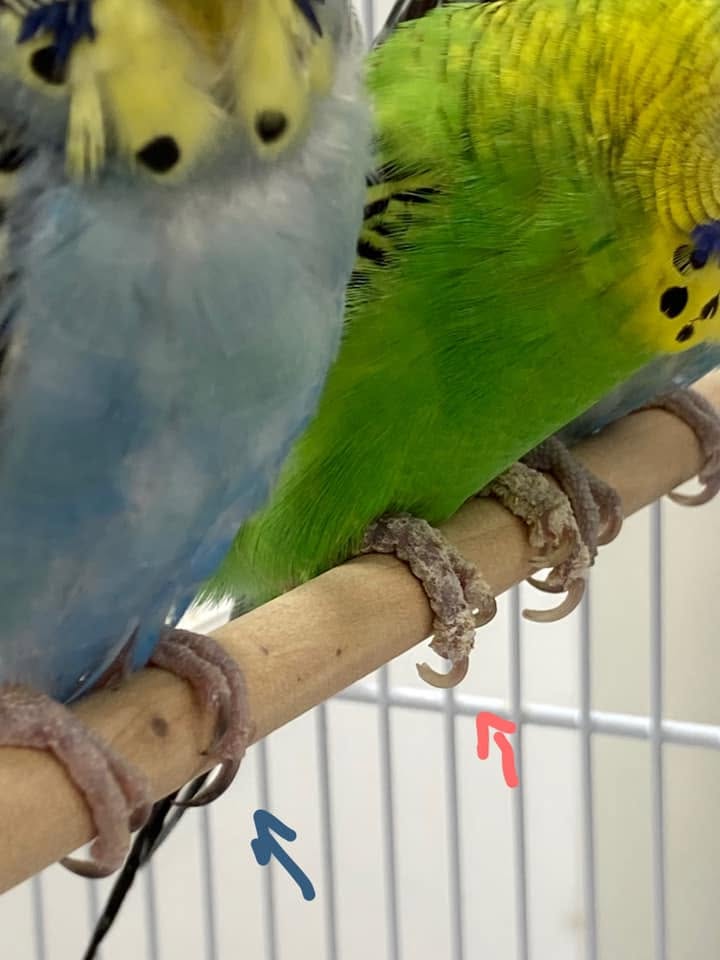
Nails that have grown too long curve back toward the foot. When a bird with overgrown nails attempts to grip a perch, the nail tip contacts the perch surface before the toe has fully straightened, forcing the toe into a curled position. The bird cannot grip normally because its own nails are preventing the foot from flattening. Over time, the tendons and muscles adapt to that restricted position — and what started as a nail problem becomes a foot position problem.
Look at the nails carefully. They should curve gently and end in a clean point that clears the perch surface when the bird is standing. If the nails are curving back toward the underside of the toe, touching or crossing the toe itself, or causing the foot to sit awkwardly on the perch — they need trimming.
Nail trimming in budgies can be done at home with appropriate small scissors or nail clippers, taking only the tip of the nail and avoiding the quick — the blood vessel that runs partway down the nail and is visible as a slightly darker line in a light-coloured nail. If you are not confident doing this yourself, a vet or an experienced bird keeper can do it quickly. Mineral or concrete perches reduce the rate of nail growth and are worth having in the cage permanently for this reason.
Bumblefoot — When the Foot Itself Is Infected
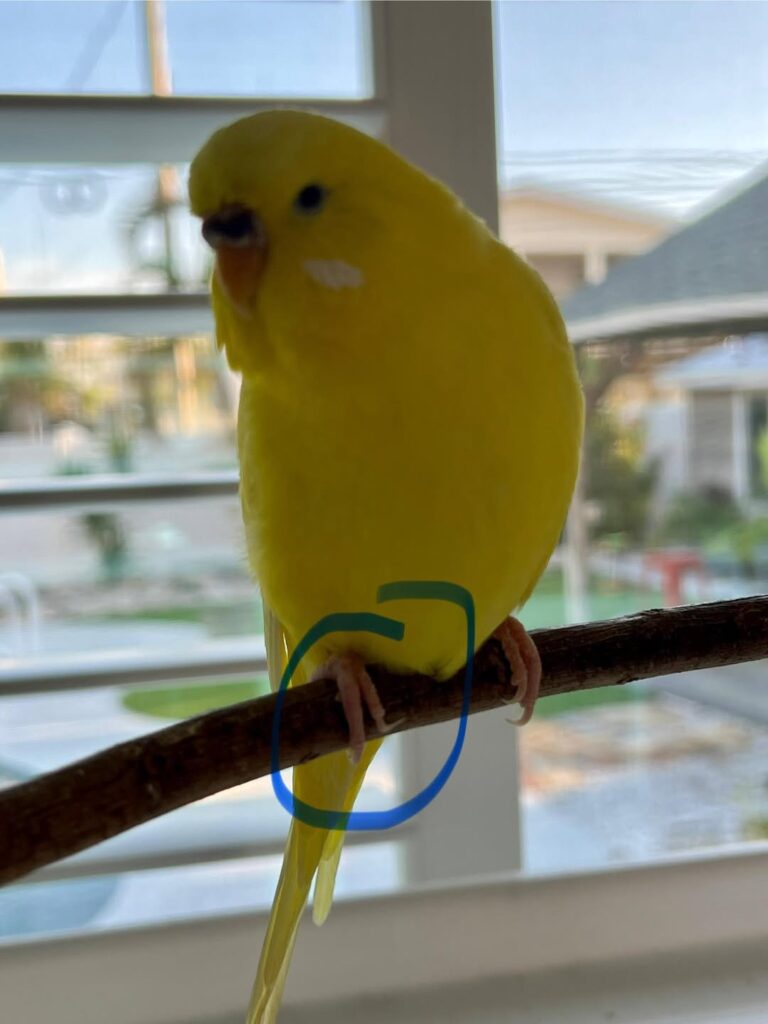
Bumblefoot is a bacterial infection of the foot pad — the fleshy underside of the foot that contacts the perch. It develops most commonly in birds that are kept on inappropriate perch surfaces, particularly smooth plastic perches that put pressure on the same point of the foot continuously, or birds that are overweight and placing excess load on the feet.
The presentation starts as redness and swelling on the bottom of the foot. The bird becomes reluctant to bear weight on the affected foot, shifting its position frequently or spending more time sitting lower on the perch. As it progresses, the swelling becomes more pronounced, the skin hardens and may crack, and in more advanced cases becomes darkened and clearly ulcerated.
Curling toes can accompany bumblefoot because the bird is actively trying to avoid pressure on the painful area. The foot curls not because of a structural problem with the tendons but because the bird is protecting the sore pad.
Bumblefoot requires veterinary treatment — antibiotics, wound management, and a change to appropriate perch surfaces. It does not resolve on its own and progresses if left untreated. A bird with a visibly swollen or discoloured foot pad and curling toes needs to see a vet this week, not at the next available appointment in a fortnight.

Scaly Face and Scaly Leg Mite — The Parasitic Cause
Knemidocoptes mites are a common parasite in budgies that most owners know as the cause of the crusty, honeycomb-like deposits around the beak and cere — scaly face. What fewer owners know is that the same mite affects the legs and feet.
In a leg mite infestation, the scales on the legs and toes become raised, thickened, and eventually encrusted with the same porous-looking material seen around the beak. The tissue under the scales is irritated and inflamed. As the infestation progresses, the distortion to the foot structure can cause the toes to sit abnormally — including curling — because the natural architecture of the foot is being disrupted by the scale overgrowth and tissue damage underneath.
This is one of the more easily identified causes of foot problems because the visual signs on the leg scales are distinctive. Look at the legs closely. Normal budgie leg scales are smooth, flat, and overlap neatly. Raised, rough, or separated scales — particularly if accompanied by a crusty appearance — are mite activity.
Scaly mite in budgies is treated with ivermectin applied topically — available from a vet. It is not something to attempt to treat with home remedies. Vaseline applied to the affected areas is sometimes recommended as a home treatment to suffocate the mites, and while it can provide some temporary relief, it is not a replacement for proper antiparasitic treatment. The mites live under the skin surface and topical occlusion alone does not reliably eliminate them.
Neurological and Systemic Causes — The Most Serious End
Sudden onset curling — feet that were gripping normally yesterday and are curled or poorly controlled today — is the pattern that warrants the most urgent response, because it can indicate neurological involvement.
A stroke or transient ischaemic event in a budgie can produce sudden unilateral or bilateral weakness or loss of coordination in the legs. The bird may appear disoriented, may have difficulty staying on the perch, and the feet may curl or fail to grip properly. The onset is rapid rather than gradual.
Toxin exposure — from non-stick cookware fumes, aerosol sprays, scented candles, cleaning products used near the cage, or any of the other household chemicals that are toxic to birds — can produce rapid neurological deterioration that includes loss of leg and foot function alongside respiratory signs.
Psittacosis and other systemic bacterial infections, severe nutritional collapse, kidney disease, and tumours affecting the nerve supply to the legs are among the other systemic causes that can present with leg and foot weakness or abnormal positioning.
The pattern that matters: if the curling came on suddenly rather than gradually, if the bird is also showing any other sign of illness, if the bird is struggling to stay on the perch rather than gripping abnormally but staying put — this is a same-day vet visit. Not tomorrow. Today.
Sudden neurological signs in a budgie are among the most time-sensitive situations in avian care. The window for effective intervention in many of these cases is short.
Chick Foot Problems — When It Starts From the Beginning
Some foot curling in budgies is not acquired through illness or environment but present from the beginning — a problem that developed during incubation or in the first days after hatching.
Splayed leg, curled toe syndrome, and other congenital or early developmental foot deformities occur in chicks that were incubated on an inappropriately smooth surface, in a nest box that was too small, or that had a nutritional deficit during development. They are more common in handreared chicks where the nest environment was not properly managed.
In chicks, early intervention — within the first few days of the foot problem being noticed — can often correct mild toe curling using a simple corrective splint made from a soft material. The window for successful correction is short because the bones and tendons of a young bird set quickly. By the time a chick is several weeks old, a foot that has developed abnormally is likely to remain that way without surgical intervention.
If you have a very young bird with curled toes, or if you are breeding budgies and have noticed foot problems in chicks, come in and talk to us or see an avian vet immediately. Days matter in this situation, not weeks.
What I Tell Budgie Owners at the Counter
When someone comes in about a budgie with curling feet, the first things I ask are how old the bird is, how quickly the curling came on, and what the perches in the cage look like. Those three answers narrow the cause considerably before we have gone any further.
A young bird on a single smooth dowel perch whose toes have gradually started to curl over several weeks is almost certainly a perch problem. That is fixable. Change the perches, give the foot time to recover, monitor for improvement.
A bird on a good perch setup whose toes have started curling over a period of months alongside gradual changes in activity level and condition is pointing toward nutrition, parasites, or an underlying health issue. That needs a vet.
A bird whose feet were normal yesterday and are wrong today — regardless of anything else — sees a vet today.
The message I want to leave every budgie owner with is this: feet are easy to overlook. They are small, they are low down in the cage, and the bird is often sitting on them. But the feet are one of the most reliable early indicators of what is happening with a bird’s overall health. An owner who checks the feet regularly — along with the droppings, the vent, the weight, the condition of the beak and cere — is an owner who will catch problems early enough to do something about them.
Come in if you want to look at your bird together and talk through what you are seeing. We are at Manor Garden Centre, Cheney Manor Industrial Estate, Swindon, SN2 2QJ — open every day. Or call us on 01793 512400.

- “It’s old so the feet are probably just stiff” — Age does cause some reduction in flexibility in birds, but curling toes are not a normal feature of an ageing budgie. An older bird with curling feet has a cause that is worth identifying — whether that is arthritis, nutritional depletion, perch problems, or something else. Age is not a diagnosis, and it is not a reason not to investigate.
- “It’s only one foot so it can’t be serious” — Unilateral foot problems can be more serious than bilateral ones, not less. A foot problem affecting one side specifically can indicate an injury, a localised infection, or a neurological issue affecting the nerve supply to that leg. One foot curling is not half a problem. It is a specific pattern worth taking seriously.
- “I put a soft perch in so the feet should be fine now” — A soft rope perch is a valuable addition to the cage, but it does not address an existing foot problem on its own. If the feet are already curled, the cause needs identifying and addressing. Better perches support recovery. They do not replace treatment.
- “It’s been like that since we got it — the shop probably kept it badly” — This may be true, and the history matters. But a foot problem that was present on purchase is still a foot problem that needs addressing now, regardless of its origin. The cause of how it started and the question of what to do about it now are two separate things.
- “I trimmed the nails and the feet look the same” — Nail trimming addresses one specific cause of abnormal foot position. If the feet look the same after the nails have been corrected, the cause is elsewhere. Work through the other possibilities — perch setup, nutrition, parasites, underlying health — rather than assuming the situation is static.
- Gradual toe curling in a bird on a single smooth dowel perch, otherwise well and active.
Almost certainly a perch problem — replace with varied diameter natural wood perches and a rope perch. Monitor over two to four weeks. Improvement should be visible if perch is the cause. - Toes curling, nails visibly long and curving back toward the foot.
Overgrown nails contributing to abnormal foot position — trim nails carefully, add a mineral perch, and monitor. If unsure about trimming yourself, a vet can do it quickly. - Bird on a seed-only diet, no fresh food, no cuttlefish, no natural light access, feet becoming abnormal gradually.
Nutritional deficiency — introduce cuttlefish bone, dark leafy greens, mineral block, and consider a full-spectrum lamp. Vet visit to assess current condition and advise on supplementation. - Swollen or discoloured foot pad, bird reluctant to bear weight, toes curled on affected foot.
Possible bumblefoot — vet this week. Do not wait. Change perch surfaces immediately while awaiting the appointment. - Raised or roughened leg scales, possible crusty deposits, toes sitting abnormally.
Possible scaly mite infestation — vet for ivermectin treatment. Do not attempt to manage with home remedies alone. - Sudden onset — feet normal yesterday, curled or uncontrolled today. Bird possibly disoriented or struggling to perch.
Neurological or systemic emergency — same-day vet. Do not wait. Check the room for toxin sources — non-stick pans, aerosols, cleaning products — and ventilate immediately if suspected. - Very young chick or newly purchased young bird with curled toes from the start.
Developmental foot problem — vet or experienced avian keeper immediately. Days matter for corrective intervention in young birds.
Visit Us at Paradise Pets Swindon
We stock budgerigars year-round alongside a full range of cage and aviary birds — all UK-sourced, kept in proper conditions before going to a new home. If you have a concern about your budgie’s feet or general health, or you want advice on perch setup, nutrition, or anything else before a problem develops, come in and talk to us. We stock a full range of natural wood perches, mineral perches, rope perches, and dietary supplements.
We also stock gerbils and hamsters, guinea pigs, and rabbits.