
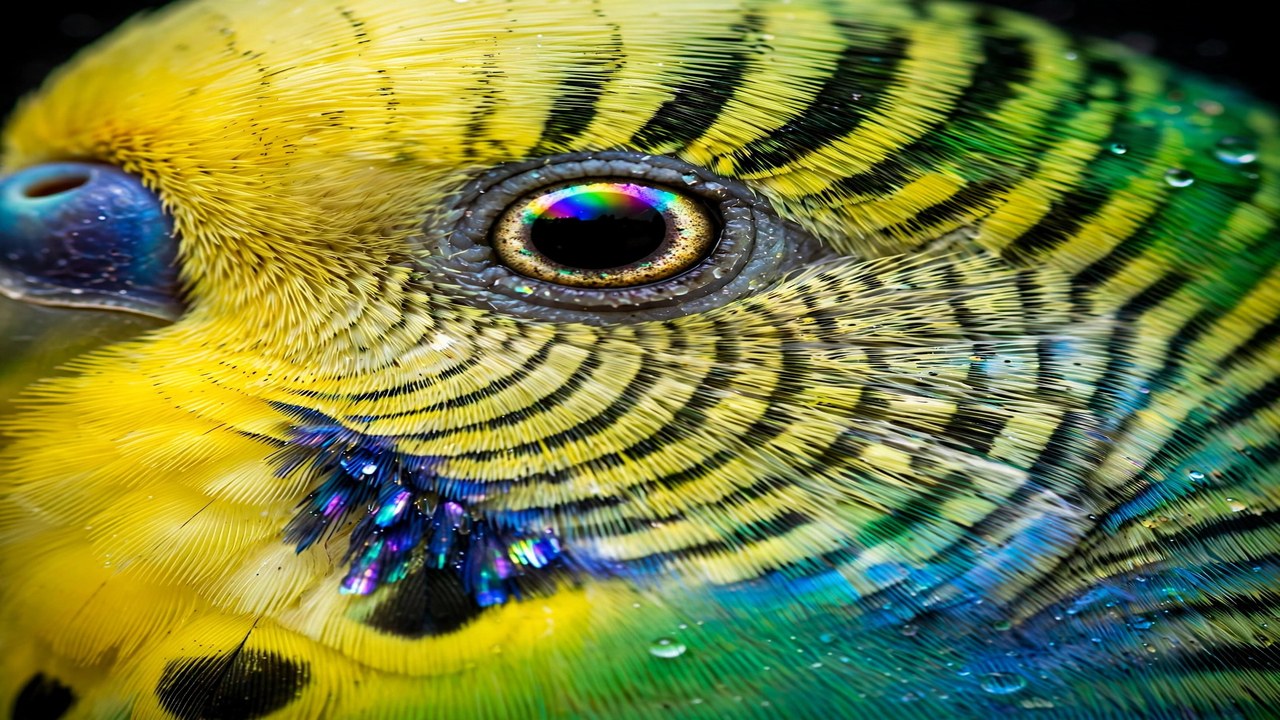

You look at your budgie and see a pretty green-and-yellow bird. Your budgie looks at the world and sees something you literally cannot imagine — hidden colors, flickering lights and details your human senses completely miss. Budgies experience a richer sensory world than we do in several surprising ways.
Here are 8 mind-blowing senses your budgie has that you don’t.
8 Budgie Senses That Put Humans to Shame
1. It Sees Ultraviolet Colors Invisible to You
Humans have three color channels (red, green, blue). Budgies have four — including ultraviolet. Their feathers carry UV-reflective patches that are invisible to us but glow brightly to other budgies. Scientists believe budgies use these hidden patterns to judge a mate’s health and attractiveness. When your budgie stares at another bird, it’s seeing a light show you can’t.
2. It Sees Your Lights Flickering
Budgies process visual information far faster than humans — their flicker-fusion rate is well above ours. That means cheap fluorescent or LED bulbs that look steady to you can appear to strobe painfully to your bird. If your budgie seems restless under certain lights, this could be why. Calm, high-quality lighting matters more to birds than most owners realize.
3. It Has Nearly Panoramic Vision
With eyes set on the sides of its head, a budgie sees almost 300 degrees around itself without turning — a legacy of being a prey animal that needed to spot hawks from any direction. The trade-off is a small blind spot directly behind and limited binocular vision in front, which is why budgies tilt their heads to look at things closely.
4. It Hears Tiny Sound Details You Miss
Budgies are exquisitely tuned to rapid changes in sound — far better than humans at detecting quick shifts in pitch and rhythm. This is how they follow lightning-fast flock chatter in the wild. It’s also why they can pick up the rhythm of human speech and eventually mimic it. Your budgie isn’t just hearing you; it’s analyzing your voice like a sound engineer.
5. Its Beak Works Like Sensitive Fingertips
A budgie’s beak is packed with nerve endings. It explores the world the way you use your hands — testing textures, judging ripeness, feeling your finger’s warmth. That gentle nibbling isn’t biting; it’s your bird literally “touching” you to learn who you are.
6. It Recognizes Your Face and Voice
Budgies can tell individual humans apart — by sight and by sound. Studies on parrots show they remember specific people, associate them with past experiences, and react differently to familiar versus unfamiliar voices. Your budgie doesn’t just see “a human.” It sees you.
7. It Tastes Food With Only ~350 Taste Buds
Humans have around 10,000 taste buds; budgies have roughly 350. Yet they still show clear preferences — most love sweet flavors and millet, and many enjoy a bit of salt. Their simpler palate is tuned for survival: detect energy-rich food fast, without overthinking it.
8. It Reads Your Mood Through Body Language
Budgies are masters at reading posture, movement speed and tone of voice. Move calmly and speak softly, and your bird relaxes. Move fast and loud, and it tenses instantly. Owners often think their budgie “just knows” when they’re upset — in a way, it does, because it’s reading signals you’re not even aware you’re sending.
What This Means For You as an Owner
- Lighting matters: Avoid flickering cheap bulbs near the cage; natural daylight or quality full-spectrum lighting is best.
- Your voice is a tool: Talk to your budgie often — it’s wired to analyze and eventually imitate human speech patterns.
- Move like you mean calm: Slow, predictable movements tell your bird’s senses “safe.” Fast hands say “predator.”
- Enrichment is sensory: Colorful toys, varied textures and gentle sounds aren’t luxuries — they feed senses far sharper than yours.
Frequently Asked Questions
Can budgies see in the dark?
Not well. Budgies are diurnal — active by day — and their night vision is poor compared to nocturnal birds like owls. Always leave a dim night light near the cage so a startled bird doesn’t injure itself thrashing in total darkness.
Why does my budgie tilt its head to look at me?
Because of its wide-set eyes, a budgie has limited binocular (3D) vision straight ahead. Tilting the head brings one eye into better position to focus on you — it’s the bird equivalent of squinting for a closer look.
Do budgies have a sense of smell?
A very weak one. Like most birds, budgies rely overwhelmingly on sight and hearing. Strong smells (perfume, smoke, non-stick pan fumes) can still harm their sensitive respiratory systems, so keep the air clean.
Can my budgie really recognize me specifically?
Yes. Parrots, including budgies, can distinguish between individual humans by face and voice, and they remember how each person has treated them. That’s why trust-building with one person doesn’t automatically transfer to a stranger.
Note: Sensory abilities vary slightly between individual birds. If your budgie seems disoriented, unresponsive to sound or light, consult an avian veterinarian.
