
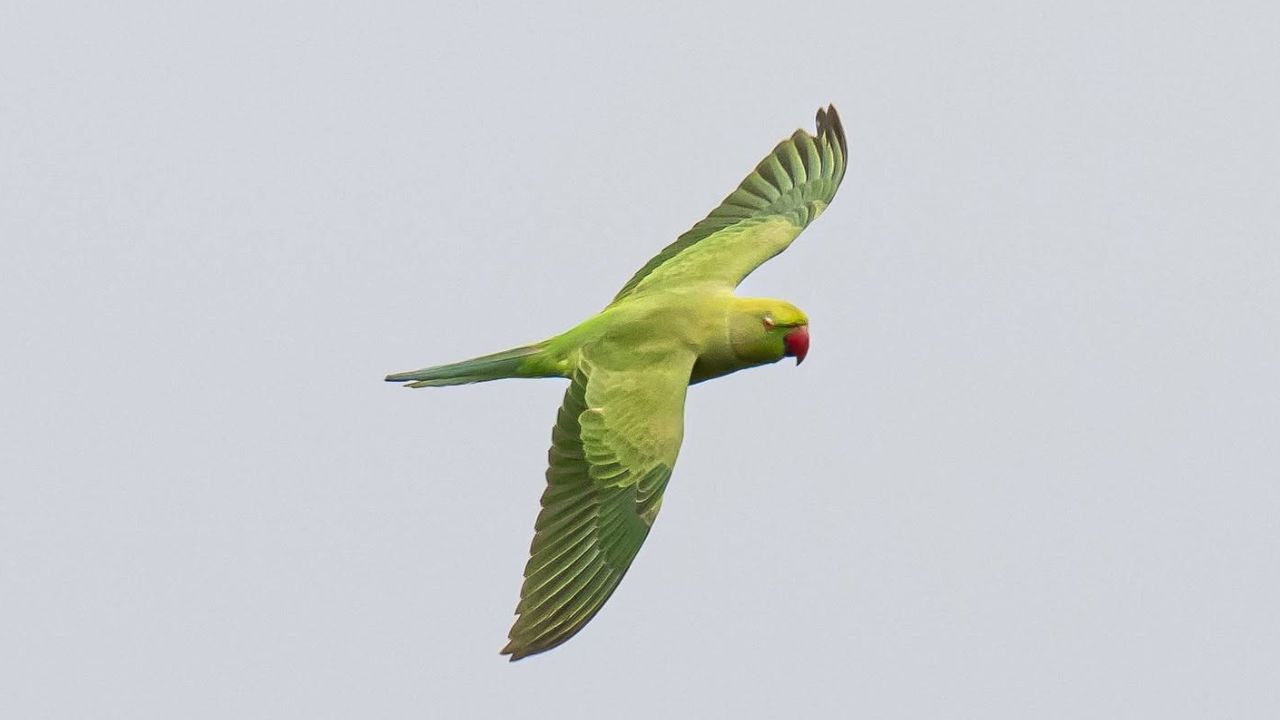

Neil has kept, bred, and sold cage and aviary birds at Paradise Pets Swindon since 1988 — over 35 years watching the UK’s relationship with parrots, both kept and wild. Few birds divide opinion as sharply as the ring-necked parakeet, now a familiar sight across much of southern England and spreading further north every year. This is an honest look at what the evidence actually says — and what it does not.
I get asked about these birds more than almost any other species that is not actually sold in the shop. People see a flash of bright green in a London park, or increasingly now in Manchester or Newcastle, and they want to know two things. What is it? And should I be worried about it?
The honest answer to the second question is: it depends who you ask, and the evidence is genuinely more mixed than either the alarmed headlines or the dismissive ones would have you believe.
The ring-necked parakeet — also called the rose-ringed parakeet — is the UK’s only naturalised parrot. It has gone from a small population of escaped pets in the 1970s to one of the most visible and most discussed birds in the country, and the question of whether it represents a real ecological problem or whether it has been unfairly singled out is a live, unresolved debate among the people who study these things for a living.
I want to lay out both sides properly, because I think this is one of those topics where the honest answer is more interesting than a simple verdict either way.
How They Got Here — And How Fast They Have Spread
The ring-necked parakeet became established in the wild in the UK in the 1970s, after captive birds escaped or were released. The exact origin story has become something of UK folklore — competing legends involve Jimi Hendrix releasing a pair in London, or birds escaping from film sets — but the more credible explanation is simply repeated small-scale escapes and releases from the pet trade over a period of years, eventually building to a self-sustaining wild population.
What is not in dispute is the rate of growth since then. The species’ population increased by approximately 2,500% between 1994 and 2023, and other analyses using BTO Bird Trends data put the increase at a staggering 16,768% between 1995 and 2022. The most recent verified estimate from 2016 put the population at around 12,000 breeding pairs, though more recent figures are harder to pin down with confidence — the species has expanded faster than survey efforts have been able to comprehensively track.
The population remains heavily concentrated in south-east England, with the RSPB estimating that around 90 per cent of the UK’s wild parakeets live in the London area. But the species is no longer confined there. Established populations are now reported in Manchester and Newcastle, and birds are regularly seen well beyond their traditional southern stronghold — a pattern of geographic spread that shows no obvious sign of slowing.

The Case That They Are a Genuine Problem
The concern from conservation organisations centres on a specific and plausible mechanism: competition with native cavity-nesting birds for limited nest holes.
Ring-necked parakeets nest in cavities — holes in trees, the kind of sites also used by woodpeckers, starlings, owls, and nuthatches, several of which are themselves species of conservation concern in the UK. Parakeets are larger and, by most accounts, more assertive in competing for these sites than many of the native species they compete with. The concern from scientists is that as parakeet numbers continue to grow, this competitive pressure on a genuinely limited resource — suitable nest cavities — could begin to produce measurable declines in native cavity-nesting species.
There is also a documented precedent elsewhere in Europe. In Belgium, increasing parakeet abundance has had a measurable negative effect on nuthatch populations through competition for nest sites. That outcome has not been replicated in UK studies to date — but the Belgian case is cited by UK researchers as evidence that the mechanism is real and capable of producing population-level harm under the right conditions, even if it has not yet done so here.
Beyond nest competition, several other concerns are raised consistently. Their loud, distinctive calls are increasingly drowning out the songs of native species in some areas, altering the acoustic character of parks and woodlands. They have been observed chasing other birds away from garden feeders, competing directly for food resources. Ring-necked parakeets are known to carry chlamydiosis and other diseases that could potentially transfer to native species, and there is at least anecdotal evidence of direct aggression toward other birds in some circumstances. There have also been reports of nesting material causing problems when it becomes wet inside electrical infrastructure, though this is a more minor and localised concern than the ecological competition question.
Officials have, at points, gone as far as considering targeted culling in newly colonised areas — on the logic that the largest existing populations are now too well-established to meaningfully control, but that intervention before a population becomes established elsewhere might be more effective and less costly than managing an entrenched population later.

The Case That the Concern Is Overstated
Set against all of this is a body of more cautious, evidence-focused opinion that argues the alarm has, so far, outpaced the data.
The RSPB’s own position is notably measured. Its assessment states plainly that there is currently no evidence that parakeets are causing problems for native woodland birds, while acknowledging that this could change as the population continues to grow. That is a meaningfully different statement from a confirmed finding of harm — it is an acknowledgement of theoretical risk alongside an honest admission that the risk has not yet materialised in any way researchers have been able to measure.
The formal UK threshold for classifying a non-native species as invasive requires demonstrated evidence that the species is driving biodiversity loss or has significant economic impact. Ring-necked parakeets are not currently classified as invasive in the UK under this standard, despite the dramatic population growth, precisely because that evidentiary bar has not been met. Researchers note that only around 10 to 15 per cent of introduced species ever go on to meet the criteria for invasive classification — most simply establish and coexist without producing measurable ecological harm.
There is also a fair observation that much of the concern is somewhat speculative by necessity, simply because dedicated research into the species’ UK ecological impact has lagged behind its population growth. Scientists themselves are calling for more comprehensive research precisely because the current evidence base is too thin to draw firm conclusions either way. That is a genuinely different position from concluding that the birds are definitely causing harm — it is closer to saying that nobody has looked closely enough yet to know for certain.
And there is the simple observation, made by more than one writer on this topic, that the parakeet is also a strikingly beautiful, charismatic animal that has become genuinely popular with large numbers of ordinary people who enjoy seeing it in their gardens and local parks — which complicates any simple narrative of unambiguous ecological villain.

Why the Disagreement Persists
Both sides of this debate are, in an important sense, correct about what they are each measuring.
The case for concern rests on a real, mechanistically plausible competitive pressure — nest cavity competition is a genuine biological phenomenon, not a hypothetical one, and it has caused measurable harm to native species in at least one other European country. The case for caution rests on the fact that, despite that plausible mechanism, no UK-specific study has yet demonstrated the predicted harm actually occurring here at a population level.
This is a situation that comes up surprisingly often in conservation science: a non-native species establishes successfully, a plausible harm mechanism exists and has caused damage elsewhere, but the actual UK evidence for harm remains, for now, inconclusive. Reasonable scientists looking at the identical body of evidence reach different emphases — some weighting the plausible mechanism and precedent more heavily, some weighting the absence of confirmed UK harm more heavily.
What nearly everyone studying the issue agrees on is that more dedicated research is needed, and that the question is worth continuing to monitor closely as the population keeps growing and keeps spreading into new parts of the country. A bird that is currently a non-issue in, say, Newcastle could become a different proposition in a decade if the population there grows the way it has in London.

What I Tell People at the Counter
When someone asks me directly whether the parakeets are a problem, I tend to resist giving a simple yes or no, because I do not think the honest evidence supports one.
What I tell people is this: there is a real, biologically sound reason to be concerned about what continued unchecked growth of this population could eventually do to some of our native cavity-nesting birds, several of which are already under pressure from other causes. That concern is not invented or exaggerated by anti-parakeet sentiment — it is shared by serious conservation scientists who study this for a living.
At the same time, the actual UK evidence for measurable harm having already happened is thinner than the more dramatic headlines sometimes suggest. The RSPB’s own measured position — concerned about the trajectory, honest about the current absence of confirmed harm — strikes me as about the right level of calibration for where the science currently sits.
I do not think either dismissing the concern entirely or treating the birds as a confirmed ecological disaster is well supported by what is actually known right now. The honest position is watchful attention, continued research, and an open mind about how this particular story develops over the coming years.
Come in if you want to talk about parakeets, or any other bird, native or otherwise. We are at Manor Garden Centre, Cheney Manor Industrial Estate, Swindon, SN2 2QJ — open every day. Or call us on 01793 512400.

- “They’re officially classed as an invasive species so the damage is confirmed” — Ring-necked parakeets are not currently classified as an invasive species under the formal UK criteria, which require demonstrated evidence of biodiversity loss. They are widely regarded as one of the most invasive species globally based on their pattern of establishment elsewhere — a different and less definitive statement than confirmed UK-specific harm.
- “The RSPB has confirmed they’re harming native birds” — The RSPB’s own published position states there is currently no evidence that parakeets are causing problems for native woodland birds in the UK, while noting this could change. That is a notably more cautious position than is often implied in casual discussion of the topic.
- “They’re a London problem, not relevant anywhere else” — While around 90 per cent of the UK population remains concentrated in London, established breeding populations now exist in Manchester and Newcastle, and the species continues to spread. The geographic picture is changing, not static.
- “Since nothing has happened yet, nothing will happen” — The absence of confirmed harm to date does not guarantee the absence of future harm, particularly as the population continues its documented pattern of rapid growth. Scientists are explicitly calling for continued monitoring precisely because the trajectory, not just the current snapshot, is what matters for this question.
- “They’re just an exotic pet that escaped — they’re basically harmless” — The origin of the population as escaped or released pets does not determine whether the resulting wild population poses an ecological risk. Origin and ecological impact are separate questions. The plausible competitive mechanism with native cavity-nesters exists regardless of how the population originally established itself.
Visit Us at Paradise Pets Swindon
We stock a full range of cage and aviary birds — all properly sourced and kept, with no wild-caught or feral-population birds. If you have a question about parrots, parakeets, or any other bird, come in and talk to us.
We also stock gerbils and hamsters, guinea pigs, and rabbits.