
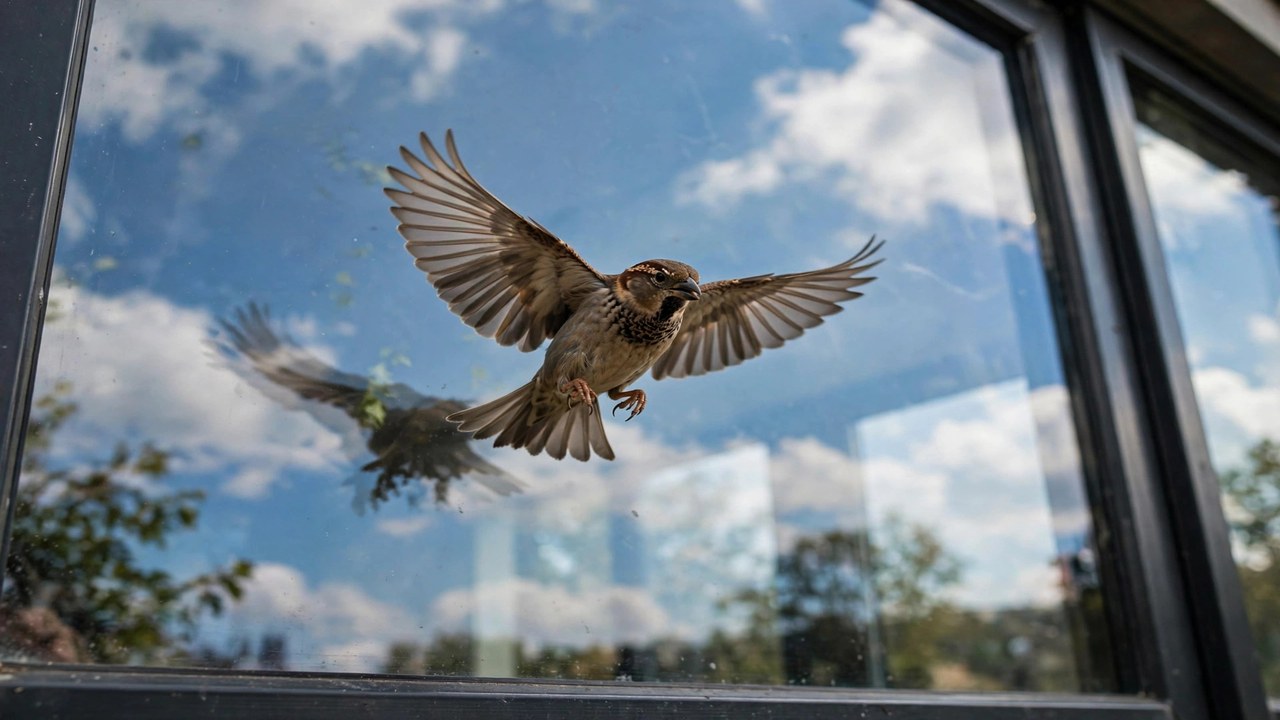

Every year, an estimated hundreds of millions of birds die colliding with glass in North America alone — making windows one of the largest human-caused killers of birds on the planet, second only to domestic cats. Most victims die instantly of brain trauma; others fly off dazed, only to die later of internal injuries.
But why can’t birds — creatures with some of the sharpest vision in nature — see something as obvious as a window?
The Simple Answer: Glass Is Invisible by Design
Windows defeat bird vision through two illusions:
1. Reflection — The Mirror Trap
Glass reflects the sky, clouds and nearby trees with near-perfect fidelity. To a bird flying at speed, a reflective window doesn’t look like a barrier — it looks like open sky and habitat continuing. The bird isn’t being stupid; it’s being fooled by a perfect illusion.
2. Transparency — The See-Through Trap
When you can see through a house — a window on one side, another on the other — birds perceive a clear flight path straight through the building. Corner windows and glass walkways are the deadliest designs for exactly this reason.
Why Bird Eyes Can’t Solve This
Birds actually see better than humans in many ways — wider field of view, ultraviolet sensitivity, faster motion detection. But none of that helps with glass, because the problem isn’t visual acuity. A bird’s brain is wired to interpret “looks like sky” as “is sky.” Evolution never prepared any animal for a perfectly transparent solid barrier — glass has existed for a blink in evolutionary time.
Speed makes it worse. A bird in flight focuses ahead on its destination, not on subtle cues inches from its face. By the time glass is close enough to detect, it’s too late to stop.
Which Birds Are Most at Risk?
- Migrating songbirds — unfamiliar with local buildings, flying at night toward lit windows.
- Hummingbirds and small songbirds — less mass means less ability to survive impact.
- Territorial birds in breeding season — some birds attack their own reflection for hours, injuring themselves repeatedly.
- Any bird near feeders — feeders placed close to windows concentrate flight paths into glass.
How to Stop It: What Actually Works
Good news: this is one of the most solvable conservation problems. The key principle — break up the reflection with patterns on the outside of the glass, spaced no more than 5–10 cm (2–4 inches) apart:
- UV-reflective decals: Nearly invisible to humans, highly visible to birds (they see ultraviolet). The most aesthetic solution.
- External screens or netting: Placed a few inches from the glass, these both break reflections and cushion impact.
- Tempera paint patterns: Cheap, effective, washable — dots or stripes on the outside surface.
- Close blinds/curtains: Reduces transparency illusion, though less effective alone.
- Turn off lights at night during migration seasons — lit windows are beacons for night migrants.
- Move feeders: Either very close (under 1 meter — birds can’t build speed) or far (over 10 meters) from windows.
What doesn’t work: a single hawk silhouette decal. Birds quickly learn it isn’t real, and one decal leaves 95% of the glass looking like open sky.
Frequently Asked Questions
I found a bird that hit my window and it’s still alive. What do I do?
Place it gently in a dark, ventilated box in a quiet warm place and leave it alone for 1–2 hours — no food, no water, no handling. Many birds recover from the concussion. If it can’t fly after that, or you see bleeding or a drooping wing, contact a wildlife rehabilitator.
Do window collisions really kill that many birds?
Yes. Peer-reviewed estimates for the US and Canada range from hundreds of millions to around a billion birds per year. It’s one of the best-documented human impacts on bird populations.
Why does my pet bird fly into windows indoors?
Same illusion, smaller scale. Pet birds — especially newly flighted ones — don’t recognize indoor glass either. Use the same fixes: decals, curtains, or screens on large indoor windows and mirrors.
Are some windows worse than others?
Yes — large picture windows, corner windows, glass railings and windows reflecting vegetation are the deadliest. Ground-floor and second-story windows cause the most collisions.
