
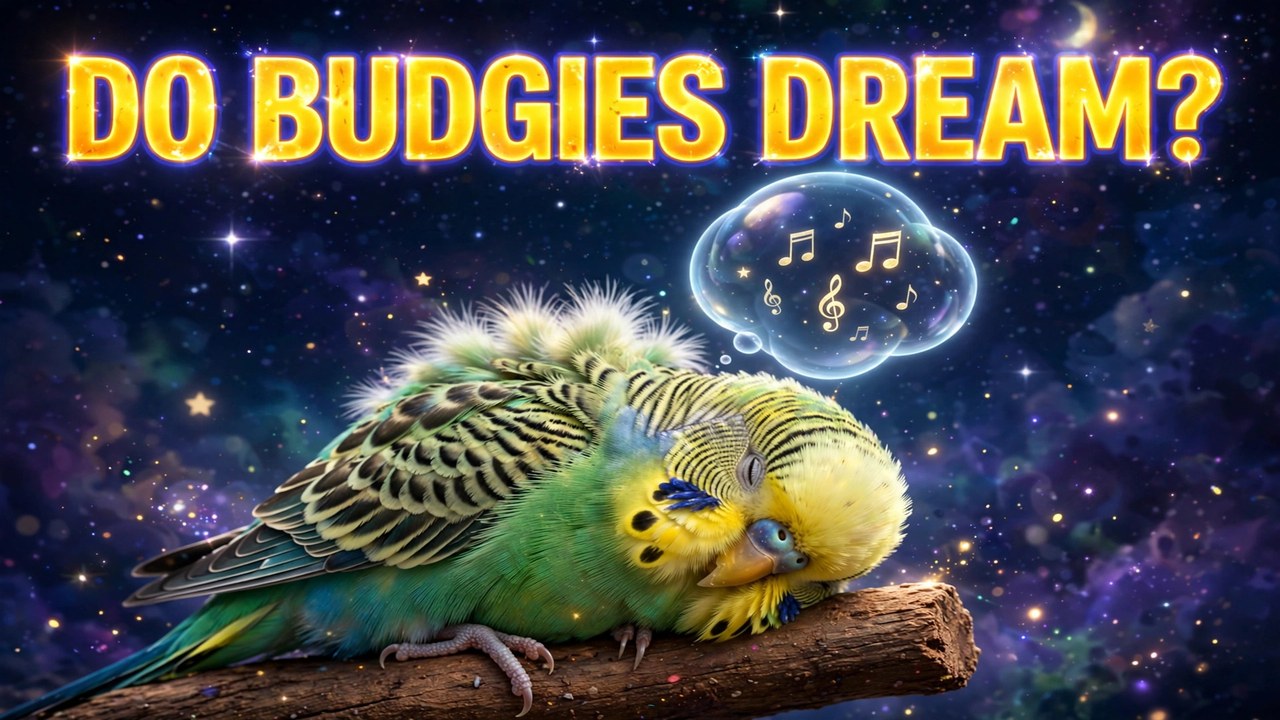

Watch a sleeping budgie closely and you’ll notice something strange: its eyes flicker beneath closed lids, its beak makes tiny silent movements, and sometimes its whole body twitches — as if it’s living through something vivid. It looks exactly like dreaming. But is it?
For a long time, scientists assumed dreaming was a mammal-only phenomenon. Then they started wiring up bird brains — and what they found changed everything we thought we knew about the sleeping minds of birds.
What the Science Actually Says
To answer whether budgies dream, researchers first had to answer a simpler question: do birds experience the same kinds of sleep that dreaming happens in? The answer turned out to be yes — with a fascinating twist.
1. Birds Have REM Sleep — Just Like You Do
Using EEG electrodes, scientists have confirmed that birds cycle between slow-wave sleep (SWS) and REM sleep, the stage where most vivid human dreaming occurs. During avian REM, birds show rapid eye movements, reduced muscle tone and irregular breathing — the same physiological signatures seen in dreaming mammals.
There’s one big difference: a bird’s sleep cycles are extremely short. Where a human REM period lasts 20–30 minutes, a bird’s may last under a minute, cycling rapidly between deep and light sleep all night. Your budgie isn’t having one long dream — it’s having dozens of micro-dreams.
2. Sleeping Birds Replay Their Songs — Possibly “Dreaming” Them
The most stunning evidence comes from songbird research. In landmark studies on zebra finches, neuroscientists recorded the brains of sleeping birds and found that neurons controlling song production fired in the same patterns as daytime singing — the birds were neurologically “rehearsing” their songs while asleep.
Budgies are parrots, not finches, but they share the same specialized vocal-learning brain circuitry. When your budgie’s beak moves silently in sleep, it may literally be practicing its chirps and whistles in a dream. Researchers cautiously describe this as the closest thing to dreaming ever measured in a non-mammal.
3. Half the Brain Can Sleep While the Other Half Stays Awake
Birds possess a superpower mammals lack: unihemispheric slow-wave sleep. A budgie can put one half of its brain to sleep while the other half stays alert — one eye open, literally watching for predators. In the wild, this let flock members take turns sleeping while others stood guard.
Your pet budgie rarely needs this anymore, but the ability is still wired in. If you see your bird dozing with one eye cracked open, it’s running its ancient security system.
4. We Can’t Prove Subjective Experience — But the Evidence Points One Way
Here’s the honest scientific caveat: no experiment can prove what a dream feels like from the inside, in a bird or even another human. What we can say is that budgies have every neurological ingredient of dreaming — REM sleep, memory replay during sleep, and sleep-dependent learning. The simplest explanation is that yes, in some form, budgies dream.
How Budgies Actually Sleep
Understanding the mechanics helps you read your bird’s nights:
- 10–12 hours needed: Budgies are equatorial birds, evolved for roughly 12-hour nights. Anything less leads to hormonal stress, crankiness and even chronic egg-laying in females.
- The one-legged tuck: Sleeping on one leg with the head turned and tucked into back feathers is the classic healthy sleep posture. The tucked leg stays warm inside the belly feathers.
- Light sleepers by design: As prey animals, budgies sleep lightly and wake easily. This is normal — not a sign of anxiety.
- Night frights: Budgies are prone to sudden nighttime panic — thrashing around the cage after being startled by a shadow, sound or vibration. A dim night light near the cage dramatically reduces these episodes and prevents injury.
What Might Your Budgie Be Dreaming About?
If sleep replay works in budgies the way it does in studied songbirds, their dreams are probably replays of the day’s most intense experiences: the millet spray they loved, the whistle they’re learning, the flock-mate they played with, or — less pleasantly — the hand that scared them. This is one more reason daytime experiences matter: a good day makes for good dreams.
How to Give Your Budgie Great Sleep
- Cover the cage at the same time every evening — darkness is the sleep signal.
- Keep it quiet: Move the cage away from TVs and late-night activity, or use a separate sleep cage in a quiet room.
- Use a dim night light: Prevents night-fright injuries without disrupting sleep.
- Maintain the routine: Same bedtime daily. Budgies thrive on predictable rhythms.
- Watch the temperature: Avoid cold drafts at night; a chilly bird sleeps poorly.
Frequently Asked Questions
Why does my budgie twitch in its sleep?
Totally normal. Twitching, beak movements and eye flickers correspond to REM sleep — the dreaming stage. It’s the avian equivalent of a dog “chasing rabbits” in its sleep.
Should I wake a budgie that seems to be having a nightmare?
No. Night frights look dramatic — thrashing, screaming — but the kindest response is to turn on a dim light, speak softly, and let the bird settle. Grabbing a panicked bird risks injury to you both.
How do I know if my budgie is getting enough sleep?
Well-rested budgies are active, vocal and playful by day. Chronically tired birds get cranky, bitey, puffy and may develop behavioral or hormonal problems. If your bird naps excessively during the day, its nights are probably too short or too disturbed.
Can budgies sleep with lights on?
They can doze, but they can’t get proper restorative sleep. Constant light disrupts their circadian rhythm and is linked to stress behaviors and reproductive issues. Darkness matters.
Note: Sleep research cited here comes from peer-reviewed studies on avian sleep (zebra finch song replay, pigeon REM studies). Individual birds vary — persistent sleep disturbances warrant an avian vet visit.
