

Neil has run Paradise Pets Swindon since 1988 — over 35 years of selling budgies, advising on their care, and visiting the homes of owners who wanted help. In that time he has seen the same mistake more times than he can count. This article is about that mistake — what it is, why it matters more than owners realise, and how to fix it.
In 35 years of running a pet shop, I have been into a lot of people’s homes. Not formally — just the occasional invitation from a regular customer who wanted me to look at a setup, or who had a bird that was not quite right and wanted an experienced eye on the environment. I have also had thousands of conversations at the counter with people who describe their setup in enough detail that I get a very clear picture.
And across all of those homes, all of those conversations, all of those years — there is one thing I see wrong more than anything else. More than cages that are too small. More than the wrong perches. More than drafts and non-stick pans and all the other things that get talked about.
It is the diet.
Specifically: almost every budgie in the UK is living on seed alone. A bowl of seed mix, topped up when it gets low, day after day after day, for the entire life of the bird. The seed is the diet. The seed is all there is.
And this single fact — more than anything else I can identify — accounts for the majority of health problems I see in UK budgies, for shortened lifespans, for birds that look dull and listless, for the gradual decline that owners attribute to “just getting old” when the bird is four years old.
Why Seed Alone Is Not a Diet
Let me be specific about this — because when I tell owners their budgie’s diet is wrong, the response is almost always the same. “But it is eating. It loves the seed. It has been fine on it for years.”
All of those things can be true. And the problem still exists.
Seed is not nutritionally complete for a budgie. It never was. The idea that a bowl of seed mix is adequate budgie nutrition is one of the most persistent and damaging myths in UK pet keeping, and it has been perpetuated for decades by exactly the kind of advice that gets passed on at the point of sale — a bag of seed mix handed over with the bird, no further conversation required.
Here is what seed-only actually provides:
- High fat — seed is energy-dense and relatively high in fat, particularly sunflower seeds and millet. This is not inherently harmful in appropriate amounts as part of a varied diet. As the entire diet, it produces fatty liver disease over time — one of the most common conditions I see in budgies over three years old.
- Some protein — but not in a complete amino acid profile. The proteins available from a standard seed mix are not sufficient for long-term optimal health.
- Almost no Vitamin A — one of the most critical deficiencies in seed-fed budgies. Vitamin A is essential for immune function, skin health, respiratory health, and eye health. A budgie on a seed-only diet typically becomes deficient over time, and the results show up as chronic respiratory problems, feather quality issues, and susceptibility to infections.
- Very little calcium — unless cuttlebone is provided separately (which many owners do not provide). Calcium deficiency affects bone health, egg production in females, and nerve function.
- No iodine — leading to thyroid problems including goitre, which causes breathing difficulties and is almost exclusively a condition of seed-fed birds.
The bird eats it. The bird appears to function on it. The bird is not fine on it — it is slowly developing the deficiencies that will express themselves as illness over the following months and years. By the time the illness is visible, the deficiency has been building for a long time.
Why This Happened — And Why It Persists
I want to explain how we got here, because it helps owners understand why the advice they were given was not malicious — it was simply outdated.
The budgerigar was first kept as a pet in England in the 1840s. For the vast majority of that history, the understanding of avian nutrition was limited. Seed was what birds ate in the wild. Seed was what was available and convenient. Seed kept birds alive, which was taken as sufficient evidence that seed was adequate.
It was not until the later decades of the twentieth century that avian veterinary science developed a sophisticated enough understanding of bird nutrition to identify the specific deficiencies that a seed-only diet produces — and even then, this knowledge took time to filter through to general pet-keeping culture.
The problem today is that the advice given to buyers of budgies has not fully updated to reflect what we now know. The seed-mix bag is still the default. The instructions on the bag do not say “this should form only part of the diet.” The person selling the bird in many shops does not explain that fresh food is not optional. The loop of incorrect advice continues.
What A Proper Budgie Diet Actually Looks Like
This is the practical part, and I want to be clear about it — because the fix is not complicated. It does not require specialist food or expensive supplements. It requires fresh vegetables, offered consistently, alongside a good quality seed mix.
The Base — Seed or Pellets
A good quality seed mix is fine as the foundation of the diet — it provides energy and some nutrients, and most budgies enjoy it. A pellet-based diet is arguably nutritionally superior to seed as a base, as pellets are formulated to be complete rather than relying on variety. Some birds accept pellets readily; others refuse them entirely and need to be transitioned very gradually.
The key word in both cases is base. It is the foundation, not the whole building.
Fresh Vegetables — Every Single Day
This is the piece that is missing from almost every UK budgie diet I see, and it is the piece that makes the most difference.
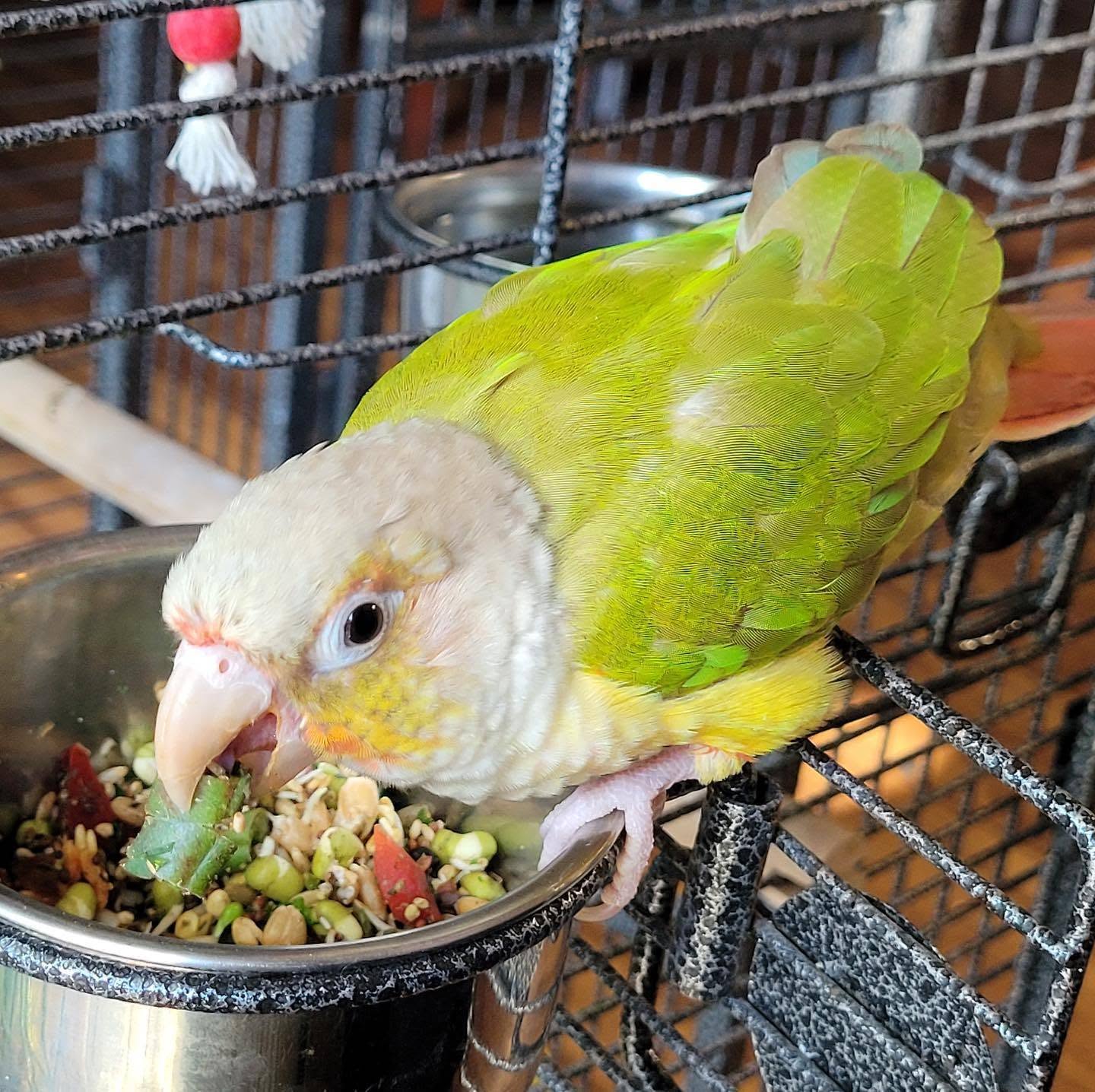
Fresh leafy greens and vegetables are what provide the vitamins and minerals that seed alone cannot. Vitamin A, Vitamin C, calcium, iron, folate — all of these come from fresh food in forms that are bioavailable and easily metabolised.
- Leafy greens — romaine lettuce, kale, watercress, spinach (in moderation), dandelion leaves, broccoli florets
- Vegetables — carrot, courgette, cucumber, peas, sweetcorn, red and yellow bell pepper (particularly rich in Vitamin A and C)
- Herbs — basil, coriander, dill — many budgies enjoy fresh herbs and they add nutritional variety
- Fruit — in small amounts; apple (no seeds), mango, melon, berries — sweet and palatable, which helps introduce reluctant birds to fresh food
Cuttlebone — The Simplest Addition and the Most Neglected
A cuttlebone clipped to the side of the cage costs almost nothing and lasts for weeks. It provides calcium, magnesium, and other minerals. It supports beak health. It is the most straightforward addition any budgie owner can make — and yet a significant proportion of the birds I see have no cuttlebone in their cage at all.
If you do one thing today based on reading this article, clip a cuttlebone to the cage. It is that simple.
The Biggest Obstacle — My Bird Will Not Eat Vegetables
This is what I hear from almost every owner when I explain what a proper diet looks like. And I understand why — because it is true, initially, for most birds that have been on a seed-only diet.
A budgie that has eaten nothing but seed for months or years has learned what food looks, smells, and tastes like. Anything that does not fit that template is not food, as far as the bird is concerned. New things are approached with suspicion at best, ignored entirely at worst.
This does not mean the bird will never accept fresh food. It means the introduction requires patience and the right approach.
- Start with something that looks like food it already knows. Millet spray is seed. A budgie that likes millet will investigate things near the millet. Tie a small piece of fresh food near the millet spray in the cage. Proximity to something familiar reduces the alarm of the unfamiliar.
- Use the eating-together response. If you have a tame bird, eat something yourself near the cage — or pretend to eat a piece of broccoli with obvious enthusiasm in front of the bird. Budgies are flock animals and they respond to seeing others eat something as a signal that it is safe. This sounds slightly absurd but it works reliably.
- Offer the same thing, repeatedly, for weeks. Put a small piece of carrot in the cage every day for three weeks, remove it after a few hours, and repeat the next day. Many birds that ignored it completely for the first two weeks will investigate and eventually eat it in week three or four. Consistency matters more than variety at this stage.
- Offer fresh food before seed in the morning. A bird that has been without food overnight is slightly more motivated to investigate something new. Offer the fresh food first thing, allow an hour, then provide the seed. This does not deprive the bird — it creates a moment of greater openness to new food.
- Wet the greens slightly. Many budgies that ignore dry leaves will investigate damp ones — partly because of the moisture, partly because damp leaves move and catch the light differently. Rinse the leaves and leave them slightly wet before offering.
The introduction takes weeks, sometimes months. This is normal and it does not mean your bird is abnormally fussy. It means you are dealing with a bird that learned very early what food is, and you are asking it to expand that definition. It will, given enough patient persistence.
What Changes When The Diet Is Right
I want to give you a picture of what actually happens when a bird that has been on a seed-only diet is moved onto a proper varied diet — because the difference is more visible than most owners expect.
- Feather quality improves visibly. A budgie on a varied diet grows better feathers at the next moult — smoother, more lustrous, better structured. The improvement is often commented on by owners before I even ask about it.
- Energy and activity increase. Many owners describe their bird as “coming alive” in the weeks after diet improvement begins. What looked like a settled, calm bird often turns out to have been a slightly lethargic one — and the difference becomes apparent only by contrast.
- The immune system improves. Fewer respiratory infections, faster recovery from minor health challenges, better overall resilience. These are the results of adequate Vitamin A and a fully nutritional diet rather than a deficient one.
- Beak and nail condition improves. Proper mineral intake from a varied diet and cuttlebone shows up in beak and nail quality over the following months.
- The bird lives longer. This is the bottom line. Well-nourished budgies live longer than seed-only budgies, on average, often significantly. The difference between a bird that lives five years and one that lives nine is frequently a diet question.
The Specific Deficiencies — What To Watch For In A Seed-Only Bird
If your budgie has been on a seed-only diet for an extended period, here are the specific problems that may already be developing — some of which are visible, some of which are not.
| Deficiency | What it causes | Early signs |
|---|---|---|
| Vitamin A | Immune suppression, respiratory vulnerability, skin and feather problems, eye issues | Frequent respiratory infections, dull feathers, discharge around nostrils or eyes |
| Iodine | Thyroid enlargement (goitre) causing breathing difficulties | Wheezing, squeaking sound when breathing, stretching neck movements |
| Calcium | Bone weakness, egg binding in females, nerve and muscle problems | Excessive beak and nail overgrowth, egg-laying problems, tremors |
| Complete protein | Poor muscle condition, slow recovery from illness or moult | Slow moult completion, bird looks thin or poorly muscled |
| Excess fat (from seed) | Fatty liver disease — very common in older seed-fed budgies | Lethargy, weight gain, breathing difficulty, sudden deterioration in older birds |
If any of those signs are present in your bird right now, alongside a seed-only diet — improve the diet and speak to an avian vet. Some of the conditions are manageable and reversible in earlier stages. All of them get worse, not better, without dietary change.
What To Do Today
If your budgie is on a seed-only diet, here is a simple starting point — nothing overwhelming, nothing requiring specialist knowledge.
- Today: Buy a cuttlebone and clip it to the cage. This costs almost nothing and starts the mineral supplementation immediately.
- This week: Offer a small piece of broccoli or a romaine lettuce leaf in the cage daily. Do not expect the bird to eat it immediately. Just start offering.
- This month: Try three or four different vegetables across the month, offering each for at least a week before concluding the bird will not eat it. Start with something green and leafy before moving to denser vegetables.
- Ongoing: Fresh food daily, not occasionally. Seed as a part of the diet, not the whole of it. Cuttlebone always present in the cage. That is the complete ongoing practice.
Frequently Asked Questions
Is seed completely bad for budgies?
No — seed is not bad. It is inadequate as the sole diet. A varied seed mix provides energy, some fat-soluble vitamins, and some protein. As part of a diet that also includes fresh vegetables, leafy greens, cuttlebone, and mineral supplementation, seed is a perfectly appropriate component. The problem is when seed is the entire diet rather than a component of it.
Should I switch to pellets instead of seed?
Pellets formulated specifically for budgies are nutritionally more complete than seed mixes and are recommended by many avian vets as the base diet. The challenge is that many seed-fed birds refuse pellets, particularly if introduced to them as adults. If you can transition your bird to a primarily pellet diet, the nutritional baseline improves significantly. If the bird refuses pellets entirely, a varied seed diet with daily fresh food and cuttlebone is the practical alternative.
My budgie has been on seed for ten years and seems fine — why change now?
Ten years on seed is unusual — the average lifespan of a seed-only budgie is shorter than a well-nourished one. But some birds are more genetically resilient than others. Regardless, “seems fine” is different from “is as well as it could be.” At ten years, adding fresh food and cuttlebone will support the immune system and general health in the remaining years. It is never too late to improve the diet.
How much fresh food should I offer daily?
A small amount — roughly the size of the bird’s head in terms of volume. Budgies are small animals and do not eat large quantities of anything. The goal is consistent daily exposure to a variety of foods, not a specific measured quantity. Offer it, leave it for a few hours, remove any that was not eaten before it wilts, and repeat the next day.
Where can I get advice on budgie diet and health in Swindon?
Come and see us at Paradise Pets, Manor Garden Centre, Cheney Manor, Swindon SN2 2QJ. Or ring us on 01793 512400. If you have a bird that has been on a seed-only diet for an extended period and is showing any health signs you are concerned about, an avian vet is the right first step. For dietary advice and practical introduction strategies, come in and we will talk it through.
One Last Thing From Me
A man came in about four years ago with a budgie that was approximately four years old. He had owned it since it was young. It had been on seed its entire life. The bird was quiet, slightly overweight for its frame, and its feathers had a dullness that I recognised immediately.
He came in because the bird was wheezing slightly. I suspected the start of goitre — iodine deficiency from years of seed-only feeding.
The vet confirmed it. But the prognosis was genuinely positive because the bird was only four, and the damage was early-stage. We started mineral supplementation, added a cuttlebone, and began the long process of introducing fresh food — which took about two months before the bird accepted anything reliably.
He rang me about eight months after that first visit. The wheezing was gone. The bird had had its first moult since the diet change and the new feathers were noticeably different — brighter, smoother, with a sheen it had not had before. It was also, by his account, significantly more active and vocal than it had been for the previous two years.
“I thought it was just getting old,” he said. “It was just hungry.”
That is the sentence that has stayed with me. Not sick. Not genetically unlucky. Not old before its time. Hungry. On a seed-only diet, eating every day, genuinely hungry for what its body actually needed.
If you have read this far, you now know something that genuinely changes what a budgie’s life looks like. Not a complicated change. Not an expensive one. Fresh vegetables, daily. Cuttlebone in the cage. Seed as part of the diet, not all of it.
That is the thing most budgie owners get wrong. And now you know how to get it right.
Questions About Your Budgie’s Diet or Health? Come And See Us
Diet advice, fresh food introduction, or concern about a bird that may have been on seed only for too long — come in or give us a ring. Free advice, no obligation. Over 35 years of budgie care expertise at the counter.