


Neil has sold and kept budgies at Paradise Pets Swindon since 1988 — over 35 years of watching how UK owners keep the country’s most popular cage bird. The UK now keeps over one million budgies — the most popular pet bird in Britain by a significant margin, according to PFMA 2026 data. New welfare research from the Avian Welfare Coalition published in 2024 found that 68 percent of cages sold online for budgies are below minimum welfare standards, and that over 50 percent of budgie health issues reported to vets are linked to poor cage conditions. This article is Neil’s honest response to those findings — what they confirm, what they miss, and what he has watched owners get wrong for thirty-five years.
A couple came in three weeks ago carrying a budgie in a cage that told the whole story before they said a word.
The cage was small — one of the ornamental dome-topped designs sold in most UK pet shops and on almost every high street. It had a mirror on one side, a single plastic perch down the middle, and a small seed dish. The budgie — a green male, about two years old — was sitting on the perch looking, to the untrained eye, like a budgie sitting on a perch.
To my eye, he looked like a bird that had been quietly struggling for some time. Feathers very slightly raised. Posture a degree less upright than a healthy bird. Not dramatically wrong — just not quite right.
“He’s been a bit quiet,” the woman said. “We thought maybe he was bored.”
He was not bored. He was unwell — a consequence of conditions that had been inadequate since they brought him home, two years earlier, from a pet shop that had sold him the cage alongside the bird and told them it was suitable.
The welfare research published in 2024 by the Avian Welfare Coalition — finding that 68 percent of cages sold online for budgies are below minimum welfare standards and that over half of budgie health problems reported to vets are linked to cage conditions — did not surprise me. It confirmed what I have been watching from this counter for thirty-five years. What it adds is the scale and the systematic evidence that the industry has lacked the honesty to acknowledge.
What the Research Actually Found — And What It Means
The Avian Welfare Coalition’s 2024 survey documented what welfare-focused bird keepers and avian vets have been observing in practice for decades. Its core findings deserve to be stated plainly before anything else.
Sixty-eight percent of cages sold online for budgies are below the minimum width standard of 60cm — the baseline recommended by the RSPCA and by welfare science for a bird that needs horizontal flight space, not just a perch to sit on. Only 31 percent of owners provide cages that meet even basic size standards. Over 50 percent of budgie health issues reported to vets are linked to poor cage conditions.
Those numbers represent a systemic welfare failure — not individual owner negligence, but a retail and cultural framework that has consistently undersold what budgies need and oversold what minimal provision provides.
The PFMA’s 2026 data confirms that the UK keeps over one million budgies — the most popular cage bird by a considerable margin. Over three million pet birds in total. The scale of what inadequate husbandry produces at population level, when the most popular bird is routinely housed in conditions below welfare standards, is significant.
What the research does not capture — because welfare surveys measure what is measurable, not what is subtle — is the chronic, low-level welfare deficit that I see most often. Not birds that are visibly ill. Birds that are quietly not thriving. Birds that are alive, that eat, that sit on their perch — and whose quality of life is significantly below what it could and should be.
- 68% of cages sold online for budgies are below the 60cm minimum width standard — Avian Welfare Coalition 2024
- Only 31% of owners provide cages meeting even basic size standards
- Over 50% of budgie health issues reported to vets are linked to poor cage conditions
- The UK keeps over one million budgies — the most popular cage bird in Britain per PFMA 2026 data
- The research documents measurable welfare failures — it does not capture the chronic, low-level welfare deficit that presents as a bird that is alive but not thriving
What Owners Most Consistently Get Wrong — From 35 Years
The research findings map closely onto what I see at the counter. But the list of what owners get wrong is longer than cage size alone — and some of the entries are less obvious than others.
Wrong 1: The Cage — The Most Documented and Most Persistent Failure
The cage size finding is the research’s headline number, and it deserves to be — because cage size is the single most impactful welfare factor in budgie husbandry and the one most consistently got wrong at point of sale.
A budgie is a flying bird. Not a perching bird. Not a hopping bird. In the wild, budgerigars are one of the most nomadic species in Australia — they travel in large flocks across vast distances, flying continuously through the day. The cage is not a replacement for this. It cannot be. But it can either approximate the conditions that allow natural behaviour — flight, movement, genuine exercise — or it can prevent them entirely.
The cages most commonly sold alongside budgies in UK pet shops and online prevent genuine flight. They are designed for aesthetics, not welfare. The dome top reduces usable space. The single central perch provides one position. The width is insufficient for a bird to open its wings and move between perches in anything resembling flight. The bird hops. It does not fly. And a bird that cannot fly through the day is a bird whose physical and psychological health is compromised.
The RSPCA’s guidance requires a minimum cage width that allows at least two wing beats between perches. For most budgies, this means a minimum of 60cm width — and length matters more than height, because budgies fly horizontally. The 68 percent of cages below this standard that the 2024 research found are not borderline cases. Many are dramatically below the minimum.
- Minimum cage width for a budgie: 60cm — enough for at least two wing beats between perches
- Length matters more than height — budgies fly horizontally, not vertically
- Dome-top cages are welfare failures — the curved top reduces usable space and prevents flight in the upper portion of the cage
- Round cages are worse — they provide no straight flight line and disorient birds that navigate by straight perch-to-perch movement
- For a pair of budgies, the RSPCA recommends a width that is three times their combined wingspans — considerably larger than the standard retail cage
- Cage upgrades produce measurable welfare improvements quickly — the 2024 case study showed feather plucking stopping and vocalisation increasing within two weeks of moving a bird to a larger enclosure
Wrong 2: Keeping One Bird — The Welfare Problem Nobody Talks About
The 2024 research focused on cage size. The welfare issue I see causing more ongoing harm at the counter is the single-bird question — and it is the one that generates the most owner resistance when I raise it.
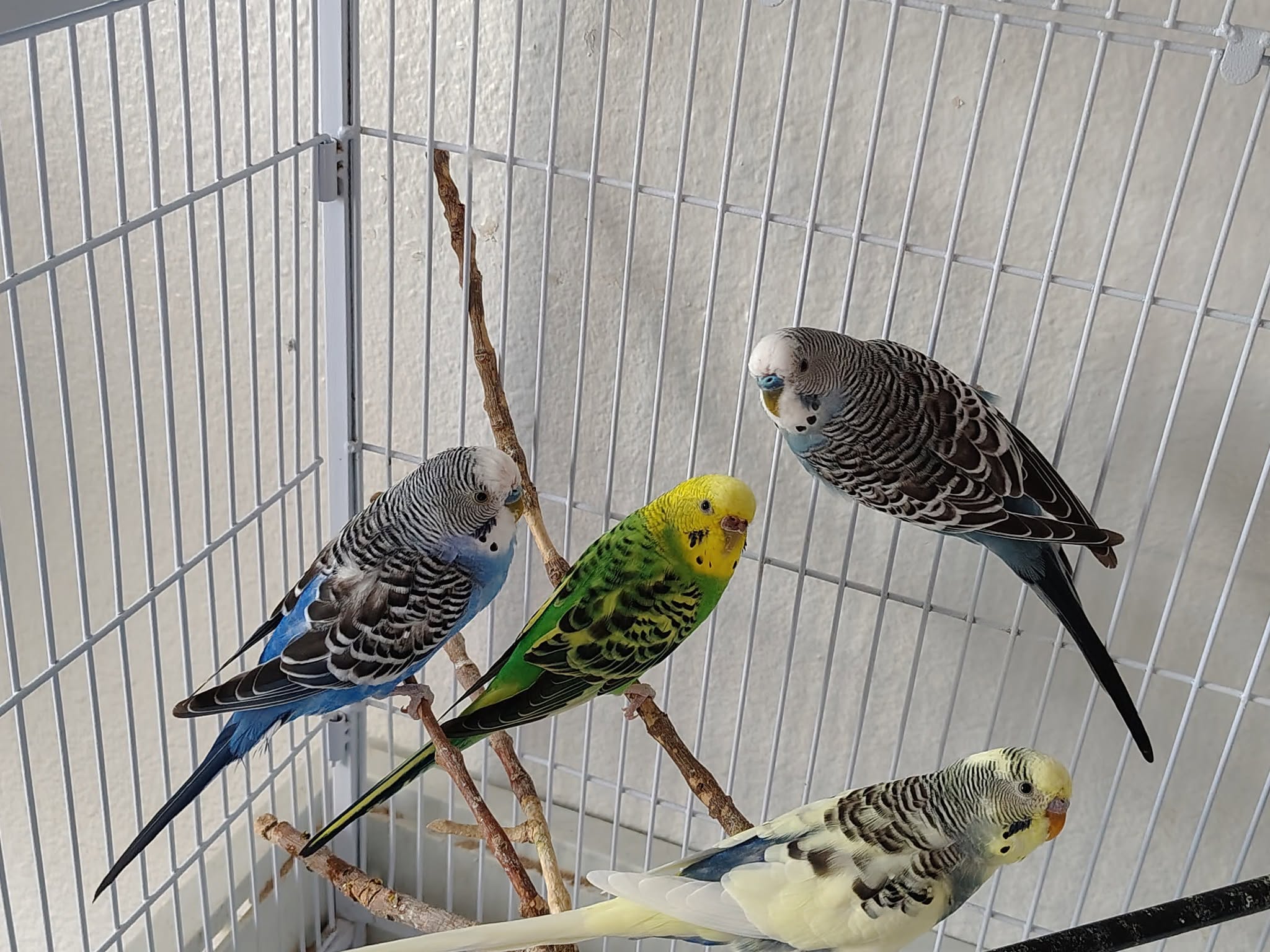
Budgies are flock animals. Their entire social structure, their communication system, their psychological wellbeing, and their natural behaviour — mutual preening, contact calling, play, companionship — evolved in the context of a flock. The RSPCA describes solitary budgie keeping as an “evolutionary aberration” and strongly recommends pairs or groups. It is the only species welfare position the RSPCA holds on budgies with that level of directness.
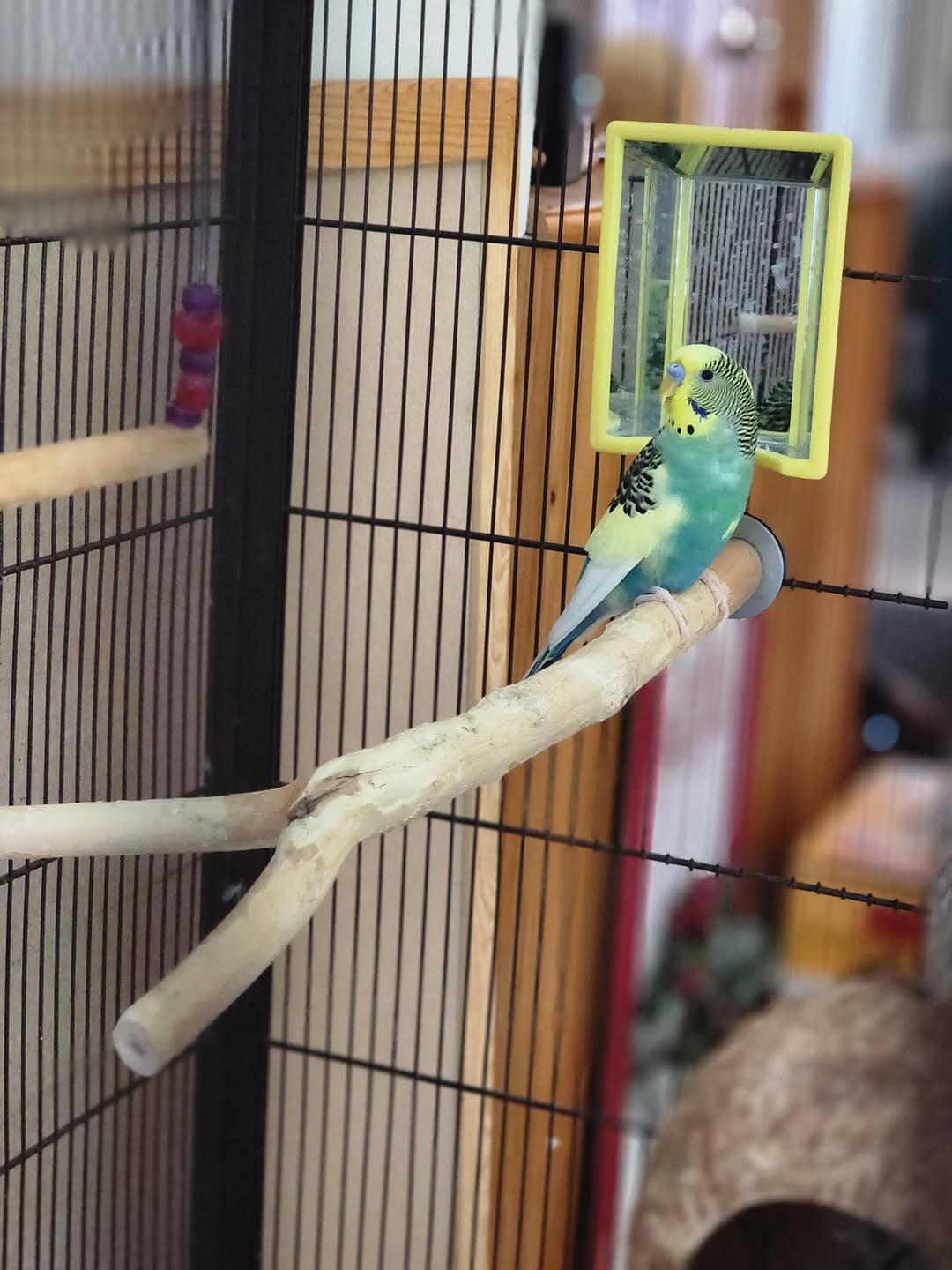
A single budgie in a cage is not a bird living well. It is a bird living in conditions that have removed the social environment its entire psychology evolved for. It compensates — sometimes by bonding intensely to the owner, sometimes by bonding to a mirror, sometimes by vocalising more persistently than normal. These compensations are not wellness. They are coping strategies.
The owner who keeps one bird and gives it a lot of attention is providing something. But that something cannot replicate what another bird provides — the constant, species-appropriate social contact that a flock member receives from other flock members through the day, regardless of whether the owner is present.
- The RSPCA describes solitary budgie keeping as an “evolutionary aberration” — this is the strongest welfare language the RSPCA uses for any captive bird keeping practice
- A single budgie’s intense bonding to an owner, mirror, or toy is a coping strategy, not evidence of adequate social provision
- Two budgies together manage working owners’ absences, irregular hours, and the social deprivation that a single bird cannot compensate for independently
- Two males together is typically the most harmonious combination — compatible temperaments, high social interaction, and less territorial behaviour than two females
- The concern that two birds will not bond with the owner is not well-founded — a well-socialised pair bonds with the owner as well as with each other
Wrong 3: The Seed-Only Diet — Thirty-Five Years of the Same Problem
If cage size is the most documented welfare failure in the 2024 research, the seed-only diet is the most persistent welfare failure I have watched over thirty-five years. And the two interact — a bird in a small cage on a seed-only diet is in a doubly compromised position that accelerates health decline in ways that a well-caged, well-fed bird would not experience.
Seed mixes are high in fat and low in the vitamins, minerals, and amino acids that budgies require for long-term health. A budgie on a seed-only diet is typically deficient in Vitamin A, iodine, calcium, and several other nutrients. These deficiencies do not produce immediate, visible illness. They produce a slow erosion of health over months and years — reduced immune function, thyroid problems in iodine-deficient birds, obesity from the high fat content of seeds, and eventually the organ failure that a nutritionally depleted bird develops significantly earlier than one fed appropriately.
Wild budgerigars do not eat a seed-only diet. They eat a wide range of grasses, seeds at different stages of ripeness, some insects, and whatever plant material is available in the Australian interior. The variety of natural diet is part of what makes them nutritionally robust in the wild. The cage bird eating dried seed mix every day for seven years is eating the equivalent of the same processed meal, every day, with no variation. The consequences over time are significant.
- Seed mixes are high in fat and deficient in Vitamin A, iodine, calcium, and multiple amino acids that budgies need for long-term health
- A seed-only diet produces slow, chronic nutritional depletion — not immediate visible illness but accelerated health decline over years
- Dark leafy greens — kale, spinach, broccoli, spring greens — should be offered daily and provide nutrients that seeds do not
- Egg food, available from most UK pet shops, provides essential protein and should be offered two to three times a week as a supplement
- Cuttlefish bone provides calcium and iodine and should be permanently available in every budgie cage — not occasionally, permanently
- Transitioning a seed-addicted bird to a varied diet requires patience — introduce new foods gradually alongside seed rather than removing seed suddenly
Wrong 4: No Enrichment — The Invisible Welfare Failure
The welfare research measured what it could measure — cage dimensions, health outcomes linked to conditions. What it could not measure is the invisible welfare failure of a budgie in an impoverished environment — a bird with nothing to do, nothing to investigate, no foraging challenge, no variety, day after day, for years.
Wild budgerigars spend most of their active day foraging — searching for food across a complex, variable environment. The foraging itself is not just about nutrition. It is cognitively engaging, physically active, and socially coordinated. A captive budgie that has its food provided in a dish, in the same dish, in the same position, every day, with the same toys available and unchanged, is a bird whose foraging drive — one of the most powerful drives it has — goes entirely unsatisfied.
The consequence is not dramatic. It is the absence of natural behaviour — less movement, less vocalisation, less engagement — that owners normalise as “that’s just how my bird is.” Sometimes it is feather chewing, which is the more visible manifestation of chronic understimulation. More often it is the quiet version — a bird sitting on its perch, not particularly interested in anything, which its owner has come to regard as simply the bird’s personality.
- Foraging is one of the most powerful drives in a wild budgerigar — the captive bird that cannot forage is chronically understimulated
- Hiding food in foraging toys, wrapping seed in paper, changing what is offered and where — these cost nothing and transform the bird’s engagement with its environment
- Toy rotation matters — the same toy in the same position every day loses its novelty quickly. Swapping toys every few days maintains interest
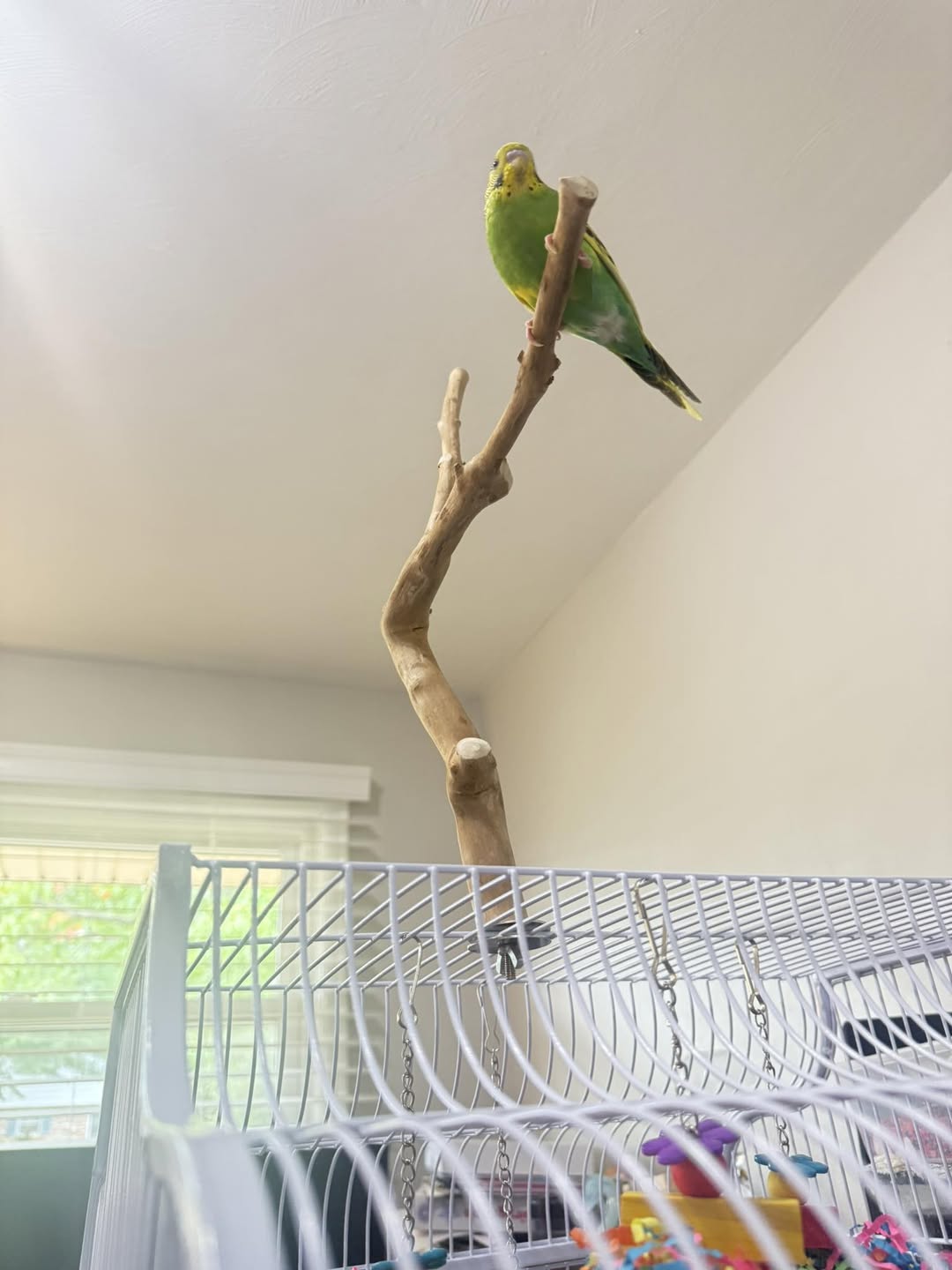
- Natural wood perches of varying diameters — apple, willow, manzanita — provide foot exercise that uniform plastic dowels do not and prevent the foot problems that appear in older birds kept on inadequate perches
- Out-of-cage time in a safe environment provides the environmental complexity that no cage, however well-equipped, can fully replicate
Wrong 5: No Veterinary Relationship — The Oversight That Costs Most
The 2024 research finding that over 50 percent of budgie health problems reported to vets are linked to cage conditions is significant — but the companion finding, not stated in the research, is that most of those problems were not caught early. They were caught when the bird was visibly unwell, which — given budgies’ illness-masking behaviour — means they had typically been developing for weeks before the owner sought help.
Most UK budgie owners have no established veterinary relationship for their bird. The bird has never been to a vet. There is no baseline weight, no baseline blood values, no history that a vet can compare an ill bird against. When something goes wrong — as it eventually does with any living animal — the owner goes to a vet who is meeting the bird for the first time in a state of illness, with nothing to compare it against, and paying the emergency rates that first-time illness visits incur.
The alternative — an annual well-bird check with an avian specialist, establishing baseline data and the veterinary relationship that makes illness management faster and more effective — costs between £65 and £90 per year. It produces a known baseline, an established vet, and in many cases the early identification of conditions that are cheap to treat early and expensive or untreatable when advanced.
- Most UK budgie owners have no veterinary relationship for their bird — the first vet visit is typically an emergency
- An annual well-bird check establishes baseline weight and health indicators that are diagnostically critical when the bird is ill
- Avian specialist vets — those with specific bird experience — produce significantly better diagnostic and treatment outcomes than general small animal vets for birds
- The Association of Avian Vets UK directory is the most reliable source for finding a qualified avian specialist in your area
- A well-bird check typically costs £65 to £90 — less than one emergency out-of-hours consultation, and significantly less than the treatment cost of a condition caught late rather than early
Wrong 6: The Lifespan Assumption — The One That Surprises Owners Most
I include this because it is the welfare issue that most changes the emotional and practical stakes of budgie ownership — and the one that owners most consistently underestimate at point of purchase.
A budgie in adequate conditions — appropriate cage, varied diet, pair housing, enrichment, veterinary care — can live for twelve to fifteen years. Some reach eighteen or beyond. This is not theoretical. I have known birds in my thirty-five years that have lived to fifteen and beyond in the care of attentive, well-informed owners.
The average UK pet budgie lives for considerably less than this — estimates typically range from five to eight years — not because budgies are short-lived, but because the conditions most UK budgies live in do not support their maximum lifespan. The seed-only diet, the inadequate cage, the lack of veterinary care — each of these reduces lifespan. Together, they produce a bird that lives half the life it could have lived.
This matters for the owner who buys a budgie for a child and expects it to live a few years. When that bird is still alive at ten, the child has left home and the parent is the primary carer for an animal they had not planned to keep for a decade. The lifespan conversation at point of sale is the one most pet shops skip entirely.
- A budgie in adequate conditions can live twelve to fifteen years — some reach eighteen or beyond
- The average UK pet budgie lives five to eight years — the gap reflects the conditions most birds live in, not the species’ biological potential
- Buying a budgie for a child is a commitment of potentially fifteen years — longer than most children remain in the family home
- Each welfare improvement — better cage, varied diet, pair housing, annual vet check — adds measurable time and measurable quality to the bird’s life
- The welfare research’s finding that cage conditions are linked to over 50% of health problems is directly linked to reduced lifespan — a bird in a poor environment does not just live less well, it lives less long
What the Industry Needs to Change
The 2024 welfare research is valuable precisely because it puts numbers on a problem that has been visible to anyone paying attention for decades. But the numbers alone do not produce change. What produces change is the industry — retailers, manufacturers, online platforms, and the media that covers pets — making different decisions about what it sells, what it says at point of sale, and what it normalises.
The cage that is sold alongside a budgie in most UK pet shops does not meet welfare standards. This is not a surprise to the people making those sales. It is a commercial decision — smaller cages are cheaper, take up less floor space in stores, and are easier to sell alongside a low-cost bird in a single transaction. The welfare of the animal is not the primary consideration in that transaction.
It needs to be.
Not because every retailer is indifferent to animal welfare — most are not. But because the commercial structure of the transaction consistently produces the outcomes the research has now documented. A different commercial structure — requiring a minimum cage size to be sold alongside any bird, providing genuine care information at point of sale, assessing buyer suitability before completing the transaction — would produce different outcomes. The resistance to this is commercial, not principled.
Frequently Asked Questions
My budgie has lived in a small cage for four years and seems fine — is upgrading the cage really going to make a difference now?
Yes — and the improvement is typically visible quickly. The 2024 case study tracked two birds moved from an inadequate to an adequate cage and found changes within two weeks: feather plucking stopped, vocalisation increased, natural behaviour resumed. A bird that has adapted to a small cage has adapted by suppressing behaviour, not by no longer needing space. Remove the constraint and the behaviour returns. Four years in a small cage is not a reason not to upgrade — it is four years of reason to do so now.
My budgie has always eaten seed and seems healthy — is the diet really a problem?
A bird can appear healthy on a seed-only diet for years before the nutritional deficiencies produce visible consequences. The consequences are cumulative and slow — reduced immune function, thyroid problems, obesity, organ stress — not sudden. The bird that “seems fine” on seeds at three may be significantly less well at seven than it would have been with dietary variety. Introduce dark leafy greens gradually — small amounts alongside the seed — and maintain cuttlefish bone. The transition to a more varied diet improves outcomes even in birds that have been on seeds for years.
The research said 68% of cages are below minimum standards — which cages actually meet the standard?
Any cage with a minimum width of 60cm and a rectangular shape, with bar spacing of no more than 12mm, is a reasonable starting point. Manufacturers such as Ferplast, Imac, and Rainforest make cages in appropriate sizes for budgies at accessible price points. A 80cm wide cage is better than a 60cm one. A flight cage — specifically marketed as a flight cage rather than a standard cage — will almost always meet the size requirement. The cage should not have a dome top, should not be round, and should have multiple perches at different heights of varying diameters.
Where can I get honest advice on improving my budgie’s welfare in Swindon?
Come and see us at Paradise Pets, Manor Garden Centre, Cheney Manor Industrial Estate, Swindon SN2 2QJ. Or ring us on 01793 512400. We will look honestly at what you have, tell you what needs to change and what does not, and help you make improvements that are practical and realistic for your situation. We would rather help you improve an existing setup than sell you an entirely new one unnecessarily.
One Last Thing From Me
The couple with the bird in the dome cage came back two months later. They had bought a larger rectangular cage — 80cm wide, multiple natural wood perches, foraging toys changed weekly. They had started offering kale and spinach alongside the seed. They were on a waiting list for a second bird — a male compatible in age and temperament, from a reputable source, to be introduced gradually.
The bird they brought in was visibly different. More active. More vocal. Posture fully upright. Eyes with the quality of engagement I had not seen on the first visit.
“We had no idea,” the man said. “We thought we were doing the right things.”
They were doing what they had been told. By the shop that sold them the cage. By the instructions on the seed bag. By the general cultural assumption that a budgie is a simple, low-maintenance pet that requires little and tolerates almost anything.
The 2024 welfare research confirms what those of us watching this from inside the industry have known for decades. Over one million budgies in the UK. Two-thirds of them in cages below minimum welfare standards. More than half of their health problems linked to those conditions.
The information to do better exists. It has always existed. The gap between what owners know and what their birds need has been maintained, in large part, by an industry that benefits from selling inadequate products alongside animals that deserve better.
That gap is worth closing. The birds are worth the effort.
Concerned About Your Budgie’s Welfare? Come In and Let’s Be Honest About It
We have been selling budgies and giving honest welfare advice for over 35 years. If the welfare research has made you look at your own setup differently — or if you have always had a feeling something was not quite right — come in and describe what you have. We will tell you honestly what matters and what does not. Free advice, no obligation. That is how we have always done things.
⭐ Customer Reviews
Amazing Bird Selection
Had a lovley visit today,staff were very friendly and very helpful,such a great petshop,their selection of birds is incredible,really impressed,thank so much to the staff at Paradise Pets

Friendly Helpful Staff
I have been coming to this place for years and they have a great stock of food for all types of pets. Have a great selection of small mammals and a lot of birds. Staff are friendly and helpful.

Great Quality Hutch
Bought a guinea pigs hutch and run combo, very happy with the service, the hutch was put in my car for me without even asking for help. The wood quality is very good, the instructions easy to follow and we are extremely happy with the fully built hutch. A good size for 2 guinea pigs

Response from Paradise Pets | Wiltshire
Thank you Melanie Latus Nice to provide services to you.
Best Bird Shop Around
It’s the best pet shop in and around Swindon. They always have an amazing selection of birds and all you need to keep them happy. I keep birds myself and the guys there are happy to answer questions and really know their stuff. I have seen budgies etc. in chain pet shops in the area looking really unhealthy and ill – I wouldn’t go anywhere else than Paradise Pets for animals.

Highly Recommended Bird Shop
I could not praise this shop enough. Really helped my Grandson buy his first bird and he’s loving it. Travelled from Somerset and was welcomed with open arms.

Great Shop with Competitive Prices
Great shop with amazing selection for small animals, hamsters, mice ect, highly recommend!
Also has a great selection for dogs & cats too & very competitive prices! 💖

