


From the counter at Paradise Pets
A woman came in last spring with a very specific complaint.
She had bought a young male budgie eight months earlier — specifically because she wanted a talking bird. The pet shop where she bought him had told her that male budgies talk, that young birds learn fastest, and that with some patience she would have a chatty companion in no time.
Eight months later, he had not said a single word. He was healthy. He was active. He clearly knew she was there and responded to her presence. But he made budgie sounds — chirping, chattering, the usual — and nothing that resembled human speech.
“Did they sell me a dud?” she asked.
I told her that was not quite the right question. I told her that what she had been sold was a budgie — and that budgies, like people, vary enormously in whether and how much they talk. The pet shop had told her the truth about the general tendency of male budgies. What they had not told her was the full picture.
By the end of our conversation, she had a clearer understanding of what was actually happening, what she could do differently, and what might simply be the nature of the bird she had. She left less frustrated — because she understood, finally, what she was working with.
First — Understanding Why Budgies Talk at All
Before you can understand why your budgie is not talking, it helps to understand what talking actually is from the bird’s perspective — because it is not what most owners assume.
Budgies do not talk because they understand language. They talk because they are social, vocal birds that have evolved to mimic the sounds around them as a way of bonding with and integrating into their social group. In the wild, budgies mimic each other — their contact calls, their flock sounds, their individual voices. In a domestic setting, the sounds of the social group are human voices, and a sufficiently motivated, bonded budgie will begin to mimic those instead.
This means that talking is fundamentally a social behaviour, not an intellectual one. A budgie that talks is a budgie that considers the humans around it to be its flock — and that is motivated enough by that bond to attempt the vocal patterns it hears most often.
The practical implication of this is significant: talking is not a trick that can be taught to any budgie through the right technique. It is a behaviour that emerges from the right relationship, the right motivation, and — critically — the right individual bird. Some budgies have more mimicry drive than others. That variation is genetic, individual, and not something any training approach can fully overcome.
- Talking is a social bonding behaviour, not language comprehension
- It requires the bird to consider humans as its primary social group
- It requires sufficient individual mimicry drive — which varies enormously between birds
- Male budgies have a stronger natural tendency toward vocalisation and mimicry than females — but this is a tendency, not a guarantee
- Young birds — under twelve months — have the most neural plasticity for learning new vocal patterns, but older birds do sometimes begin talking later than expected
- A budgie that chatters and vocalises actively is already doing the behaviour that precedes talking — it is not silent, it is not unmotivated, it simply has not yet produced recognisable words
The 7 Reasons Your Budgie Is Not Talking
These are the reasons I see most often when owners come in frustrated that their budgie has not talked. Some are things the owner can change. Some are things that cannot be changed. Knowing which is which is the most useful thing I can offer.
Reason 1: The Bird Has Not Bonded Sufficiently With Its Owner
This is the most common reason I see for a budgie that will not talk — and the one that most owners do not initially consider, because they feel they have a good relationship with their bird.
Talking emerges from deep social bonding. A budgie that is kept in a room where it is not regularly and meaningfully interacted with — that is fed and watered but not talked to, not given out-of-cage time, not treated as a social companion — has no particular motivation to mimic human speech. The sounds around it are not the sounds of its social group. They are background noise.
The bond required for talking is specific and earned. It involves daily interaction, consistent presence, being talked to directly and at close range, and — in many cases — significant out-of-cage time where the bird is physically in the owner’s space rather than separated from it by cage bars.
- The bird is in a room where the owner spends little time — a spare room, a hallway, a study used only occasionally
- The bird rarely or never comes out of the cage for direct interaction time
- The owner talks at the bird from across the room rather than at close range, face to face
- The bird has a companion budgie — which reduces its motivation to bond intensely with humans and therefore reduces its drive to mimic human speech
- Interaction with the bird is inconsistent — sometimes daily, sometimes not for several days
What to do
Make the bird the centre of social time, not the periphery of it. Move the cage to a room where you spend time — the kitchen, the living room, wherever you are most present. Talk to it directly, at close range, face to face, every day. Increase out-of-cage time if the bird is tame enough. The talking, if it comes, will come from this foundation — not from any specific word-repetition technique applied to a bird that is otherwise socially peripheral.
Reason 2: The Presence of a Second Budgie
This is the conversation I have most often with owners who bought two budgies at the same time because they thought a companion would make the birds happier — which is true — without realising that it significantly reduces the likelihood of either bird talking — which is also true.
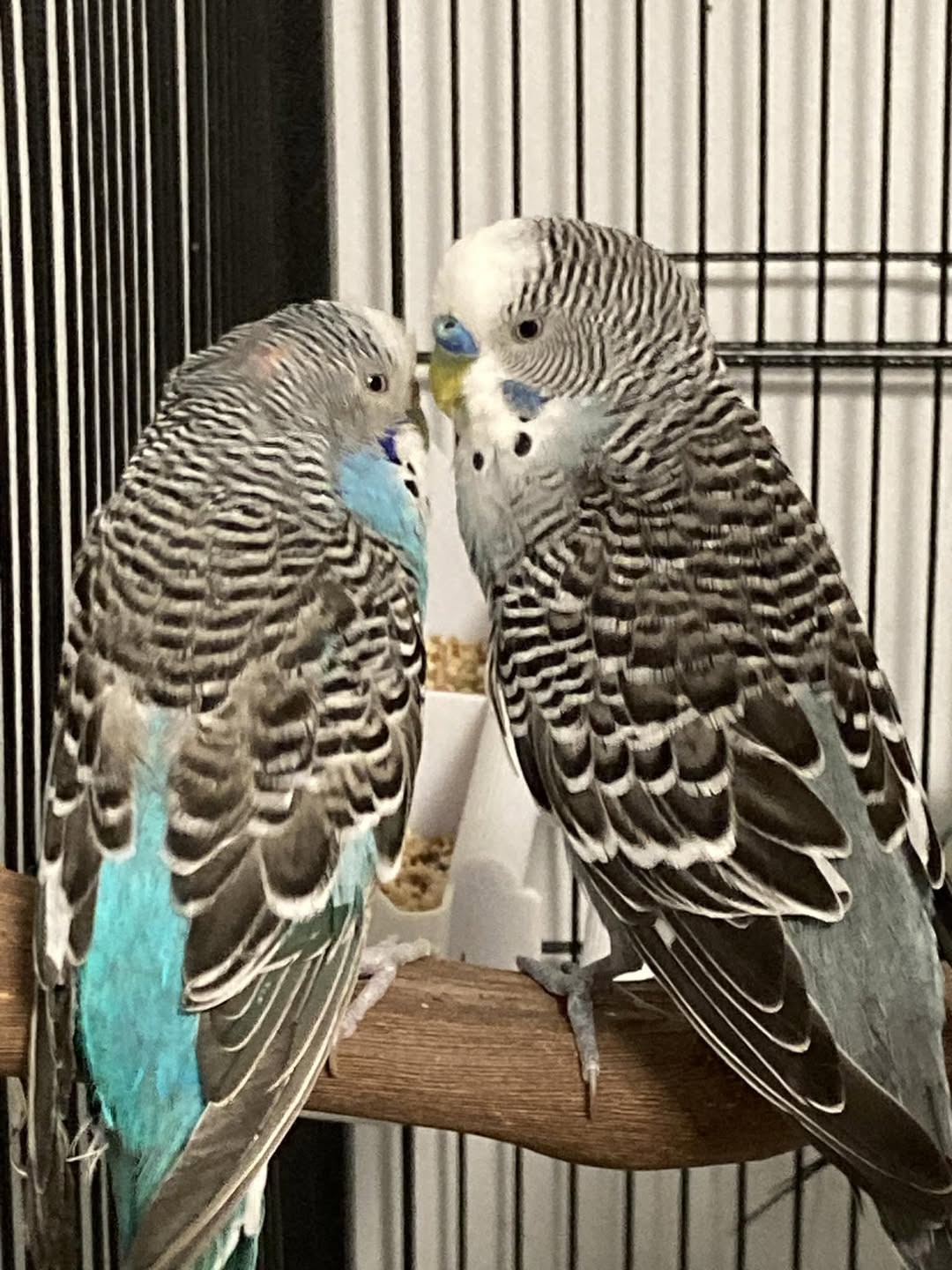
A budgie with a companion budgie does not need to bond intensely with humans. Its social needs are met by the other bird. Its mimicry drive — the motivation to produce sounds that bond it to its social group — is satisfied by mimicking budgie sounds rather than human sounds. The pair chatter to each other in budgie, and they are perfectly content.
This is not a welfare problem. Two budgies together are happier, less stressed, and lead better lives than a single budgie in most cases. But if talking is the priority, a single budgie that is heavily bonded to its owner is significantly more likely to talk than one of a bonded pair.
- You have two or more budgies housed together
- The birds clearly prefer each other’s company to human interaction
- Neither bird shows strong interest in mimicking human sounds
- Both birds are more vocal with each other than toward humans
What to do
Understand the trade-off honestly. Two budgies together will almost always be happier birds. One budgie alone, heavily bonded to its owner, will almost always be more likely to talk. You cannot reliably have both. If talking is important to you, a single bird with intensive human social interaction is the better setup. If the bird’s happiness and companionship are the priority, a bonded pair is the better choice — and the talking is unlikely.
Reason 3: The Training Approach Is Wrong
Most of the talking advice that circulates online and in pet care books is focused on repetition — say the same word to your budgie enough times and it will eventually repeat it. This is not entirely wrong, but it is an incomplete picture of what actually produces talking, and owners who focus solely on word repetition while neglecting the social foundation often repeat words at a bird for months without result.
There are specific things that make the talking approach more effective — and specific things that actively undermine it.
- Talking to the bird from across the room is far less effective than talking at close range, face to face, at the bird’s eye level
- Playing recordings of words on a phone or speaker near the cage is significantly less effective than a human voice in person — the bird is motivated to mimic its bonded human, not a device
- Using too many different words too early confuses the learning process — one or two words repeated consistently is more effective than a varied vocabulary
- Teaching when the bird is distracted, active, or not focused on you is wasted effort — the best teaching moments are when the bird is calm, settled, and looking at you
- Shouting or speaking unnaturally loudly to emphasise words is counterproductive — natural conversational tone is what budgies mimic
- Giving up and reducing interaction when the bird does not respond quickly creates the conditions least likely to produce results
What to do
Talk to the bird consistently, at close range, face to face, in a natural conversational tone. Choose one or two short words or phrases — the bird’s name, “hello,” a simple greeting — and use them consistently in the same context. The context matters: “hello” said every time you uncover the cage in the morning, consistently, over weeks, is more likely to be learned than “hello” said randomly at various times. Create consistent vocal routines and let the bird find the pattern.
Reason 4: The Bird Is Female
Female budgies can talk — I have known several — but they do so significantly less often than males and with a smaller vocabulary when they do. This is a biological reality, not a training failure.
Male budgies have a stronger natural drive toward vocalisation and vocal complexity. Their songs are longer, more varied, and more elaborate than females. The same drive that produces elaborate song in males is the drive that produces mimicry of human speech. Female budgies are more typically quieter, with simpler vocal patterns and less motivation to produce complex new sounds.
If the owner was not told the sex of their bird when they bought it — or was told incorrectly, which happens — this can explain a complete absence of talking in a bird that is otherwise healthy, bonded, and well stimulated.
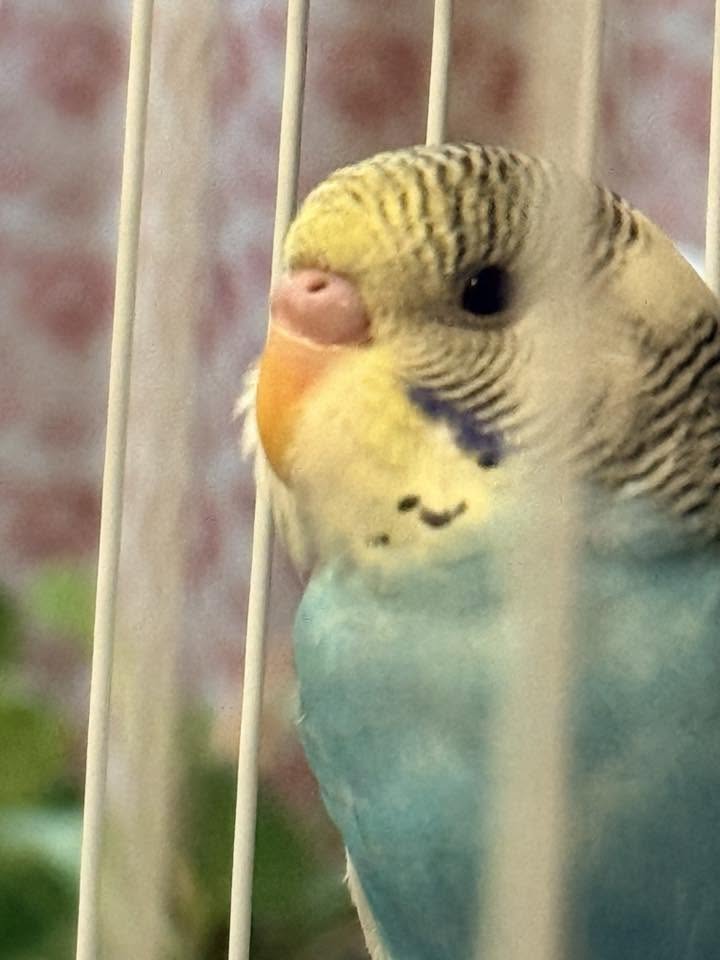
- The bird is female — identified by a brown, beige, or white cere (the fleshy area above the beak). Males have a blue cere in adulthood
- The bird is vocal — chirping, chattering — but has not produced anything resembling words after an extended period
- The bird was sold as a potential talker without the sex being made clear
What to do
Check the sex of the bird if you are not certain. Look at the cere — in an adult bird, a blue or purple-blue cere indicates male. A brown, tan, or white cere indicates female. If your bird is female, adjust your expectations rather than your approach. Some female budgies do eventually produce words — it is not impossible — but the likelihood is meaningfully lower and the vocabulary if it comes will likely be smaller. The bird is not failing. It is being female.
Reason 5: The Bird Is Not Yet Ready
Eight months felt like a long time to the woman who came in frustrated. In budgie talking terms, it is not necessarily long at all.
Some budgies begin producing recognisable words within weeks of the owner starting to work with them. Some take eighteen months. Some begin talking at three years of age after showing no signs of it for years. The timeline is individual and cannot be predicted or forced.
What I have observed consistently over thirty-five years is that talking, when it comes, often arrives suddenly — the owner has been working with the bird for months with no apparent result, and then one morning the bird says something clearly recognisable. The learning has been happening, invisibly, all along. The production just takes time.
- The bird is under eighteen months old — the learning process is still very much active
- The bird is actively vocal — chattering, interacting, responding to the owner’s voice
- The owner has been consistent with interaction and talking but has not yet had results
- The bird’s chattering sounds increasingly varied and complex — sometimes a sign that mimicry is developing before recognisable words emerge
What to do
Continue. The most common reason a budgie does not talk is that the owner gave up before it was ready. Consistency over time is the most important variable in talking development — not any specific technique, not any special word, not any particular schedule. Be present, be consistent, be patient, and let the bird’s timeline be what it is.
Reason 6: Too Much Background Noise and Distraction
A budgie learning to talk needs to be able to hear and focus on the sounds it is trying to mimic. A bird kept in a room where the television is on all day, where there is constant background noise from music or radio, or where the household is noisy and unpredictable, is not in an environment that supports vocal learning.
This does not mean the bird needs silence. Budgies are social birds and silence is not natural or desirable. But the specific sounds the owner wants the bird to learn need to be delivered in focused, direct, close-range interaction — not broadcast into a room full of competing audio.
- The television or radio is on consistently in the room where the bird is kept
- The household is noisy and the bird is rarely in a quiet environment
- Interaction with the bird happens while other things are going on rather than in focused one-to-one time
- The bird is exposed to many different voices and sounds rather than primarily one consistent voice
What to do
Create focused teaching moments in relative quiet. Turn the television off. Sit with the bird, close to the cage or with the bird out on your hand, and talk to it without the competition of background audio. This does not need to be long — five to ten minutes of genuinely focused interaction twice a day is more effective than hours of peripheral exposure in a noisy room. Quality of interaction matters more than quantity of time.
Reason 7: This Bird Is Simply Not Going to Talk
This is the honest answer that most owners do not want to hear — and the one that I think is most important to give clearly, because without it, owners spend years in frustration with a bird that is perfectly good but will never do the specific thing they were hoping for.
Some budgies do not talk. This is not a failure of training, a failure of the owner, or a failure of the bird. It is individual variation. Just as some humans are naturally more verbally expressive than others, some budgies simply have less mimicry drive — less motivation to produce novel vocal patterns, less interest in human sounds, less neural tendency toward speech mimicry.
These birds are not lesser birds. They chirp, they chatter, they interact, they bond, they are good company. They simply do not produce human words. And after a certain point — after the appropriate conditions have been in place for an extended period and there has still been no movement — it is kinder and more honest to reach that conclusion than to keep adjusting the approach in search of a result that may not be coming.
- The bird is male, kept singly, well bonded to its owner, and over two years old with no talking progress
- All the conditions that support talking have been in place for a sustained period
- The bird is vocal and active but shows no sign of attempting to mimic human sounds
- Multiple consistent approaches have been tried over an extended period without result
What to do
Accept it — and appreciate what you have. A budgie that does not talk is still a budgie that is intelligent, responsive, and genuinely engaging. Many of the most rewarding budgies I have known over thirty-five years were birds that never said a single recognisable word. The relationship does not depend on talking. If it genuinely matters to you that you have a talking bird, a different bird — not a different approach to the same bird — may be the answer.
What Actually Makes Talking More Likely — The Honest Summary
- A single male budgie. Not a bonded pair. One bird, with you as its primary social relationship. This is the single most impactful factor.
- Daily face-to-face interaction at close range. Not talking across the room. Not playing recordings. You, close to the bird, talking directly to it, consistently.
- A young bird — ideally under six months when you start. Neural plasticity for vocal learning is highest in young birds. Starting early gives you the best window.
- Consistency over time. The same words, in the same contexts, from the same person, over weeks and months. Variety and inconsistency work against talking development.
- A quiet focused environment for teaching moments. Not background noise. Focused interaction, even briefly, in relative quiet.
- Patience without expectation. Pressure and frustration from the owner communicates itself to the bird. Relaxed, enjoyable interaction is better than determined teaching sessions.
- Realistic expectations from the start. Some birds talk. Some do not. You cannot know in advance which you have. Any other framing is setting up for disappointment.
What Not To Do
| What owners do | Why it does not work | What to do instead |
|---|---|---|
| Play YouTube videos or audio recordings of talking budgies near the cage | Budgies are motivated to mimic their bonded humans, not recorded voices or other birds. The recordings may entertain the bird but they do not produce the social motivation that drives mimicry | Talk to the bird yourself, directly, at close range. Your voice is what the bird will mimic if it mimic anything |
| Try to teach many different words at once | Vocal learning in budgies builds on repetition and pattern recognition. Too many different inputs at the same time prevents any single pattern from being reinforced enough to stick | Choose one or two short words or phrases and use them consistently in the same context for several weeks before introducing anything new |
| Give up on interaction when the bird does not talk | The interaction is the foundation of talking — reducing it in frustration removes the very conditions that make talking possible | Continue consistent daily interaction regardless of whether talking has appeared. The interaction has value independent of whether it produces speech |
| Cover the cage or isolate the bird to force focus on human voices | Isolation is a stress response for a social bird and stress suppresses learning. A bird that is anxious or distressed does not learn vocal patterns — it manages its stress | Keep the bird in a social environment where it is comfortable, and create focused interaction within that positive context |
| Assume the pet shop guaranteed a talking bird | No honest seller can guarantee a specific bird will talk. If this was implied, it was misleading. The general tendency of male budgies to be more vocal does not mean any individual male budgie will produce human speech | Adjust expectations to match the reality of the individual bird in front of you rather than the generalisation you were sold |
Frequently Asked Questions
At what age do budgies usually start talking?
There is no consistent age. Some budgies begin producing recognisable sounds between three and six months. Others start at eighteen months or later. A small number begin talking after two or three years with no previous sign of it. The most reliable predictor is not age but the quality of the social bond and the consistency of interaction. If you are still working on those foundations at twelve months, the bird has not necessarily reached the end of its window — it may simply not have been ready yet.
My budgie says something that sounds like a word but I can’t make it out — is this talking?
Almost certainly yes, in the early stages. Budgie talking often begins as something that sounds like a word but is not yet fully formed — a rhythm and pattern that resembles speech before it resolves into something clearly recognisable. If you are hearing something that sounds like it might be language, encourage it actively. Respond to it, repeat the word you think it is attempting, and give the bird the positive interaction that reinforces the behaviour. It is far more likely to sharpen into something recognisable if you meet it with enthusiasm than if you wait for it to be perfect before responding.
Do female budgies ever talk?
Yes, occasionally — but far less commonly than males and with a smaller vocabulary when they do. I have known female budgies that produced a handful of clear words over a lifetime. They are the exception rather than the rule. If your bird is female and has not talked after a year of consistent interaction, the probability of it talking is lower than it would be for a male in the same situation — but it is not zero, and continuing the interaction is worthwhile for the relationship regardless of whether talking ever comes.
Will getting my budgie a companion bird stop it talking?
If the bird is already talking, a companion budgie may reduce the frequency of talking but is unlikely to eliminate it entirely once the behaviour is established. If the bird has not yet started talking, adding a companion budgie significantly reduces the probability of it ever doing so. The social bond with the companion replaces much of the motivation to bond with humans that drives talking. This is the honest trade-off — better bird welfare, lower talking probability.
Where can I get budgie behaviour advice in Swindon?
Come and see us at Paradise Pets, Manor Garden Centre, Cheney Manor Industrial Estate, Swindon SN2 2QJ. Or ring us on 01793 512400. We have been keeping and advising on budgies for over 35 years and are happy to talk through your specific bird and situation — including whether talking is a realistic expectation for the bird you have.
One Last Thing From Me
The woman with the eight-month-old male came back about four months later. She had moved the cage into the living room where she spent her evenings. She had started sitting with him, talking to him directly, every day. She had stopped trying to teach him specific words and just talked to him the way she would talk to anyone she spent time with.
He had started saying something. She was not entirely sure what it was — possibly his name, possibly “hello,” possibly something entirely his own. But it was something.
“I stopped worrying about whether he would talk,” she said, “and he started.”
I hear that a lot. The pressure to produce a specific result is often what stands between a budgie and the relaxed, bonded relationship from which talking naturally emerges. When the relationship becomes the goal rather than the means to get talking — the talking sometimes follows.
And sometimes it does not. And the relationship is still worth having.
Questions About Your Budgie? Come In and Ask
We have been keeping, selling, and advising on budgies for over 35 years. Whether your budgie talks, does not talk, or does something in between — we can help you understand what you have and what is realistic. Come in for a conversation. Free advice, no obligation. That is how we have always done things.
⭐ Customer Reviews
Amazing Bird Selection
Had a lovley visit today,staff were very friendly and very helpful,such a great petshop,their selection of birds is incredible,really impressed,thank so much to the staff at Paradise Pets

Friendly Helpful Staff
I have been coming to this place for years and they have a great stock of food for all types of pets. Have a great selection of small mammals and a lot of birds. Staff are friendly and helpful.

Great Quality Hutch
Bought a guinea pigs hutch and run combo, very happy with the service, the hutch was put in my car for me without even asking for help. The wood quality is very good, the instructions easy to follow and we are extremely happy with the fully built hutch. A good size for 2 guinea pigs

Response from Paradise Pets | Wiltshire
Thank you Melanie Latus Nice to provide services to you.
Best Bird Shop Around
It’s the best pet shop in and around Swindon. They always have an amazing selection of birds and all you need to keep them happy. I keep birds myself and the guys there are happy to answer questions and really know their stuff. I have seen budgies etc. in chain pet shops in the area looking really unhealthy and ill – I wouldn’t go anywhere else than Paradise Pets for animals.

Highly Recommended Bird Shop
I could not praise this shop enough. Really helped my Grandson buy his first bird and he’s loving it. Travelled from Somerset and was welcomed with open arms.

Great Shop with Competitive Prices
Great shop with amazing selection for small animals, hamsters, mice ect, highly recommend!
Also has a great selection for dogs & cats too & very competitive prices! 💖

