
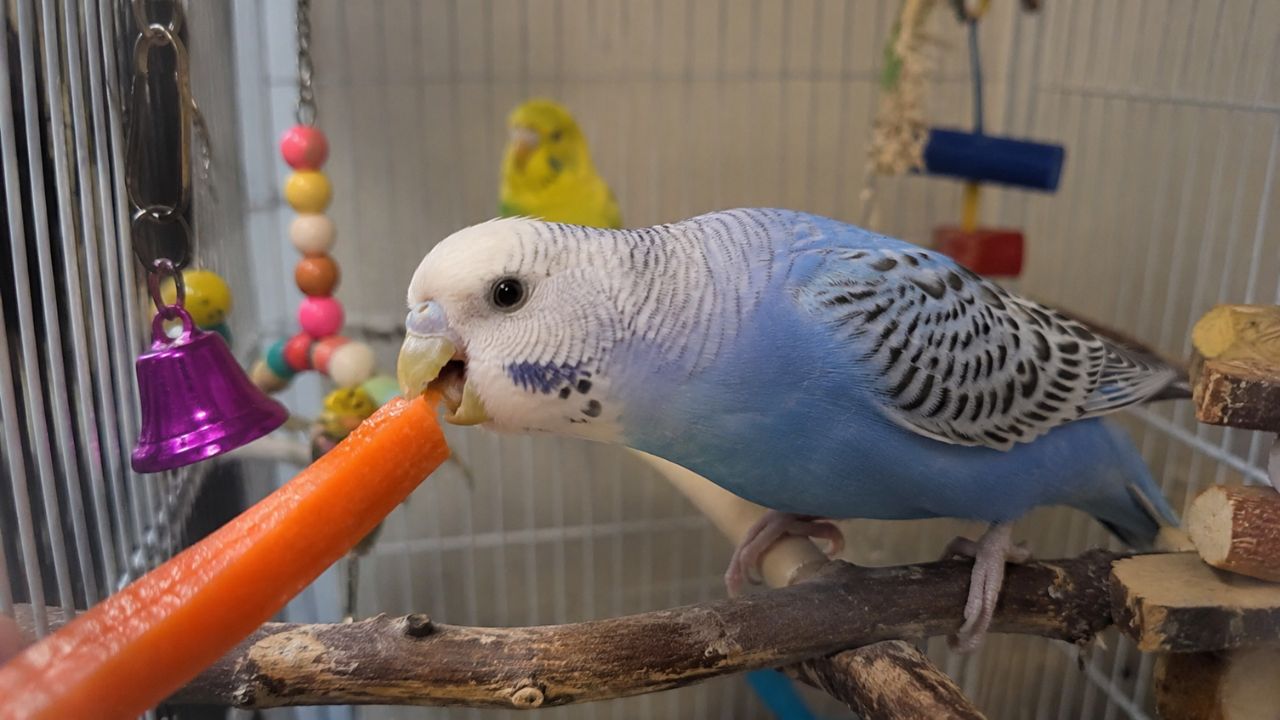

Neil has kept, sold, and advised on cage and aviary birds at Paradise Pets Swindon since 1988 — over 35 years of first-hand experience with budgerigars. Questions about fresh food come up at the counter almost every week. Carrots are one of the most commonly asked about, and they are also one of the most frequently mishandled. This is the honest answer — including the part that most owners do not think about until something goes wrong.
Yes. Budgies can eat carrots. Carrots are safe, nutritious, and well-tolerated by most budgerigars when offered correctly.
That is the simple answer. The slightly longer answer — the one that actually matters — is that the vegetable itself is not the part most owners get wrong. The part most owners get wrong is the preparation, the quantity, and the assumptions people make about fresh food once they decide it is safe.
I have been selling budgies for thirty-five years. Fresh food questions come up constantly at the counter, and they follow a predictable pattern: someone discovers that a particular food is technically allowed, decides to introduce it, and then either offers too much or prepares it in a way that creates a problem that could easily have been avoided.
This is the full answer — what carrots actually offer a budgie, how to introduce them correctly, what to watch for, and why the way you feed matters as much as what you feed.
What Carrots Actually Offer a Budgie
Carrots are a genuinely useful addition to a budgie’s diet when offered correctly. The nutritional content is worth understanding — not because you need to become an expert in avian nutrition, but because knowing what you are offering helps you use it well.
The main nutritional contribution is beta-carotene — the compound that gives carrots their orange colour. Budgies convert beta-carotene into vitamin A, and vitamin A is one of the nutrients most commonly deficient in budgies kept on seed-only diets. Vitamin A supports immune function, feather condition, respiratory health, and the integrity of the mucous membranes. A budgie on a seed-heavy diet with no fresh food at all is at meaningful risk of vitamin A deficiency over time. Carrots are one of the better dietary sources of the precursor vitamin, which makes them a practical and useful supplement to a seed-based diet.
Carrots also provide water content, which supports hydration — useful particularly in warmer months. They provide some dietary fibre, small amounts of potassium and B vitamins, and their firm texture makes them genuinely good for beak exercise and enrichment.
That said — carrots are not a complete fresh food rotation on their own. They are a good addition to a varied diet. They are not a substitute for leafy greens, or for the range of fresh vegetables that cover the broader nutritional picture.

Raw or Cooked — and Why This Matters More Than Most People Think
Raw. Always raw.
This is the part of the carrot question that surprises people most when I say it clearly, because the assumption tends to be that cooked vegetables are softer and therefore easier or safer for a small bird. That assumption gets it backwards.
Cooking destroys a significant portion of the beta-carotene and water-soluble vitamins that make carrots nutritionally useful in the first place. A cooked carrot offered to a budgie has substantially less nutritional value than a raw one — you have removed the main reason you were offering it.
Beyond the nutrition, cooked vegetables deteriorate rapidly at cage temperature. A piece of raw carrot left in a cage for a few hours is still perfectly fine. A piece of cooked carrot at room temperature becomes a bacterial environment within a couple of hours in warmer conditions. In the summer particularly, cooked vegetables left in a cage can cause gut problems that owners then cannot trace to the food because they assumed cooked was safer.
Raw carrot, washed thoroughly, offered fresh. Remove anything uneaten after a few hours. That is the correct approach.
The one thing to add: wash the carrot properly. Not a quick rinse. A proper wash under running water, with any visible soil removed completely. Pesticide residue and soil contamination are realistic concerns with root vegetables. Peeling is optional but not necessary if the carrot is washed well — the peel is nutritious and the texture is good for the bird. Organic carrots, if you have access to them, reduce the pesticide concern. But a well-washed standard carrot is fine.
How Much to Offer — The Quantity Mistake
This is where the second common error happens. Someone discovers their budgie likes carrot. The budgie eats it enthusiastically. They offer more. The budgie eats that too. And then they wonder why the droppings have changed colour or consistency, or why the bird seems less interested in its seed mix.
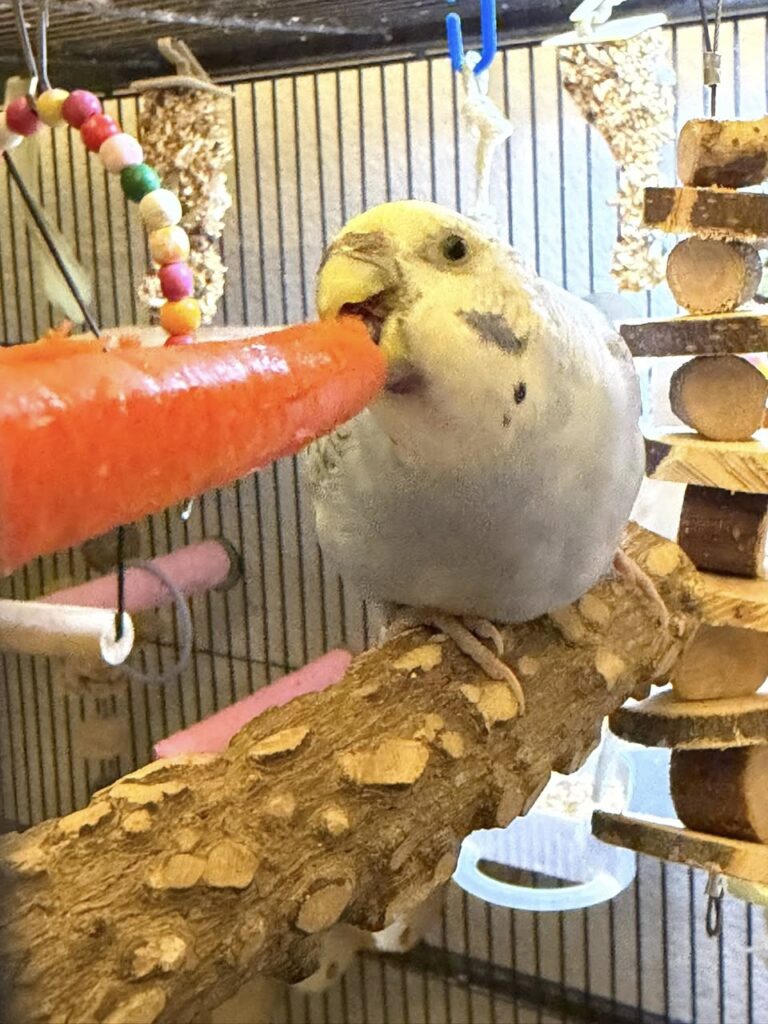
Carrots — like all fresh food — should be a supplement to the main diet, not a significant part of it. A piece roughly the size of the bird’s head, offered two to three times per week, is a sensible starting quantity. Not a large chunk twice a day. A modest portion a few times per week.
The reason quantity matters: fresh food, including carrots, can cause loose droppings in budgies that are not accustomed to it, particularly when introduced too quickly or offered in large amounts. This is usually temporary — the digestive system adjusts — but it can be alarming if you do not know what caused it, and it is entirely avoidable by introducing new foods gradually.
If your budgie has been on a seed-only diet and has never had fresh food, do not start with a large daily portion of carrot. Offer a small piece. Watch the droppings. If they remain normal, continue at that quantity for a week or two before increasing slightly. If they become loose, reduce the amount and allow more time for adjustment.
The other quantity consideration: too much carrot over a sustained period provides a high level of beta-carotene, which can theoretically affect the colouration of pale feathers — particularly in light-coloured birds. This is more of a theoretical concern than a practical one at sensible quantities, but it is worth knowing. A few small pieces several times a week will not cause this. A very large amount daily over months potentially could.
How Budgies Actually Eat Carrot — And What to Expect at First
Budgies are creatures of habit and they are often suspicious of new foods — particularly foods that look different from what they have been eating. A budgie that has never seen raw carrot before may ignore it entirely for several days. This is completely normal and does not mean the bird dislikes it or will never eat it.
The approach that works: introduce the carrot alongside familiar food, not as a replacement for it. A small piece clipped to the cage bars near where the bird already spends time is more likely to be investigated than a piece dropped in the food bowl that the bird has to notice amid familiar seed. Budgies are curious about things that are at beak level and that move slightly. A piece of carrot clipped to the bars ticks both.
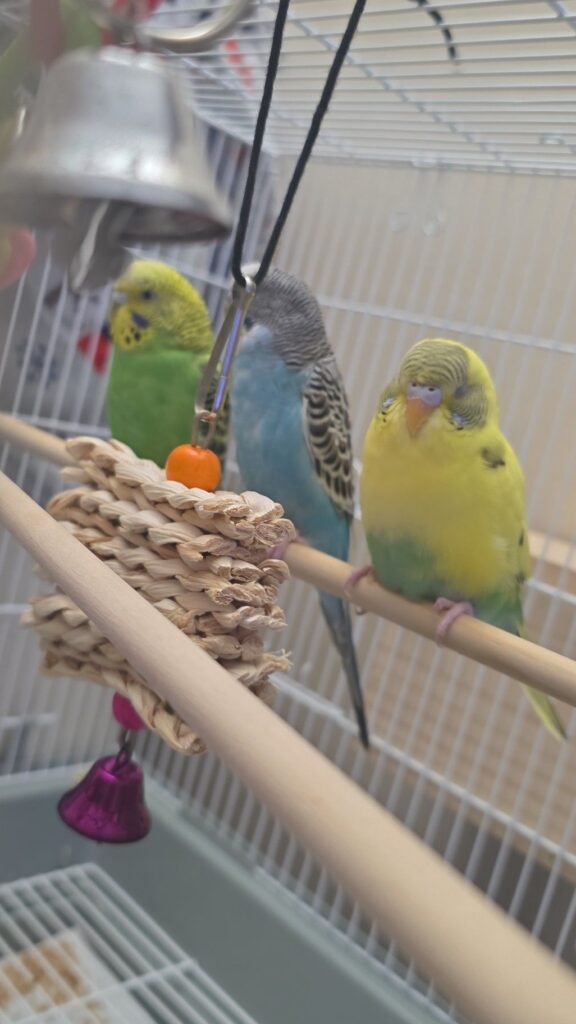
If your budgie watches a cage companion eat the carrot, it will often try it within a day or two. Social feeding is a strong driver of dietary exploration in flock birds. If your bird is kept alone, this process can take longer — be patient, keep offering, do not force it.
Some budgies never warm to carrot and prefer other vegetables. That is fine. The nutritional gap can be filled with other fresh foods — leafy greens like kale or spinach, courgette, broccoli, sweet pepper. The goal is variety, not any specific vegetable.
What the Droppings Tell You
Any time you introduce a new food to a budgie’s diet, the droppings are the most reliable indicator of how the bird is tolerating it. This is worth understanding before you start — not because something is likely to go wrong, but because knowing what normal looks like helps you identify what abnormal looks like.
A budgie’s normal dropping has three components: a dark green or brown solid portion, a white or cream urate portion, and a small amount of clear liquid. The proportions and exact colour vary with diet.
When you introduce fresh carrot, you may notice: the solid portion takes on an orange tint — this is the pigment from the carrot passing through and is completely normal. You may notice slightly looser or more liquid droppings, particularly if you have introduced the carrot in a larger amount than the bird is used to. This usually settles within a few days.
What to watch for that indicates a problem: very watery droppings that persist beyond a few days after introduction, complete absence of the solid portion, blood in the dropping, or any dropping change accompanied by other symptoms — fluffed feathers, reduced activity, reduced appetite, sitting on the cage floor. These warrant a vet assessment. Dropping changes in isolation, appearing immediately after a new food was introduced and resolving within a couple of days, are almost always dietary adjustment rather than illness.
Carrot Tops — The Part Most Owners Don’t Think About
If you buy carrots with their green tops still attached — the feathery green fronds — those tops are also safe for budgies and are often eaten with more enthusiasm than the carrot itself.
Carrot tops have a different nutritional profile from the root. They are higher in certain minerals and have a texture that budgies tend to find interesting to work through. Many birds that ignore raw carrot will immediately investigate and eat the tops if offered alongside. If you have access to carrots with their tops, it is worth trying both — you may find the tops are the preferred part.
The same rules apply: fresh, washed, removed if uneaten within a few hours.
One note: carrot tops can be mildly bitter. Some budgies eat them readily, others ignore them. Neither response is a problem. Offer them, observe, and let the bird decide.
What Budgies Should Not Eat — Keeping the Context Clear
Because this question comes up in the context of fresh food safety, it is worth briefly listing the vegetables and foods that are genuinely dangerous for budgies — not to alarm anyone, but because knowing the actual unsafe list makes it easier to approach fresh food with appropriate confidence rather than excessive caution.
Foods that are genuinely toxic to budgies and should never be offered: onion and garlic in any form, avocado, rhubarb, raw potato, apple seeds and pits from stone fruits. These are not “best avoided in large quantities” — they are genuinely dangerous at small amounts and should never be offered at all.
Mushrooms and any wild-foraged plant material should be avoided unless you can identify them with absolute certainty — the risk of toxicity is too high.
Everything else — the vast majority of fruit and vegetables — is either safe or a matter of offering sensibly in terms of quantity and freshness. Carrots are firmly in the safe and useful category. The risk with carrot is not toxicity. The risk is overfeeding, incorrect preparation, and poor freshness management — all of which are easily controlled.
The Budgies I See With the Best Condition
After thirty-five years of selling and advising on budgies, the birds I consistently see in the best condition — best feather, best weight, most active and most vocal — tend to have a few things in common.
They are on a seed mix that is actually consumed rather than selectively picked through. They have some pellet or complete food available. They get fresh food two or three times a week — not every meal, and not in large quantities, but regularly and varied. Leafy greens, vegetables including carrot, occasional fruit. Cuttlebone available at all times. Fresh water changed daily.
That combination — not an elaborate regime, not expensive supplements — consistently produces budgies in genuinely good condition. The seed-only birds are often fine for years, but they are missing something. The birds with a varied diet show it.
Carrot is a good starting point for fresh food if you have not offered any before. It is nutritious, easy to obtain, easy to prepare correctly, and most budgies will eventually take to it. If yours does not, try other vegetables. The goal is getting fresh food into the diet regularly in some form — the specific vegetables matter less than the consistency.
Come in if you want to talk through your budgie’s diet in more detail. We are at Manor Garden Centre, Cheney Manor Industrial Estate, Swindon, SN2 2QJ — open every day. Or call us on 01793 512400. We are always happy to discuss what you are feeding and whether there is anything worth changing.
- “My budgie doesn’t need fresh food — it’s been fine on seed for years” — Budgies are remarkably resilient and can appear healthy on a seed-only diet for a long time. But vitamin A deficiency, in particular, often presents gradually — reduced feather quality, increased susceptibility to respiratory infections, changes in the mucous membranes that become visible only when the bird is examined closely. “Appears fine” is not the same as “optimally nourished.” Fresh food is not an optional extra for a well-kept budgie.
- “I gave it carrot once and it ignored it, so it doesn’t eat vegetables” — Budgies are neophobic — genuinely wary of new things. One offer, once, is not a test of whether the bird will eat something. Consistent exposure over days or weeks is how budgies learn to accept new foods. I have seen birds that ignored a vegetable for three weeks suddenly eat it enthusiastically once they decided it was safe.
- “Cooked vegetables are easier for small birds to digest” — Not for budgies. Raw is correct for almost all fresh vegetables offered to budgies. The argument for cooked is a human one applied incorrectly to birds. Raw carrots, raw leafy greens, raw sweet pepper — these are what the bird benefits from. Cooked versions have lower nutritional value and deteriorate faster at cage temperature.
- “If a little is good, more is better” — Fresh food is a supplement, not a staple. More than a modest portion several times per week tends to cause loose droppings at best and can displace the seed intake that still forms the foundation of the diet. The goal is variety and regularity, not volume.
- “I leave vegetables in all day so the bird can eat whenever it wants” — Fresh vegetables deteriorate at room temperature and particularly at cage temperature. In warm weather, a piece of vegetable that has been in the cage since morning may be a bacterial environment by afternoon. Offer fresh, remove what is uneaten within a couple of hours. This applies year-round and particularly in summer.
When to See a Vet — And When to Adjust at Home
- Budgie showing orange-tinted droppings after eating carrot, otherwise healthy and normal.
Pigment from the carrot — completely normal. No action needed. Continue offering as before. - Slightly loose droppings in the first few days after introducing carrot.
Dietary adjustment — reduce the quantity offered and allow more time for the digestive system to adjust. If it resolves within a few days, continue at the reduced quantity and increase slowly. No vet needed. - Very watery droppings persisting beyond three to four days after introducing fresh food, with no other symptoms.
Reduce fresh food entirely and return to seed only for a week. Reintroduce in smaller quantities. If the problem recurs consistently with fresh food regardless of quantity, see a vet to rule out an underlying digestive issue. - Dropping changes accompanied by fluffed feathers, reduced activity, sitting on the cage floor, or reduced appetite.
Do not attribute this to the food and wait. This combination of symptoms requires a vet assessment promptly — it is not a fresh food reaction. - Bird has been refusing all fresh food for months and is on a seed-only diet with declining feather condition.
Worth discussing with us before concluding the bird will not eat fresh food. There are techniques for encouraging fresh food acceptance that work in the majority of cases. We would rather help you get there than leave the nutritional gap unaddressed.
What I Tell Budgie Owners at the Counter
When someone asks about carrots at the counter, the conversation usually opens one of two ways. Either they are asking whether it is safe — in which case the answer is yes, with the caveats above. Or they have already introduced carrot and something has happened with the droppings that concerned them — in which case the answer is almost always that the quantity or the preparation needs adjusting.
Both conversations end the same way. Fresh food is genuinely useful for a budgie’s long-term health. Carrots are a good place to start. Offer raw, offer in modest portions, introduce gradually, remove what is uneaten. Let the bird take its time to accept something new. Do not stop offering because it ignored the first offering.
The birds I see in the best condition over the longest period of time are the ones whose owners have taken the time to introduce a varied diet — not because the owner is particularly expert, but because they were curious enough to ask the question and patient enough to implement the answer consistently.
Come in and see us at Manor Garden Centre, Cheney Manor Industrial Estate, Swindon, SN2 2QJ. We are open every day. Or call on 01793 512400.

Visit Us at Paradise Pets Swindon
We stock a wide range of cage and aviary birds year-round — all UK-sourced, all kept in genuinely good conditions. If you have questions about your budgie’s diet, what fresh food to introduce, or how to improve condition in a bird that seems below par, come in and talk to us. We are always happy to go through what you are feeding and suggest what might be worth changing.
We also stock a full range of gerbils and hamsters, guinea pigs, rabbits, and an extensive selection of cage and aviary birds.
⭐ Customer Reviews
Amazing Bird Selection
Had a lovley visit today,staff were very friendly and very helpful,such a great petshop,their selection of birds is incredible,really impressed,thank so much to the staff at Paradise Pets

Friendly Helpful Staff
I have been coming to this place for years and they have a great stock of food for all types of pets. Have a great selection of small mammals and a lot of birds. Staff are friendly and helpful.

Great Quality Hutch
Bought a guinea pigs hutch and run combo, very happy with the service, the hutch was put in my car for me without even asking for help. The wood quality is very good, the instructions easy to follow and we are extremely happy with the fully built hutch. A good size for 2 guinea pigs

Response from Paradise Pets | Wiltshire
Thank you Melanie Latus Nice to provide services to you.
Best Bird Shop Around
It’s the best pet shop in and around Swindon. They always have an amazing selection of birds and all you need to keep them happy. I keep birds myself and the guys there are happy to answer questions and really know their stuff. I have seen budgies etc. in chain pet shops in the area looking really unhealthy and ill – I wouldn’t go anywhere else than Paradise Pets for animals.

Highly Recommended Bird Shop
I could not praise this shop enough. Really helped my Grandson buy his first bird and he’s loving it. Travelled from Somerset and was welcomed with open arms.

Great Shop with Competitive Prices
Great shop with amazing selection for small animals, hamsters, mice ect, highly recommend!
Also has a great selection for dogs & cats too & very competitive prices! 💖

