
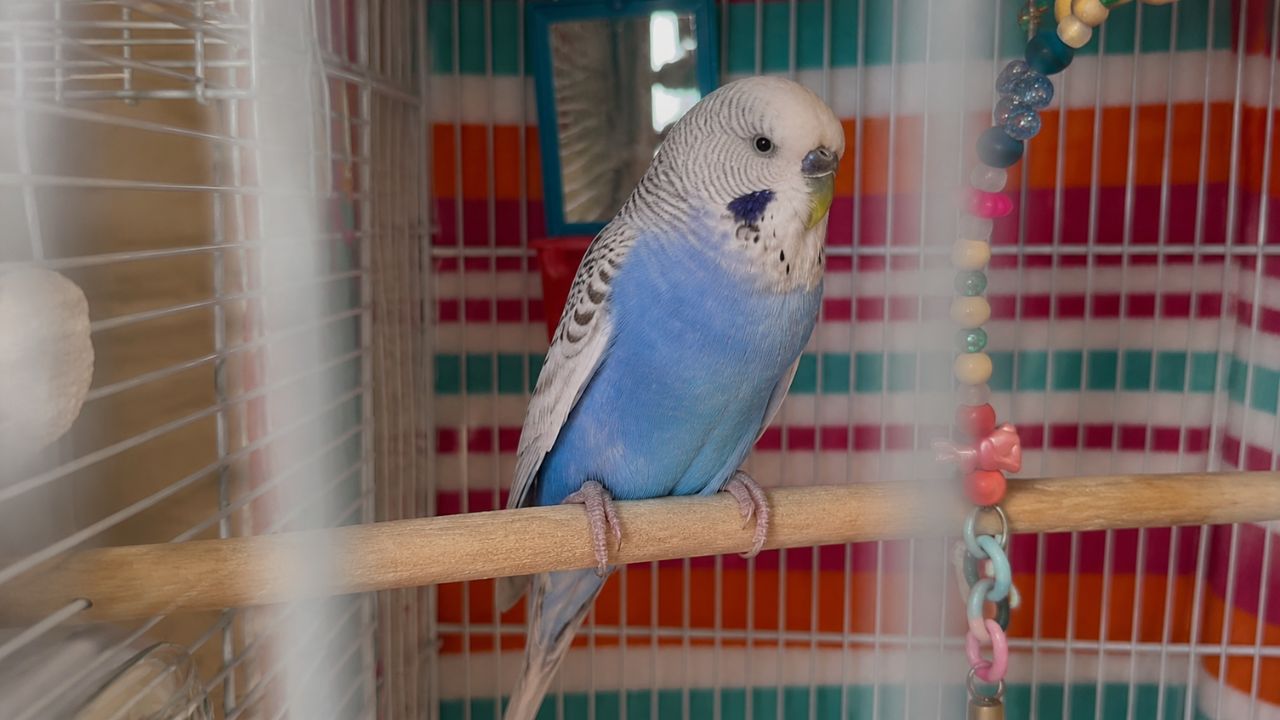

Neil has sold and kept budgerigars at Paradise Pets Swindon since 1988 — over 35 years of first-hand experience with one of the UK’s most popular pet birds. A budgie that has stopped talking is one of the questions he gets asked regularly — sometimes casually, sometimes with real worry behind it. This article is his honest, complete guide on why budgies stop talking, which causes are nothing to worry about, and which ones need a vet appointment this week.
A retired teacher came in one Thursday morning. She had owned budgies most of her adult life — this was her fourth — a green male she had raised from eight weeks old. He had been talking since he was about four months old. Nothing elaborate — his name, a few phrases she had repeated, the sound of the kettle. But consistent and clear.
He had gone quiet about three weeks ago. Not completely silent. He still chirped. Still sang occasionally. But the words had stopped. She had not changed anything. His diet was the same. The cage was the same. She was home just as much as usual. She could not work out what had happened.
“Is something wrong with him?” she asked.
I asked her a few questions. How old was the bird? Coming up to three years. Had she noticed anything else change — appetite, droppings, activity? Nothing obvious. Had the season changed, or the light levels in the room where she kept him? She thought about it. Yes, actually — the clocks had gone back recently and the room was noticeably darker in the afternoons than it had been.
That, combined with the bird’s age, told me a lot.
“I do not think anything is wrong with him,” I said. “But let me explain what I think is happening — and the few things I want you to watch for, just in case.”
That conversation is a version of this article.
First — Why Budgies Talk at All
Before we get into why they stop, it helps to understand why they talk in the first place. Because the same mechanism that drives the talking also explains most of the reasons it stops.
Budgies are highly social, vocal birds. In the wild they live in large, noisy flocks and communication is constant. They vocalise to maintain contact, to signal safety, to reinforce social bonds, to attract mates. Sound is their primary social medium.
When a budgie lives in a human home, it maps that human social world onto its own social instincts. The voices it hears repeatedly become part of its auditory landscape. Certain sounds get associated with safety, with food, with the presence of the flock. And when the bird is sufficiently relaxed, sufficiently stimulated, and sufficiently motivated — it starts to reproduce those sounds.
Talking in a budgie is not a trick. It is not performance. It is social vocalisation. The bird is doing the bird equivalent of participating in flock conversation. And it will do it most when it feels safe, engaged, and part of a flock — whether that flock is other birds or the human family it has bonded with.
Understanding this tells you most of what you need to know about why budgies stop talking. If the conditions that produce talking change — the social dynamic, the stimulation level, the bird’s physical state, the light and seasonal environment — the talking changes with them.
Reason 1: Seasonal Change and Reduced Light — The Most Common Reason I See
This is what I suspected with the retired teacher’s bird, and it is what turns out to be behind the majority of cases I investigate where the bird is otherwise well.
Budgies are seasonally responsive animals. Their behaviour, hormones, and activity levels are all influenced by day length. In the wild, long days trigger breeding season — heightened vocalisation, courtship displays, increased activity. Short days signal the end of breeding season — quieter behaviour, reduced activity, more time spent resting.
In a UK home, as the days shorten from September onward, a light-sensitive budgie follows the same pattern. It becomes quieter. It sings less. It talks less. It may sleep more. This is not illness — it is a seasonal rhythm responding to environmental cues.
A budgie kept in a room where natural light reduces significantly in autumn and winter is most susceptible to this. The change can be quite noticeable and quite abrupt — the bird is chatty in September and noticeably quiet by November. If nothing else has changed, this is almost always what is happening.
- Talking reduced or stopped around the time the clocks went back or light levels dropped in the room
- The bird is otherwise well — eating normally, active, producing normal droppings
- Other behaviours have also reduced slightly — less singing, less active during the day
- The cage is in a position where natural light has reduced over recent weeks
- The bird has been through previous winters and the same pattern may have occurred before, perhaps unnoticed

What to do
If you are certain the bird is otherwise well, seasonal silence requires no medical intervention. What it does benefit from is better lighting. A bird-specific full-spectrum UV lamp run on a natural day-length timer — ten to twelve hours — mimics the longer days that trigger active behaviour. Many owners find their bird’s vocalisation increases noticeably within two to three weeks of introducing proper lighting. Come and talk to us about UV lighting if this is new to you — I have written about it separately and it is one of the most underused welfare improvements for indoor budgies in the UK.
Reason 2: Moulting — When the Body Prioritises Feathers Over Everything Else
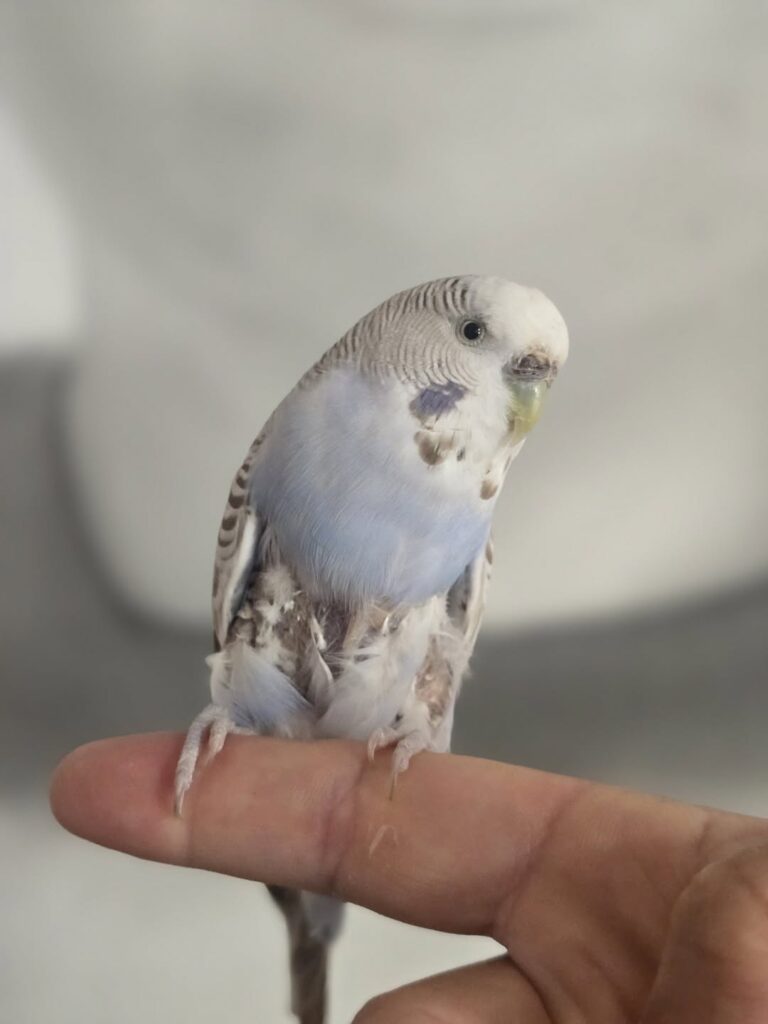
Moulting is a physically demanding process. A budgie replacing its entire plumage over the course of several weeks is directing a significant proportion of its bodily resources toward feather production — protein, energy, micronutrients. During this period, budgies typically become quieter, less active, slightly less interested in interaction, and often stop or significantly reduce talking.
This is completely normal. It is the bird’s body saying: we are busy right now, non-essential functions are on reduced output.
Most budgies moult once or twice a year. The primary moult tends to occur in late summer and again in spring, though indoor birds on artificial lighting can moult less predictably. A moult typically lasts four to six weeks.
- Small feathers visible at the bottom of the cage or on the cage floor
- Pin feathers — small, waxy-looking new feathers emerging, particularly on the head
- The bird is slightly fluffed during rest periods, which is normal during moult
- Overall activity is reduced but the bird is still eating, drinking, and producing normal droppings
- Talking and singing have reduced rather than stopped completely
- The change coincided with the appearance of shed feathers
What to do
Support the moult nutritionally. Egg food or a small amount of boiled egg once or twice a week provides the protein needed for feather synthesis. Ensure the diet is as complete as possible — this is a good time to review whether the bird is on an adequate diet. Ensure cuttlebone is available for minerals. The talking will return when the moult completes and the bird’s resources are no longer directed primarily toward feather production.
Reason 3: A New Bird in the Cage — Social Dynamics Shift Everything
This one surprises owners who have added a companion bird with the best intentions. They expected the existing bird to be happier and more vocal. Instead, it has gone quieter.
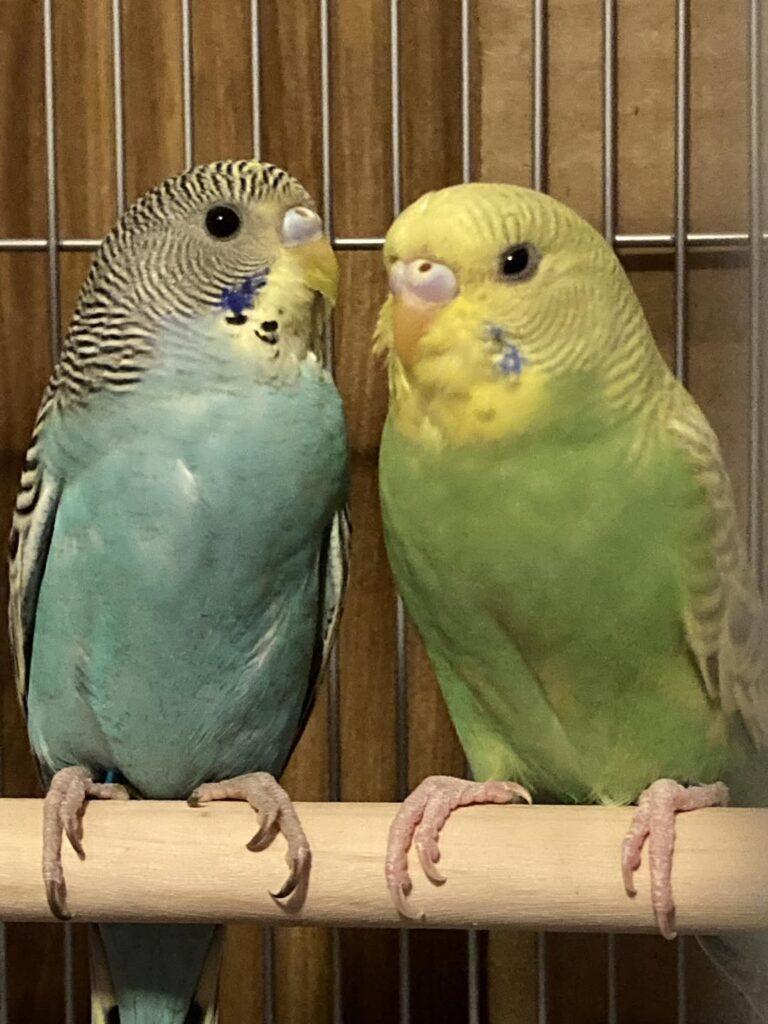
When a new bird is introduced to a cage with an established bird, the entire social structure of that small environment changes. The existing bird has to reorient its social world. It is no longer talking to fill the social silence — it now has a flock member to communicate with in bird language, which is fundamentally different from the human-mimic vocalisation that we call talking.
In many cases, the talking reduces or stops because the bird’s social needs are being met directly, in its own language, by the new companion. The bird has less motivation to seek human vocal engagement when it has genuine avian social contact.
This is actually a sign that the social introduction has worked — the birds are bonded and communicating. But it does mean the talking may not return to its previous level.
- The talking stopped or reduced after the introduction of a second bird
- Both birds appear healthy and are interacting normally
- The existing bird is still vocal — just in chirps and contact calls rather than mimicked words
- The existing bird seems otherwise happy and settled in the company of the new bird
What to do
Accept that this is likely a permanent change in the dynamic. A bird with a companion may talk less — the social need that drove the human-directed vocalisation is now met differently. If talking was particularly important to you, this is worth knowing before adding a second bird rather than after. In some cases, birds with companions still talk, particularly if human interaction remains high. But it is not guaranteed.
Reason 4: Stress or Environmental Change — The Signal Most Owners Miss
A budgie that has stopped talking as a result of stress is often not showing any other obvious sign that something is wrong. The bird is eating. The droppings look normal. It is active enough. But it is quiet in a way that did not used to be the case.
Stress suppresses vocalisation in budgies. A bird that feels unsafe or unsettled does not call out — calling out draws attention, and in a state of perceived threat, drawing attention is dangerous. The silence is a protective instinct.
The stressors I see most often behind this pattern:
A new pet in the household — particularly a cat or dog that the budgie can see or smell. Even if the predator never approaches the cage, its persistent presence creates a background level of threat perception that reduces the bird’s willingness to vocalise freely.
A change in the cage position — moved to a different room, a different wall, a position with more foot traffic or less security. A budgie that felt settled in its previous position may need weeks to reach the same comfort level in a new one.
A change in the household — a new person, a departure, a different routine. Budgies are creatures of familiarity and routine. Significant changes to either can produce sustained quietness.
Reduction in owner interaction — if the person the bird was most bonded with has become less available — changed job hours, new commitments, time away — the bird may stop talking because the audience it was talking for is no longer consistently present.
- Talking stopped around the time something in the environment changed
- New pet in the household that the bird can see or smell
- Cage was recently moved or the household routine has changed significantly
- The primary owner has been less available than usual
- The bird seems alert but watchful rather than relaxed
- Other signs of stress may be present — bar biting, over-preening, persistent calling

What to do
Identify the stressor if possible and address it. Move the cage back to its original position if that was the change. Ensure the cat or dog cannot approach the cage. Rebuild the interaction routine — consistent, daily engagement with the bird, at the same time each day. Talking to the bird, using its familiar phrases, gives it the social input that encourages the response. Most birds whose silence is stress-related will begin vocalising again as the stressor is removed and routine is re-established.
Reason 5: Illness — When Silence Is a Symptom
This is the reason that silence in a budgie can never be entirely dismissed without checking, because reduced vocalisation is one of the earliest and most consistent signs that a bird is unwell.
Budgies, as prey animals, suppress visible symptoms of illness. But vocalisation is not always fully suppressed in the early stages. A bird that was chatty and has gone quiet — particularly if the quietness appeared relatively suddenly rather than gradually — may be telling you, in the only way it can, that something is wrong.
The conditions I consider when a bird has gone quiet:
Respiratory infection. A bird with a respiratory problem may find vocalisation physically uncomfortable or effortful. The voice may change — becoming hoarser or more strained — before talking stops entirely. Listen for any change in the quality of the bird’s voice alongside the reduction in talking.
Systemic illness — bacterial infection, liver disease, parasites. General unwellness suppresses all activity including vocalisation. A bird fighting an infection is using its resources to survive, not to chat.
Crop problems. A bird with crop discomfort or infection may reduce vocalisation because the throat and crop area are uncomfortable.
Hormonal changes in females. A female budgie developing ovarian cysts or going through a significant hormonal change may become noticeably quieter. This is one of the more easily missed presentations of an internal health issue.

- The silence appeared suddenly — within hours or a day or two — rather than gradually
- The bird has also reduced its eating or drinking
- The bird looks fluffed, lethargic, or is sitting lower on its perch than usual
- The droppings have changed — watery, brightly coloured, or reduced in volume
- The voice has changed before stopping — hoarser, strained, or different in character
- The bird is a female and the silence coincides with behavioural changes that suggest hormonal shift
- Nothing in the environment has changed and there is no other obvious explanation
- The bird has been quiet for more than two to three weeks with no improvement
What to do
If the silence is accompanied by any other sign of illness — however subtle — see an avian vet this week. Do not wait for more symptoms to develop. A budgie that is suppressing illness well enough to seem broadly normal may be much more unwell than it appears. Catching an illness early gives significantly better treatment outcomes than catching it late.
Reason 6: Age — The Honest Conversation Some Owners Need
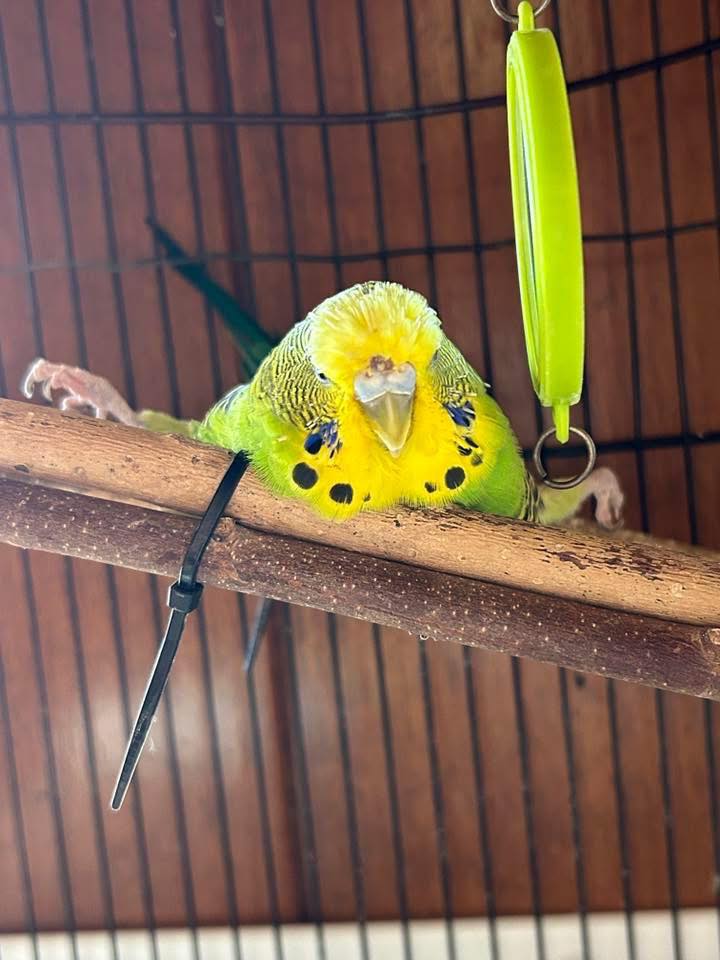
An older budgie — from around seven or eight years old — may gradually talk less as part of the natural ageing process. Older birds are often less energetic, sleep more, and produce less vocalisation overall. If your bird has been chatty for many years and is now becoming quieter as it enters its later years, this may simply be age.
This does not mean the bird is dying — many budgies live happily and contentedly into their early teens. But the energy and vocal output of a ten-year-old budgie is typically different from that of a two-year-old.
- The bird is seven years or older
- The reduction has been gradual rather than sudden
- The bird is still eating, moving, and engaging — just more slowly and quietly than before
- Other signs of healthy ageing — less activity generally, longer sleep periods
- A vet check has ruled out treatable conditions
What to do
Continue to provide interaction, good nutrition, and appropriate enrichment for an older bird. Talking to the bird, playing familiar phrases, and maintaining a consistent gentle routine gives an older bird the social stimulation it still needs, even if its responses are less frequent. A vet check for an older bird that has gone quiet is still worthwhile — age-related decline and treatable illness can look similar, and knowing which you are dealing with matters for how you manage the bird’s care.
Reason 7: The Bird Simply May Not Talk Again
This is the honest answer that some owners need to hear, and the one I am always careful to give without causing unnecessary distress.
Not all budgies talk. Talking in budgies is influenced by sex — males talk more readily than females — by individual temperament, by how early the bird was socialised and exposed to human speech, by the consistency of vocal engagement it has received, and by factors that are simply individual and not fully explainable.
A budgie that talked and has stopped may not restart. The reasons I have described above can explain the reduction. But some birds, once they stop, do not resume — particularly if they have acquired a companion, passed through a significant seasonal or hormonal change, or simply reached a stage where human-mimic vocalisation no longer motivates them.
This is not a failure. It is not a sign of a problem. Some budgies chatter constantly throughout their lives. Some never talk at all. Most fall somewhere in between, at different stages of their lives.
If you have a bird that has stopped talking and you have worked through the causes above without finding a clear reason — and the vet has confirmed the bird is healthy — accept that the talking may not return, and find other ways to engage with the bird that it clearly does enjoy.
How to Encourage a Budgie to Start Talking Again
If the medical and environmental causes have been addressed, here is the practical approach to encouraging a bird that has gone quiet to begin talking again.
- Talk to the bird consistently, at the same times each day.
Morning feeding time and early evening are the periods when budgies are typically most vocal and receptive. Use a calm, clear voice. Repeat the same words and phrases rather than a constantly changing range of new ones. Familiarity is what triggers mimicry. - Use the bird’s name repeatedly.
A bird’s own name is usually the first thing it will reproduce. Say it clearly, at moderate pace, as part of natural interaction. “Hello [name]” as you approach the cage every morning, every day, for weeks. This kind of consistency is what produces results. - Reduce competing noise during interaction.
A television or radio on in the background competes with your voice for the bird’s auditory attention. During dedicated talking sessions, turn background noise off. Your voice should be the clearest, most consistent sound the bird hears. - Use the same phrases the bird has produced before.
A bird does not relearn a phrase from scratch — it retrieves something it already has. The familiar phrases it used to produce are more likely to come back than entirely new ones. Use them consistently and the bird’s own memory may do the rest. - Improve the lighting.
If seasonal light reduction is a factor, a bird-specific UV lamp on a ten to twelve hour timer raises general activity and vocalisation levels. Many owners see talking return within weeks of improving the lighting environment. - Be patient. Measure in weeks, not days.
A bird that has been quiet for three weeks will not talk again after three days of renewed effort. The process of bringing back vocalisation that has lapsed takes the same patience as the original training. Consistency and time are the only reliable tools.
What Not To Do
| What people do | Why it is wrong | What to do instead |
|---|---|---|
| Play recordings of talking budgies loudly near the cage | The unfamiliar voices of unknown birds can unsettle a bird rather than stimulate it — particularly in birds that are already quieter than usual | Use your own voice, consistently, with familiar phrases |
| Leave the television on all day hoping the bird will pick up words | Television speech is too fast, too varied, and too inconsistent to produce mimicry in most birds. It is noise, not teaching | Clear, consistent repetition of specific words and phrases by the owner produces results. Television does not |
| Assume talking will return without addressing the cause | If a stressor, seasonal change, or nutritional issue is behind the silence, it will not resolve on its own without being addressed | Work through the causes systematically, address what you find, then work on encouraging vocalisation |
| Wait more than three weeks before seeing a vet if nothing else explains it | Persistent unexplained silence in a previously vocal bird is a symptom worth investigating. The longer it is left, the later any illness is caught | If silence has persisted for more than two to three weeks with no clear benign explanation, book a vet check |
| Reduce interaction because the bird is not responding | Reduced interaction removes the social stimulus that encourages vocalisation — it deepens the silence rather than resolving it | Maintain consistent daily interaction even when the bird is not responding — the stimulus is still being received |
Frequently Asked Questions
My budgie has never talked — is something wrong?
Not necessarily. Not all budgies talk. Females are significantly less likely to talk than males. Some individual birds, regardless of sex, simply do not develop mimicry. A budgie that is otherwise healthy, active, and vocalising in chirps and contact calls is a well bird — the absence of words is not a health indicator.
My budgie talks but only when I am not in the room — why?
This is very common and it is usually because the bird is more relaxed when it does not feel it is being watched. Many budgies vocalise freely when alone and become quieter when observed — the awareness of being watched inhibits the relaxed, spontaneous vocalisation. This is not a problem. It is a common budgie personality trait.
Can a budgie lose words it has already learned?
Yes. Words that are no longer consistently heard or reinforced can fade from the bird’s active repertoire over time. A budgie that learned a phrase it heard constantly but that is no longer repeated may stop producing it. This is not permanent loss — re-exposure to the familiar phrase often brings it back more quickly than the original learning took.
My budgie has a companion and has stopped talking — will it start again if I separate them?
Possibly, but I would not recommend separation purely to restore talking. The social wellbeing of the birds together is more important than talking. If the birds are bonded and thriving together, the talking reduction is an acceptable trade-off. Separation causes genuine stress and is not a welfare-appropriate solution to a preference for a vocal behaviour.
Should I be worried if my budgie stops talking for a week?
One week of reduced talking coinciding with a moult, a seasonal light change, or a minor environmental shift is not immediately concerning if the bird is otherwise well. Watch carefully, address any obvious environmental factors, and if the bird is clearly well in every other respect, give it two to three weeks before escalating to concern. If anything else changes alongside the silence — appetite, droppings, activity level — do not wait.
Where can I get budgie advice in Swindon?
Come and see us at Paradise Pets, Manor Garden Centre, Cheney Manor Industrial Estate, Swindon SN2 2QJ. Or ring us on 01793 512400. We have been keeping, selling, and advising on budgies for over 35 years and we will give you an honest answer about what you are seeing.
One Last Thing From Me
The retired teacher came back about six weeks after our conversation. She had added a bird-specific UV lamp on a timer. She had been talking to her bird more consistently during the early morning feeds. She had started repeating the phrases he used to say — the same ones, every day, at the same time.
He had started talking again about three weeks in. Not at the same level as before, she said — but clearly there again. His name. The phrase she said when she uncovered his cage every morning. A sound that was nearly the kettle.
She said she thought she had probably been taking it for granted. The talking. The way he would answer when she talked to him. She had not realised until it stopped how much she had relied on it as a measure of his wellbeing.
That is the most honest thing about a budgie stopping talking. It is not always a crisis. It is often a message — about light, about season, about the state of the bird’s world. And when you listen to it properly, rather than just worrying about it, it usually tells you something useful.
Come and see us if you need help working out what yours is telling you.
Worried About Your Budgie Going Quiet? Come In and Let’s Work Through It
We have been selling and advising on budgies for over 35 years. If your bird has stopped talking and you cannot work out why, come in and describe exactly what you are seeing. We will tell you honestly what we think — and whether it needs a vet. Free advice, no obligation.
⭐ Customer Reviews
Amazing Bird Selection
Had a lovley visit today,staff were very friendly and very helpful,such a great petshop,their selection of birds is incredible,really impressed,thank so much to the staff at Paradise Pets

Friendly Helpful Staff
I have been coming to this place for years and they have a great stock of food for all types of pets. Have a great selection of small mammals and a lot of birds. Staff are friendly and helpful.

Great Quality Hutch
Bought a guinea pigs hutch and run combo, very happy with the service, the hutch was put in my car for me without even asking for help. The wood quality is very good, the instructions easy to follow and we are extremely happy with the fully built hutch. A good size for 2 guinea pigs

Response from Paradise Pets | Wiltshire
Thank you Melanie Latus Nice to provide services to you.
Best Bird Shop Around
It’s the best pet shop in and around Swindon. They always have an amazing selection of birds and all you need to keep them happy. I keep birds myself and the guys there are happy to answer questions and really know their stuff. I have seen budgies etc. in chain pet shops in the area looking really unhealthy and ill – I wouldn’t go anywhere else than Paradise Pets for animals.

Highly Recommended Bird Shop
I could not praise this shop enough. Really helped my Grandson buy his first bird and he’s loving it. Travelled from Somerset and was welcomed with open arms.

Great Shop with Competitive Prices
Great shop with amazing selection for small animals, hamsters, mice ect, highly recommend!
Also has a great selection for dogs & cats too & very competitive prices! 💖

