
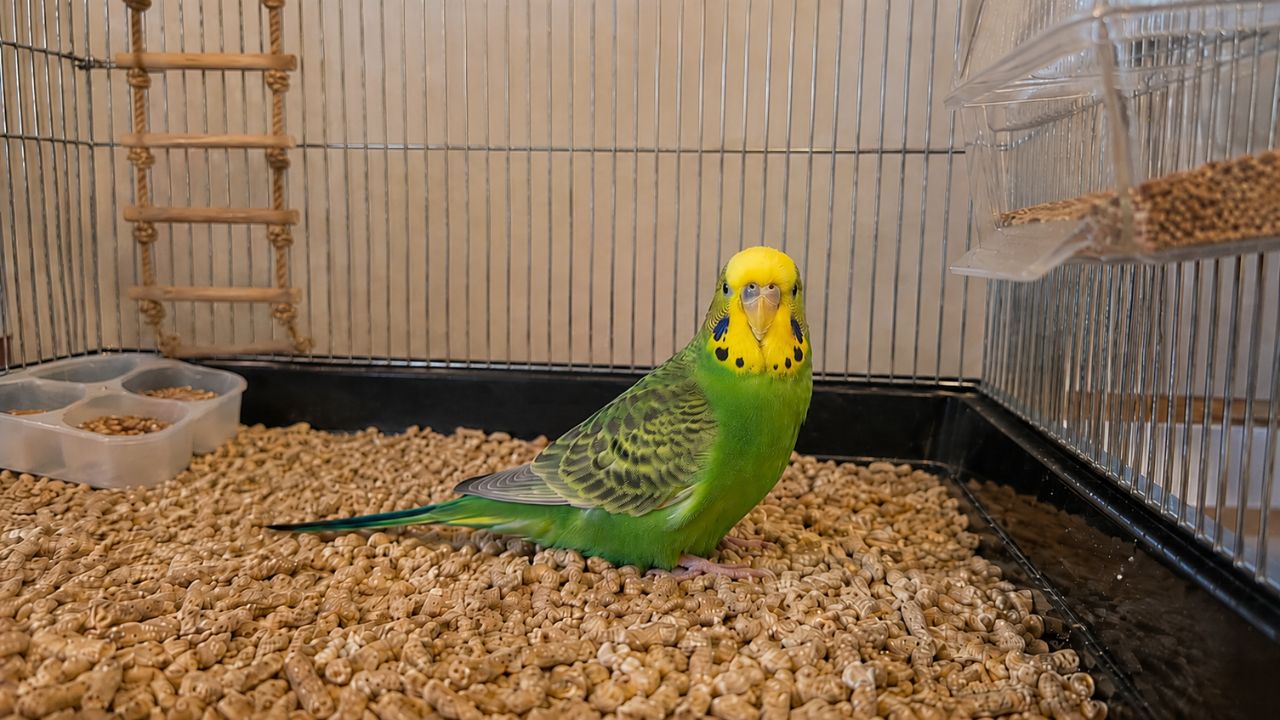

Neil has kept, bred, and sold budgies at Paradise Pets Swindon since 1988 — over 35 years of first-hand experience with these birds. A budgie that has moved to the bottom of the cage is one of the most urgent calls he receives. This is his honest, practical guide on exactly what to do — written for UK owners who need answers fast.
A woman came into the shop on a Friday afternoon holding a small travel cage pressed against her chest. She did not say anything at first. She just held it up so I could see inside.
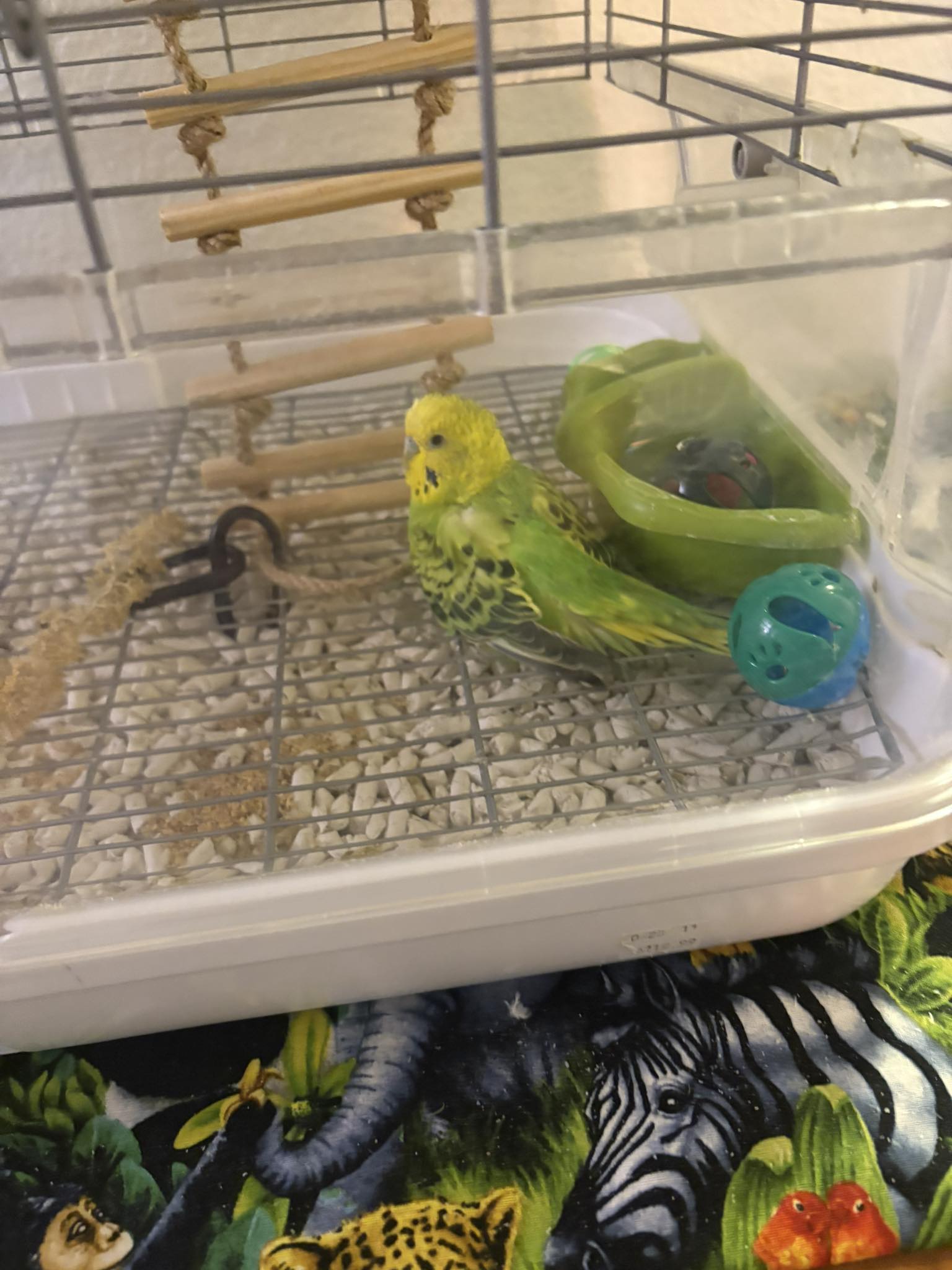
Her budgie was sitting on the cage floor. Not on a perch. Not fluttering about. Just sitting very still in the corner, feathers puffed up, eyes half-closed.
“She was fine this morning,” the woman said. “I just came home from work and she was like this.”
I have seen that scene more times than I can count over 35 years. A budgie on the cage floor. An owner who cannot understand how it happened so fast. And the clock already ticking — because with budgies, once they are showing symptoms this obvious, you do not have days. You have hours.
A budgie sitting at the bottom of the cage is a medical emergency until proven otherwise. That is the single most important sentence in this article. Everything else follows from it.
This guide covers the most common causes I see, how to tell them apart, and exactly what to do right now to give your bird the best possible chance.
- Do not wait to see if it improves. It rarely does on its own.
- Phone an avian or exotic vet immediately — same day, not tomorrow
- Keep the bird warm — move it to a warm room, aim for around 30°C near the bird
- Check breathing — rapid, laboured, or tail-bobbing breathing is a critical emergency
- Do not handle excessively — stress alone can cause a sick budgie to crash
- If you are local to Swindon, ring us on 01793 512400 — we will help you judge the urgency
Why This Is So Serious — What Most Owners Do Not Know
Let me explain something about budgies that changes everything once you understand it.
Budgies are prey animals. In the wild, a sick or weak bird gets picked off first — by predators, by other birds, by anything that spots vulnerability. So over millions of years of evolution, budgies have developed a remarkable ability to appear normal even when they are seriously unwell. They keep eating, keep chirping, keep flying around — right up until they physically cannot do it anymore.
This is called masking illness, and it is one of the most important things any budgie owner can understand.
What it means in practice is this: by the time your budgie is sitting at the bottom of the cage, the underlying problem has almost certainly been developing for days — sometimes longer. You are not seeing the start of the illness. You are seeing the point at which the bird can no longer hide it.
That is why the window for action is so short. Not because the illness appeared suddenly, but because the visible signs appear suddenly — at the end of a process that was already well underway.
What Normal Looks Like — And What Does Not
Before we go through the causes, I want to make sure we are talking about the same thing. Because there are a couple of situations that look like a budgie on the cage floor but are not necessarily a crisis.
A budgie that is moulting heavily, or a very young bird still finding its feet, may occasionally sit lower than usual. A budgie startled by something may drop to the floor momentarily. Female budgies sometimes sit low when they are being broody.
What we are talking about in this article is different. It is the budgie that:
- Has been on the cage floor for more than a few minutes, not just briefly
- Has its feathers puffed up — a classic sign the bird is trying to conserve heat
- Has eyes half-closed or looks sleepy and unresponsive during daylight hours
- Is not eating or drinking, or has significantly reduced its intake
- Is quiet — no chirping, no chattering, none of its usual sounds
- Feels light — noticeably lighter than usual when you hold it
- Has droppings that look different — watery, discoloured, or absent
That picture — particularly several of those signs together — is what tells me the bird is in trouble.
The 6 Main Causes I See — In Order Of How Often I Encounter Them
Cause 1: Illness Or Infection — The Most Urgent Category
When a budgie comes to the cage floor and stays there, the first thing I always think about is illness. Not because it is the only explanation, but because it is the one you cannot afford to get wrong — and it is more common than most owners expect.
Budgies are susceptible to a range of bacterial, viral, and fungal infections. They can develop respiratory illness, gut infections, liver problems, kidney disease, and more — often with very little visible warning until the masking finally breaks down. By the time the bird is on the floor, the immune system has often been fighting something for days already.
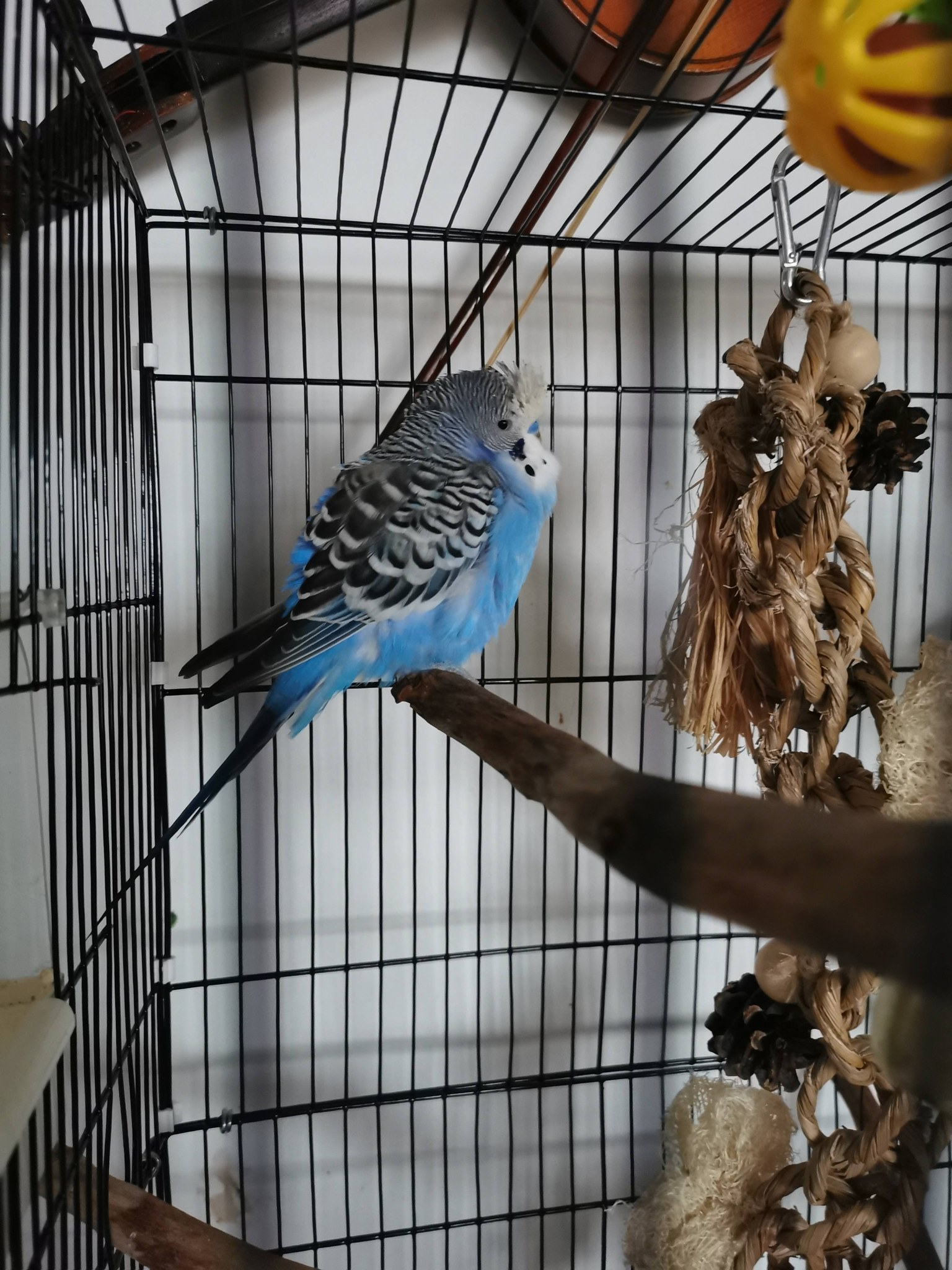
- Feathers permanently puffed up — the bird is struggling to maintain body temperature
- Eyes half-closed or closing during the day — in a healthy budgie this does not happen
- Tail bobbing with each breath — a sign the bird is working hard to breathe
- Discharge from nostrils or eyes, or wet, crusty feathers around the face
- Droppings have changed colour, consistency, or frequency
- The bird smells different — a sour or unusual odour can indicate infection
- Rapid, laboured, or open-mouth breathing — avian emergency
What to do
Same-day avian vet. No exceptions. Budgies are small animals and they deteriorate with frightening speed once they are visibly unwell. While you arrange the vet, keep the bird warm — a temperature of around 30°C near the bird helps enormously with recovery, and warmth alone can stabilise a sick bird while you get help. Do not try to diagnose or treat this yourself. The range of possible causes is too wide and the window for action too short.
Cause 2: Respiratory Problems — More Common In UK Winters
Respiratory illness deserves its own section because it is one of the most common conditions I see in budgies in the UK, and because the signs are specific enough that owners can often spot it themselves.
Budgies have a very efficient respiratory system — but that efficiency also means infections spread through it quickly. Draughts, cold temperatures, damp conditions, and airborne irritants (cigarette smoke, aerosol sprays, non-stick cookware fumes) all put the respiratory system under stress. In UK winters particularly, birds kept near doors or windows, in garages, or in poorly heated rooms are at significant risk.
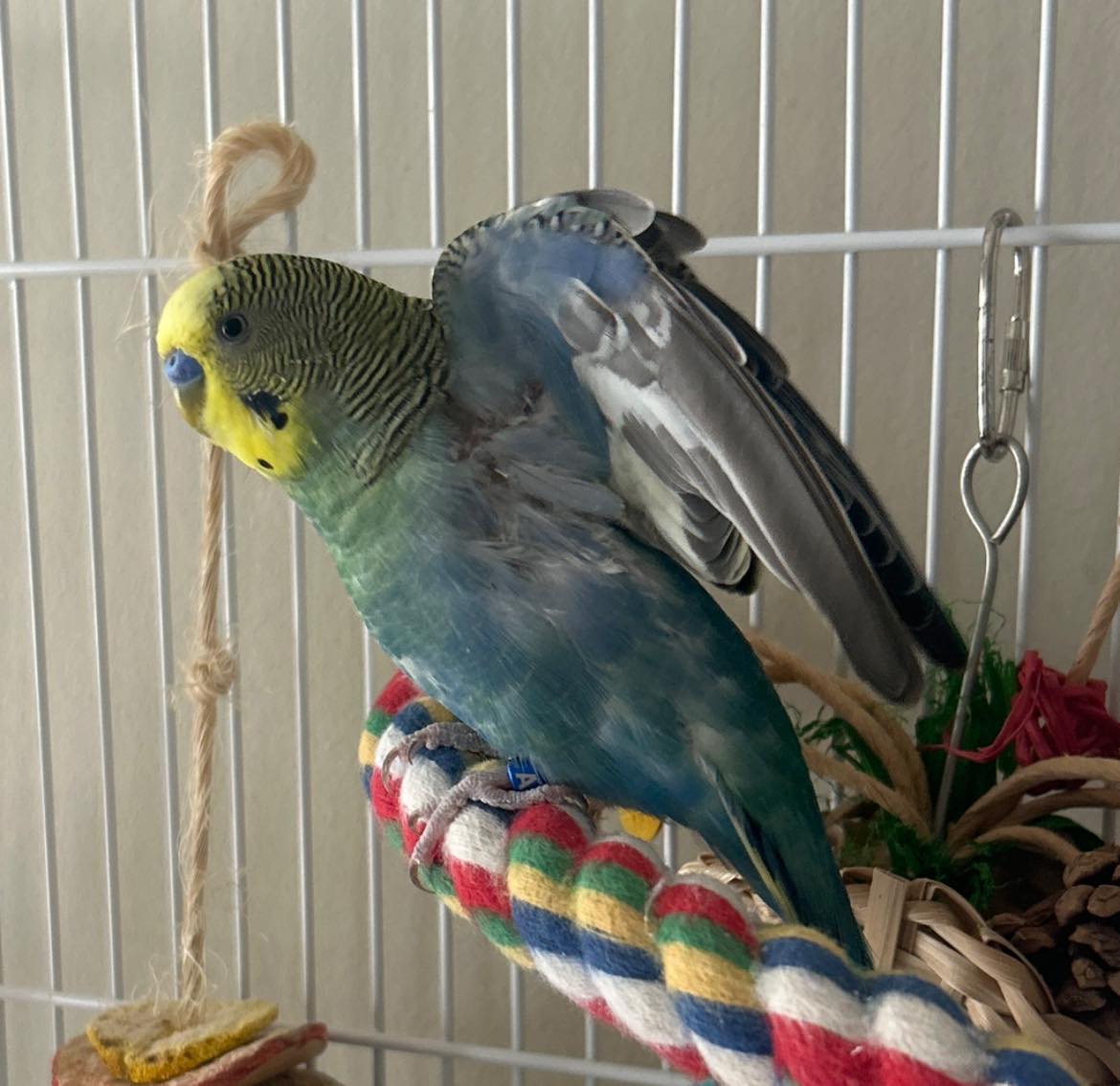
- Tail bobbing rhythmically with each breath — the clearest single sign
- Clicking, wheezing, or rattling sounds when breathing
- Open-mouth breathing — the bird cannot get enough air through its nostrils
- Wet or crusty nostrils
- Bird sitting low, feathers puffed, breathing with obvious effort
- Any exposure to cigarette smoke, aerosols, or non-stick pan fumes — these can be fatal to budgies in minutes
What to do
Avian vet, same day. Respiratory infections in budgies need antibiotics and often supportive care. Remove any possible airborne irritants from the bird’s environment immediately — this step alone has saved birds that were in respiratory distress from fume exposure. Keep the room warm and draught-free while you arrange the vet.
For more on respiratory issues specifically, our guide on heavy breathing in budgies covers the warning signs every UK owner needs to recognise.
Cause 3: Injury — Often Missed Because There Is No Obvious Blood
A budgie on the cage floor is not always ill. Sometimes it is injured — and injuries are easy to overlook because budgies rarely show blood from internal injuries, and even external injuries can be hidden by feathers.
Common injuries I see: a bird that has flown into a window, a mirror, or a wall. A bird that has had a night fright and crashed around the cage in the dark. A bird that has caught a foot in a toy, a loose wire, or an ill-fitting perch. A bird that has been grabbed by another animal — a cat that batted at the cage, a dog that knocked it over.
- Check the feet and legs carefully. Is the bird bearing weight on both feet? Is either leg held at an odd angle? Are there any cuts, swelling, or constriction marks?
- Check the wings. Are both wings held normally against the body? A drooping wing often indicates a fracture or dislocation.
- Look at the head and eyes. Any asymmetry, head tilt, or loss of coordination can indicate a head injury from impact.
- Check for any puncture wounds. Even small cat scratches are serious — cat bacteria are toxic to birds and require immediate antibiotic treatment.
- Was there any event that could have caused an injury? A noise at night, another animal in the room, a recent out-of-cage flight session?
What to do
Any suspected injury is a vet visit. Even if you cannot see visible damage, an X-ray may be needed to rule out fractures. Cat scratches or bites are a particular emergency — even a scratch that looks minor can introduce bacteria that are fatal to birds within hours without antibiotics. Do not delay on this one.
Cause 4: Egg Binding — Female Budgies Only, But A Genuine Emergency
This is one of the most common serious conditions I see in female budgies, and it is one that owners regularly miss because they do not know to look for it.
Egg binding is exactly what it sounds like — a female budgie that is unable to pass an egg. It can happen to any female, even one that has never been with a male and has no fertile eggs. The egg forms, and for various reasons — calcium deficiency, the egg being too large, the bird being too young or in poor condition — it becomes stuck.
A budgie with egg binding will sit at the bottom of the cage, often straining, with a characteristic wide-legged stance. The abdomen may look swollen. The bird is in genuine pain and deteriorates rapidly.
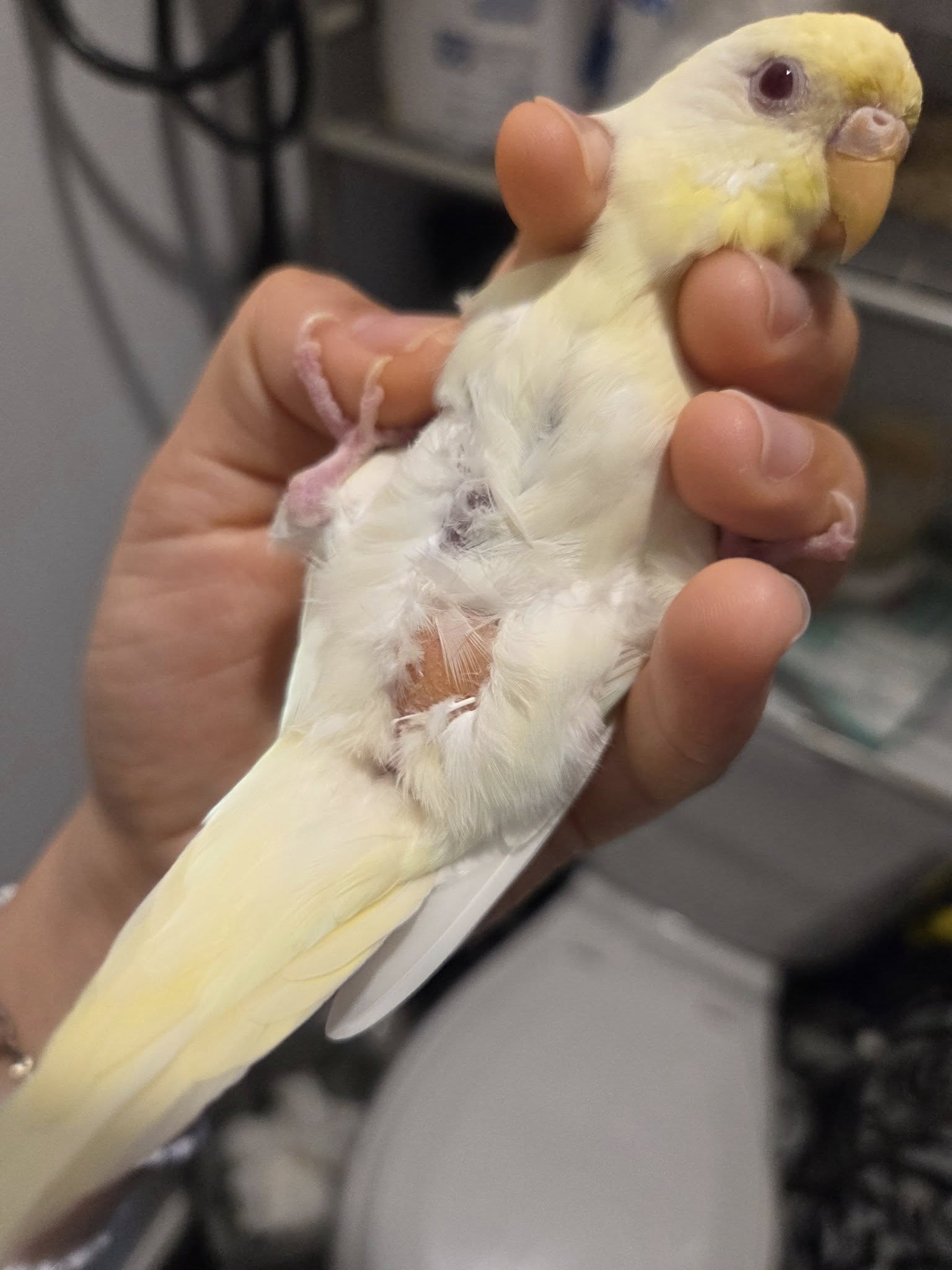
- Female bird sitting at the bottom of the cage with legs spread wide
- Visible straining or repeated tail-pumping motions
- Abdomen appears rounded or swollen
- Bird is quiet, lethargic, and not eating
- Droppings may be absent or very small
- The bird feels heavier than usual around the abdomen when held gently
What to do
Avian vet, immediately. Egg binding is fatal if not treated. While you arrange the vet, warmth is critical — a warm, humid environment helps relax the muscles and can sometimes allow the egg to pass naturally, but do not wait for this to happen on its own. This is a genuine time-critical emergency. Do not leave it until the next morning.
For more on telling male and female budgies apart, our guide on how to identify male and female budgies can help if you are unsure of your bird’s sex.
Cause 5: Poisoning Or Toxic Exposure
This is a cause that arrives fast and gets serious very quickly. Budgies are extraordinarily sensitive to airborne toxins — far more sensitive than humans or even cats and dogs. By the time you notice the bird on the cage floor after a toxic exposure, it may already be in critical condition.
The most dangerous sources in a typical UK home:
- Non-stick cookware — PTFE fumes from overheated non-stick pans are fatal to birds. Do not use non-stick pans in a home with budgies, or keep the bird in a completely separate part of the house with no airflow connection to the kitchen
- Aerosol sprays — air fresheners, deodorants, cleaning sprays, furniture polish. Even brief exposure in an enclosed room can be enough
- Scented candles and incense — the particles and fumes are highly toxic to avian respiratory systems
- Cigarette and vape smoke — cumulative damage over time, but acute exposure can cause rapid deterioration
- Carbon monoxide — gas leaks or faulty appliances. If other people or animals in the home are also feeling unwell, leave immediately and call 999
- Toxic plants — avocado is particularly dangerous to budgies. Many common houseplants are toxic if the bird chews on them
What to do
Move the bird to fresh air immediately — outside or in a room with no connection to the source of toxins. Then get to an avian vet as fast as you can. If you suspect carbon monoxide, get everyone out of the property and call the emergency services. There is no home treatment for poisoning. Speed is everything.
Cause 6: Old Age And End Of Life
This is the most difficult cause to talk about, but it is part of any honest guide on this subject.
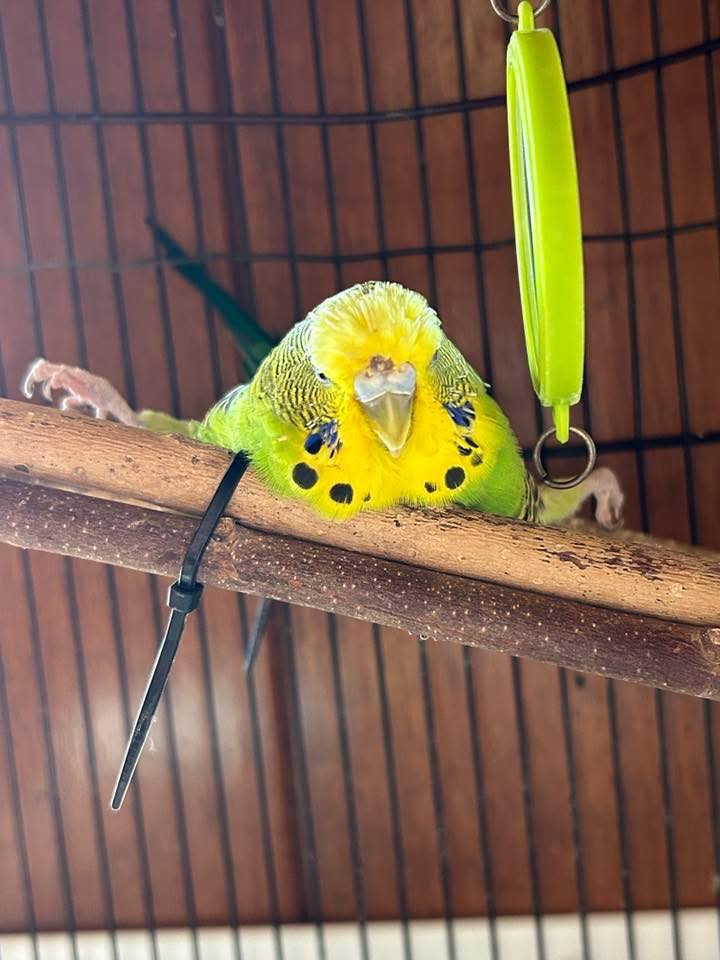
A budgie that is seven or eight years old or more — particularly one that has been gradually slowing down over recent weeks — may simply be nearing the end of its natural life. The signs are usually gradual: spending more time on lower perches, less interest in food, quieter, less reactive, and eventually coming to the floor.
This is not a failure on your part. It is the natural end of a life well-lived.
- How old is the bird? Budgies typically live six to eight years, sometimes more. An older bird declining gradually is different from a young bird suddenly on the floor.
- Has it been gradual? Natural decline is slow — weeks of gradually reducing activity, not a sudden collapse.
- Is the bird still comfortable? Eating a little, drinking, responsive to you when you approach? Or is it in distress?
- Has a vet ruled out treatable conditions? What looks like old age is sometimes arthritis, a chronic infection, or a nutritional deficiency — all of which can be managed.
What to do
Even in suspected old-age cases, a vet visit is worthwhile. Sometimes what looks like natural decline is actually a treatable condition. If the vet confirms the bird is genuinely at end of life, your role shifts to comfort — warmth, easy access to food and water at floor level, gentle company, minimal stress. There may also come a point where euthanasia is the kindest option. That is a hard conversation, but it is sometimes the right one.
For more on the typical lifespan of pet budgies, our guide on how long budgies actually live covers what to expect and how to give yours the best chance at a long life.
What I Check When Someone Brings In A Budgie That Is On The Floor
When an owner walks in with a budgie that is sitting at the bottom of the cage, I do not guess. There is a sequence I go through every time.
- How is the bird breathing?
Tail bobbing, open-mouth breathing, clicking or wheezing sounds — respiratory emergency, vet immediately. - How long has it been on the floor?
Minutes could be a fright or minor accident. Hours means something is seriously wrong. - Is the bird eating and drinking?
A budgie that has not eaten for twelve hours is already in serious trouble. - What do the droppings look like?
Watery, discoloured, or absent droppings narrow down the possible causes significantly. - Is the bird male or female?
Female on the floor with a swollen abdomen — egg binding until proven otherwise. Vet immediately. - Has there been any toxic exposure?
Cooking, sprays, candles, smoke. Ask specifically — owners often do not connect the two events. - How old is the bird?
Young bird suddenly on the floor — acute illness or injury. Old bird gradually declining — different conversation. - What does the environment look like?
Temperature, draughts, location. Cold and draughty conditions accelerate decline in a sick bird.
Five minutes of these questions usually narrows things down enough to know whether it is a critical emergency, a vet visit that can happen within the hour, or a longer-term care conversation.
What Not To Do
Over 35 years, I have seen well-meaning owners do things that made a bad situation worse. Please avoid these.
| What people do | Why it is wrong | What to do instead |
|---|---|---|
| Wait overnight to see if it improves | Budgies deteriorate in hours — by morning it is often too late | Phone an avian vet the same day, even if it is evening |
| Handle the bird repeatedly to check on it | Stress and handling causes a sick bird’s condition to crash | Minimal handling — keep the bird warm and leave it quiet |
| Force-feed water or food | A weak bird can aspirate — fluid in the lungs is fatal | Offer food and water at floor level and let the bird choose |
| Put the bird directly on a heat pad or radiator | Direct heat can burn or overheat the bird | Warm the room to around 30°C — indirect, gentle warmth |
| Try over-the-counter treatments | Most are ineffective; some are harmful to birds in this condition | Only use what an avian vet has prescribed for this bird |
| Assume it is “just moulting” or “just tired” | A healthy budgie does not sit on the cage floor | Take it seriously — the bird cannot afford for you not to |
How To Prevent This Happening
Most of the cases I see could have been avoided with better husbandry from the start. Here is what I tell every budgie owner.
- Weigh your budgie weekly — weight loss is the earliest sign of illness, often appearing before any other symptom. A small set of kitchen scales takes thirty seconds.
- Never use non-stick cookware in a home with budgies, or ensure the bird is completely isolated from any kitchen fumes.
- No aerosols, scented candles, or incense in any room the bird occupies or that shares airflow with its room.
- Keep the cage away from draughts and cold — 18 to 22°C is the ideal range for budgies in a UK home.
- Feed a proper diet — seed alone is not sufficient. Fresh vegetables, leafy greens, and cuttlebone for calcium should all be part of the daily routine.
- Have an avian vet identified before you need one — find one in your area now, not when the bird is already on the floor.
- Observe the bird daily — five minutes of watching your budgie’s behaviour, droppings, and posture every day will catch changes early, before the masking breaks down.
When To Go Straight To The Vet — Do Not Stop Here First
I am always glad to have owners come in and talk things through. But there are situations where I send them straight to an avian vet without stopping. These are them.
- Tail bobbing with every breath, or open-mouth breathing
- The bird has not eaten or drunk anything in twelve hours or more
- Female with a swollen abdomen sitting wide-legged on the floor
- Any suspected toxic fume exposure — non-stick, aerosol, smoke
- The bird is unresponsive or cannot grip your finger
- Visible injury — drooping wing, inability to stand, any puncture wound
- Rapid deterioration over a matter of hours
For everything else — the bird that seems unwell but is still alert, still eating a little, where the cause is unclear — bring it in or ring us first. We will help you work out the level of urgency.
Frequently Asked Questions
Is it normal for a budgie to sit at the bottom of the cage sometimes?
No. A healthy budgie spends its time on perches, not on the cage floor. The floor of the cage is not somewhere a well budgie chooses to be. Any budgie that is spending significant time on the floor is showing a warning sign that deserves investigation.
My budgie is on the floor but still eating — should I still be worried?
Yes. A budgie that is still eating may be less critically ill than one that has stopped, but being on the floor is still abnormal. Monitor very closely, and if the bird does not return to perching within a few hours or any other symptoms develop, get to a vet.
How quickly can a budgie go from seeming fine to seriously ill?
Very quickly. Because budgies mask illness so effectively, the visible collapse can happen in hours even when the underlying condition has been developing for days. This is why I say act immediately — not because the illness appeared suddenly, but because the window for treatment is short once the masking breaks down.
What temperature should I keep a sick budgie at?
Around 30°C near the bird is the standard supportive care temperature. This helps a sick bird maintain its body temperature without using energy it does not have. Use a heat lamp on one side of the cage so the bird can move away if it gets too warm. Do not use direct heat sources like hot water bottles pressed against the bird.
My budgie fell off its perch — is this the same thing?
Falling off a perch is a serious sign and should be treated with the same urgency. It can indicate extreme weakness, a neurological problem, a head injury, or a severe systemic illness. Get to an avian vet the same day.
Where can I get urgent budgie advice in Swindon?
Come and see us at Paradise Pets, Manor Garden Centre, Cheney Manor, Swindon SN2 2QJ. Or ring us on 01793 512400. For genuine emergencies — particularly breathing problems, egg binding, or toxic exposure — go straight to an avian vet. We will help you work out which it is.
One Last Thing From Me
The woman I mentioned at the start of this article — the one who came in on a Friday afternoon with her budgie pressed against her chest? She had come straight from work. She had not gone home first, had not stopped to have a cup of tea, had not waited to see how the bird was in an hour. She had seen it on the floor and she had come straight out.
Her budgie had a respiratory infection. The vet gave her antibiotics and supportive care instructions. She kept the bird warm all weekend, syringe-feeding recovery food every few hours. By Monday the bird was back on its perch. By Wednesday it was talking again.
That outcome was entirely down to the fact that she did not wait. The difference between a budgie that recovers and one that does not is almost always the same thing — how fast the owner acted when they saw the signs.
If your budgie is on the cage floor, please act now. Phone an avian vet today. If you are in Swindon and you are not sure how serious it is, ring us first and we will tell you honestly. But whatever you do — do not leave it until tomorrow.
Budgie On The Floor? Phone An Avian Vet Now — Or Come And See Me First
For genuine emergencies — breathing problems, egg binding, toxic exposure, or a bird that is unresponsive — go straight to an avian vet. For everything else, bring the bird in or ring us. I will take a proper look and tell you honestly what I think. Free advice, no obligation. That is how we have done things for 35 years.