
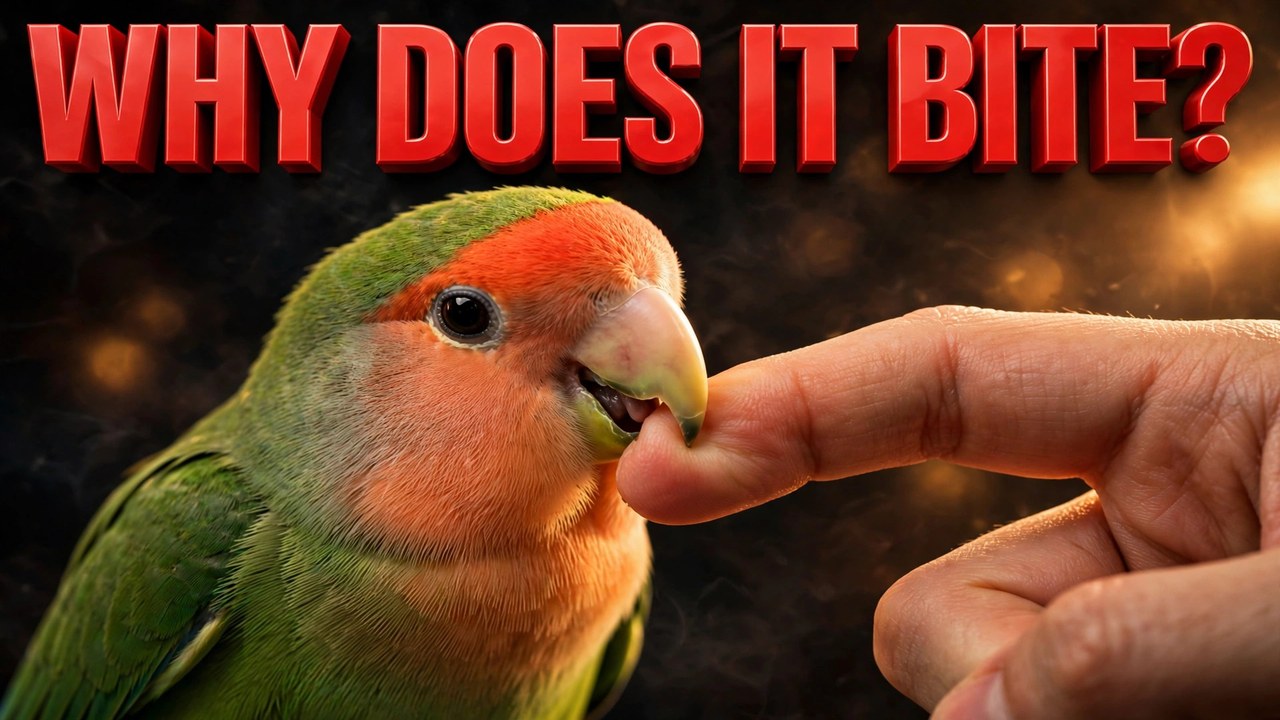

Lovebirds have a reputation problem. They’re sold as tiny bundles of affection — and they are — but many owners get a painful surprise: those adorable little beaks can really bite. Hard enough to draw blood, hard enough to make you flinch every time a hand goes near the cage.
Here’s the truth most pet shops skip: lovebirds don’t bite because they’re mean. Every bite has a reason, and once you understand the reason, you can fix it. Here are the 5 real reasons lovebirds bite — and exactly what to do about each one.
5 Reasons Your Lovebird Bites (and How to Fix Each)
1. It’s Afraid of You — The Most Common Reason
A lovebird that isn’t hand-tamed sees your approaching hand the way you’d see a bear walking toward you. Biting is its only defense. Fear-biting looks specific: the bird backs away first, feathers slick tight, eyes wide — and strikes only when it feels cornered.
The fix: Stop forcing contact completely. For 1–2 weeks, just exist near the cage — read, talk softly, move predictably. Then start offering millet spray through the bars, letting the bird come to you. Progress to an open cage door with your hand resting still inside. The bird must choose to approach, every single time. Most fear-biters transform within 2–4 weeks of this protocol because the underlying emotion — terror — is gone.
2. It’s Defending Its Territory
Lovebirds are famously territorial about their cage. A bird that’s sweet on your shoulder can turn into a tiny guard dog the moment your hand enters its cage — lunging, hissing, biting. This isn’t personal. In the wild, a lovebird’s nest cavity is life itself, and the instinct to defend it is hardwired.
The fix: Change the geography, not the bird. Do all handling outside the cage — let the bird come out on its own, then interact on a playstand or your shoulder. Never reach into the cage to grab the bird; instead, lure it out with a treat or let it step onto a perch you offer at the door. Respect the cage as sovereign territory and the aggression usually vanishes.
3. Hormones Have Taken Over
During breeding season, even the sweetest lovebird can become a biting machine. Hormonal birds get territorial, possessive (of you, a toy, a mirror, a dark corner) and dramatically more reactive. Females are especially prone — and chronic hormonal behavior can lead to dangerous egg-laying.
Signs it’s hormonal: the biting started suddenly in spring, the bird is shredding paper, trying to nest in dark spaces, regurgitating on toys, or fiercely guarding one person. The fix: reset the bird’s internal calendar — ensure 12–14 hours of uninterrupted darkness nightly, remove nest-like spaces (happy huts, boxes, dark corners), stop petting below the neck (it simulates mating), and rearrange the cage weekly to break territorial claims. Hormonal biting typically fades within weeks of these changes.
4. You’re Missing the Warning Signs
Lovebirds almost always warn before they bite — owners just don’t speak the language yet. The classic pre-bite sequence: eye pinning (pupils rapidly dilating and contracting), feathers slicking tight against the body, a low hiss or growl, and leaning away from your hand. Ignore these, and the bite is the bird’s last resort.
The fix: Learn to read the bird and honor the “no.” When you see eye pinning or hear the hiss, calmly withdraw your hand — you’re teaching the bird that warnings work, which means it needs the bite less often. Over weeks, a bird whose warnings are respected typically stops escalating to bites at all. This single skill fixes more biting than any training technique.
5. Biting Has Become a Learned Habit
This is the trickiest one: the bird learned that biting works. You reach in → it bites → you yell and yank your hand away → the scary hand leaves. From the bird’s perspective, biting just successfully defended it. Every dramatic reaction — screaming, shaking the hand, chasing the bird — accidentally rewards the bite with exactly the outcome the bird wanted.
The fix: Make biting boring and ineffective. When bitten, don’t yell or flinch dramatically — calmly and neutrally place the bird down on the nearest perch and withdraw attention for a minute. No drama, no chase, no scolding. Simultaneously, heavily reward gentle beak behavior with treats and praise. You’re rewriting the equation: gentle = good things happen, biting = nothing happens. Most learned biters improve noticeably within 2–3 weeks of consistent, boring responses.
Beak Exploration vs. Real Biting: Know the Difference
Not everything that touches your skin is a bite. Lovebirds explore the world with their beaks the way toddlers use their hands:
| Behavior | What It Feels Like | What It Means |
|---|---|---|
| Gentle nibbling | Light pressure, no pain | Exploration or affection — totally normal |
| Beak “testing” | Firm grip before stepping up | Balance check, not aggression |
| Warning nip | Quick pinch | “Back off” — respect it |
| Real bite | Hard, sustained pressure, may bleed | Fear, hormones or learned defense |
Never punish exploratory nibbling — it’s how your bird learns to trust your hands. Only the hard, intentional bites need the protocols above.
What NEVER Works (Stop Doing These)
- Hitting or flicking the beak: Creates a bird that fears hands — guaranteeing more biting, forever.
- Yelling “no” loudly: Lovebirds love drama; loud reactions are rewarding, not punishing.
- Spraying with water: Damages trust without teaching anything.
- Forcing handling (“flooding”): Grabbing a biter until it “gives up” creates learned helplessness, not tameness.
- Rehoming at the first bite: Almost all biting is fixable. The bird isn’t broken — the communication is.
Frequently Asked Questions
Do lovebird bites hurt?
Yes — disproportionately for their size. Lovebirds have strong beaks designed for cracking seeds, and a hard bite can break skin and draw blood. But most bites are warnings, not full-force attacks. Learning to read the warnings means you’ll rarely experience the real thing.
Why does my lovebird bite only me and not my partner?
The bird has different relationships with different people — it may trust one person and fear another, or be hormonally bonded to one person and territorial toward everyone else. Have the “bitten” person become the exclusive treat-giver for a few weeks to rebuild the association.
My lovebird was sweet and suddenly started biting. Why?
Sudden behavior changes point to hormones (spring season), a new stressor (moved cage, new pet, schedule change), or illness. Rule out sickness first — pain makes any animal bite — then look at hormonal and environmental triggers.
Can an older, chronic biter still be tamed?
Yes. Age makes it slower, not impossible. The same principles apply: remove fear, respect warnings, make biting ineffective and gentleness rewarding. Even birds with years of biting history can become handleable with months of consistent work.
Should I wear gloves to handle a biter?
Temporarily, thin gloves can protect you while rebuilding trust — but don’t rely on them long-term. Birds read bare hands better, and the goal is a bird that doesn’t want to bite, not a hand it can’t hurt.
Note: If biting appears alongside lethargy, appetite loss, fluffed feathers or breathing changes, see an avian veterinarian first — pain and illness are medical causes of aggression.
